What To Know
- The nature of the original material, the way it was processed, the amount or significance of protected material retained and how the resulting work is subsequently used or distributed could all become important considerations.
- If an original song remains under copyright protection and is fed into AI technology to change a singer’s voice, remix the track or generate another song that retains identifiable elements of the original, copyright issues could arise.
Thailand’s growing enthusiasm for generative artificial intelligence has opened new possibilities for musicians, content creators and digital entrepreneurs, but authorities are warning that the technology does not provide a free pass to use copyrighted songs. The Department of Intellectual Property (DIP), under the Ministry of Commerce, has clarified the legal considerations surrounding AI-generated and AI-modified music, highlighting the risks of reproducing, remixing or distributing protected material without authorization.
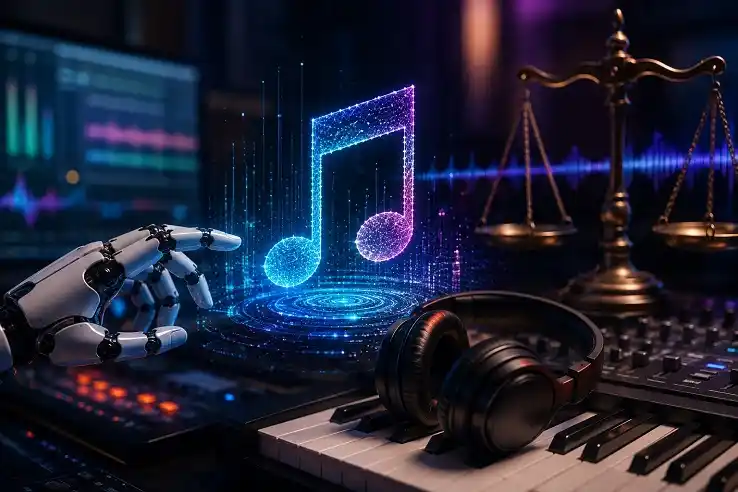
Image Credit: Thailand AI News
Generative AI is increasingly being used for AI voice conversion, song remixing and the creation of new music inspired by existing tracks. However, the rapid development of these technologies has created uncertainty over where creative experimentation ends and copyright infringement begins. According to this Thailand AI News report, the DIP wants creators, businesses, AI developers and members of the public to understand that existing copyright principles remain highly relevant even though Thailand does not yet have specific copyright provisions dedicated exclusively to generative AI.
Thai Copyright Law Faces the Generative AI Era
Oramon Sapthaveetham, Director-General of the Department of Intellectual Property, explained that Thailand’s Copyright Act B.E. 2537 (1994), together with subsequent amendments, currently contains no provisions specifically addressing artificial intelligence.
Another important factor is the absence of precedent-setting Thai court rulings dealing directly with copyright disputes involving generative AI. This means there is no simple legal formula that automatically determines whether every AI-generated song, voice conversion or remix is lawful or infringing.
Instead, existing copyright principles have to be applied to the circumstances surrounding each use. The nature of the original material, the way it was processed, the amount or significance of protected material retained and how the resulting work is subsequently used or distributed could all become important considerations.
The DIP’s clarification therefore sends an important message to Thailand’s expanding AI creator community: using new technology does not automatically remove legal obligations attached to existing creative works.
AI Remixes and Voice Changes Could Create Legal Risks
One of the most significant areas highlighted by the department involves using protected songs as source material for AI systems.
If an original song remains under copyright protection and is fed into AI technology to change a singer’s voice, remix the track or generate another song that retains identifiable elements of the original, copyright issues could arise.
Those recognizable elements could include lyrics, melodies, musical arrangements or other substantial characteristics that establish a clear connection with the protected work.
The AI process itself may also involve copying or processing music files. Consequently, an AI-assisted creation can potentially involve acts legally associated with reproduction or adaptation, even when the final product is different from the source material.
Where such activities are carried out without authorization from the relevant copyright holder and do not qualify for an exception under Thai law, they could potentially constitute copyright infringement.
There are exceptions that may apply in particular circumstances, including certain reproduction or adaptation activities for research or study that are not conducted for profit. However, the department stressed that disputes ultimately have to be considered individually according to the relevant facts and the nature of the works involved.
Public Domain Music Is Not Always Risk-Free
Music that has entered the public domain presents a different situation. In principle, when copyright protection for a musical work has expired, that work can be used as data or as a basis for AI-assisted creation without infringing the expired copyright.
Yet public-domain status should not automatically be interpreted as meaning that every available recording or version of the composition is unrestricted.
A song can involve several layers of intellectual property rights. Even where the underlying composition is no longer protected, a particular sound recording, performance, arrangement, adaptation or newer derivative version may remain protected.
This distinction could become particularly important for AI developers building datasets and for creators sourcing audio from online platforms. Determining that an old composition is in the public domain is not necessarily sufficient if the actual recording supplied to an AI system is a newer protected recording.
One Song Can Have Several Rights Holders
The DIP is advising AI users and creators to investigate copyright ownership and related rights before incorporating other people’s material into their projects.
Where the intended activity falls within rights legally reserved for the copyright holder, permission should generally be obtained unless a statutory exception applies. Depending on the agreement, authorization may also involve compensation, licensing fees or royalties.
Creators should additionally examine exactly what a license permits. Permission granted for one particular use does not necessarily authorize every other form of exploitation.
This is particularly relevant to music because a single track can involve numerous parties and separate rights. These may include a lyricist, composer, arranger, producer and performer, while rights connected with the sound recording itself may add another layer of complexity.
For AI companies and creators, this means obtaining access to a song from one party does not necessarily resolve every intellectual property question surrounding that material.
Thailand Pushes Responsible AI Development
The department’s position also illustrates a wider challenge confronting governments worldwide: encouraging AI innovation while ensuring that creators continue to receive meaningful protection for their intellectual property.
AI can dramatically reduce the technical barriers involved in producing music. A creator can now experiment with voices, arrangements and musical concepts at a speed that would have been extremely difficult only a few years ago. But the same technology can also make copying, modifying and redistributing recognizable creative material significantly easier.
The DIP is therefore encouraging responsible AI use rather than discouraging technological development. Checking ownership, understanding license conditions and seeking authorization where required can allow creators and businesses to experiment with AI while reducing exposure to infringement claims and costly disputes.
Creators who remain uncertain about a proposed use can study the relevant legislation or seek advice from the Department of Intellectual Property before publishing or commercially exploiting AI-assisted material.
Mediation Offers an Alternative to Court Battles
The department has also emphasized that litigation is not the only route available when disagreements arise over AI-created intellectual property.
According to Oramon, the DIP can provide mediation services for intellectual property disputes, with specialists helping the parties negotiate on the basis of applicable legal principles and a shared understanding of the facts.
The department has previously mediated disputes involving unauthorized AI modification of content followed by distribution through online platforms. Bringing the parties together allowed the circumstances and legal considerations to be discussed and, in appropriate cases, helped produce mutually acceptable settlements without requiring court proceedings.
Mediation can be particularly valuable in emerging areas such as generative AI, where technology is evolving considerably faster than legislation and judicial precedent. It may reduce legal costs and the time required to settle disagreements while helping preserve commercial and professional relationships.
Members of the public seeking clarification about AI and copyrighted works, Thai copyright law or intellectual property disputes can contact the Department of Intellectual Property hotline at 1368.
A Warning That Could Shape Thailand’s AI Music Boom
Thailand’s clarification does not shut the door on AI-generated music. Instead, it establishes an important practical boundary for a rapidly expanding creative industry: powerful new tools still operate within an existing framework of intellectual property rights. As AI voice cloning, automated remixing and generative music platforms become increasingly accessible, creators will need to understand not only what technology allows them to produce, but also what the law allows them to use.
For Thailand’s AI ecosystem, responsible innovation could ultimately prove just as important as technical innovation. Developers, musicians and digital creators who establish clear licensing practices and properly investigate ownership before using existing works will be better positioned to exploit generative AI commercially without turning technological experimentation into an expensive copyright dispute.
For more details, please visit:
https://www.ipthailand.go.th/en/home-eng.html