

What To Know
- Artificial intelligence investment is rapidly emerging as an important new engine for Thailand’s economy, strengthening electronics trade and attracting fresh capital at a time when conventional industrial activity remains subdued.
- Rising demand for data storage, semiconductor services, printed circuit boards and supporting infrastructure is giving Thailand an increasingly important position in the global AI hardware supply chain.
Artificial intelligence investment is rapidly emerging as an important new engine for Thailand’s economy, strengthening electronics trade and attracting fresh capital at a time when conventional industrial activity remains subdued. Rising demand for data storage, semiconductor services, printed circuit boards and supporting infrastructure is giving Thailand an increasingly important position in the global AI hardware supply chain.
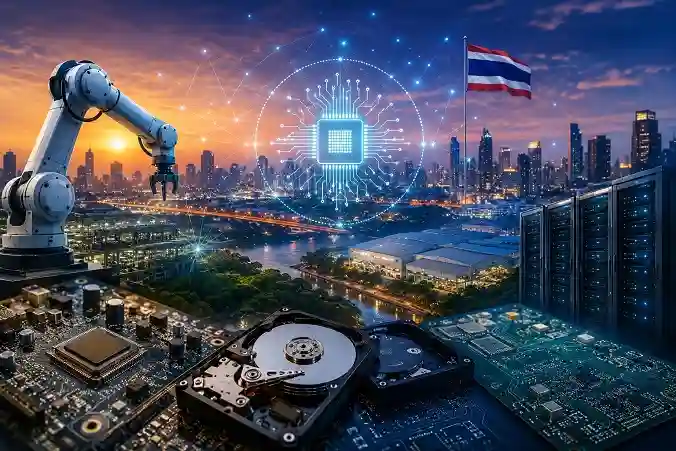
Image Credit: Thailand AI News
Thailand’s broader economic performance remains relatively restrained, with second-quarter GDP expanding by 1.9 percent. However, imports and exports of machinery, electronic components and technology-related equipment have recorded considerably stronger momentum. Amid this changing economic landscape, this Thailand AI News report finds that Thailand’s growing connection to the international AI investment cycle could become increasingly important to future growth, although significant structural risks remain.
Thailand Finds Its Place in the AI Supply Chain
Thailand’s strongest position in the AI economy currently lies in hardware rather than the development of foundational AI models or major software platforms. The country already possesses an established electronics manufacturing base that could benefit considerably from escalating global investment in computing infrastructure.
One particularly important segment is data storage. Thailand remains a major manufacturing location for hard disk drives, with large multinational technology manufacturers maintaining substantial production operations in the country.
Printed circuit board manufacturing is another area experiencing rapid expansion as increasingly sophisticated computing equipment requires greater quantities of advanced electronic components.
Thailand is also developing downstream semiconductor capabilities through outsourced semiconductor assembly and testing, commonly known as OSAT. Photonics, which plays an important role in high-speed data transmission and advanced computing infrastructure, represents another potentially valuable growth area.
These activities demonstrate that Thailand does not necessarily need to become a global AI software powerhouse to capture substantial economic value from the artificial intelligence revolution.
AI Spending Gives Thai Trade a Welcome Boost
Economic officials have highlighted the significant increase in electronics-related trade during the past two years, providing Thailand with an important source of momentum while several other areas of manufacturing remain relatively weak.
The acceleration in technology-related imports and exports suggests that global spending on AI infrastructure is already creating measurable opportunities for Thailand.
AI is also moving beyond factories and data centers into economic analysis. Officials have indicated that AI models are increasingly useful for examining complex international financial developments and improving economic forecasting, demonstrating how the technology could influence investment decisions and policymaking.
Data Centers Create a Major Energy Challenge
Thailand’s expanding AI opportunity is not without potentially serious costs. Rapid foreign direct investment in electronics manufacturing and data centers could eventually produce excess capacity if companies build infrastructure significantly faster than demand develops.
Energy presents an even more immediate concern. Large-scale data centers consume enormous amounts of electricity, and continued expansion could place additional pressure on Thailand’s national power system.
If greater electricity demand requires increased natural gas imports, the consequences could extend far beyond technology companies. Higher electricity generation costs could ultimately place upward pressure on tariffs, potentially affecting households and businesses receiving little direct benefit from AI investment.
Another weakness is Thailand’s dependence on imported technology. With the country reportedly relying on overseas sources for nearly 70 percent of its technology requirements, a considerable proportion of the economic value generated by investment could potentially flow outside the domestic economy.
Economic gains may therefore remain concentrated among electronics manufacturers, specialized suppliers and data center operators unless stronger domestic supply chains emerge.
Why Today’s AI Boom Looks Different
Questions about an AI investment bubble inevitably invite comparisons with the dot-com collapse of the early 2000s. Financial experts, however, point to several important differences between the two periods.
Today’s AI expansion increasingly involves tangible infrastructure, including data centers, optical networks, semiconductor equipment and advanced cooling systems. Many major technology companies financing this expansion also possess established businesses, substantial revenues and significant cash flow.
Unlike numerous dot-com companies that depended heavily on external financing despite generating little or no profit, major technology companies can fund significant portions of their AI capital expenditure through internally generated cash and reinvested earnings.
Nevertheless, analysts caution that strong global AI fundamentals do not automatically make Thailand’s equity market the region’s most attractive AI investment opportunity. Some neighboring ASEAN and emerging markets may provide more direct exposure to AI growth alongside potentially more attractive valuations.
Can Thailand Turn AI into Lasting Prosperity?
Thailand’s challenge is now shifting from simply attracting AI investment to ensuring that the investment produces lasting domestic economic value. Policymakers will need to strengthen local technology capabilities, carefully manage electricity requirements and encourage stronger connections between AI infrastructure and established Thai industries.
Food processing, tourism, logistics, health services, manufacturing and other service industries could potentially benefit if AI investment generates productivity improvements beyond electronics factories and data centers.
Thailand has secured an increasingly important foothold in the physical infrastructure supporting the global AI revolution. Whether that position translates into sustained prosperity will depend on how effectively the country develops domestic expertise, strengthens local supply chains and distributes opportunities across the wider economy. AI investment could become a powerful growth engine, but its long-term success will ultimately depend on creating productivity, skilled employment and economic value that extends well beyond data centers and electronics manufacturers.