

What To Know
- Thailand is rewriting the playbook for its rapidly expanding artificial intelligence infrastructure industry as an extraordinary wave of data center investment begins testing the limits of the country’s electricity grid, water supplies and regulatory system.
- Instead of judging success mainly by the number of projects or their headline investment value, authorities increasingly want to determine whether new facilities are compatible with Thailand’s available infrastructure and whether they make a meaningful contribution to the domestic economy.
Thailand is rewriting the playbook for its rapidly expanding artificial intelligence infrastructure industry as an extraordinary wave of data center investment begins testing the limits of the country’s electricity grid, water supplies and regulatory system. After years of aggressively courting digital investment, authorities are shifting their attention from simply attracting more projects to determining whether those projects deliver enough economic and technological value to justify the enormous resources they consume.
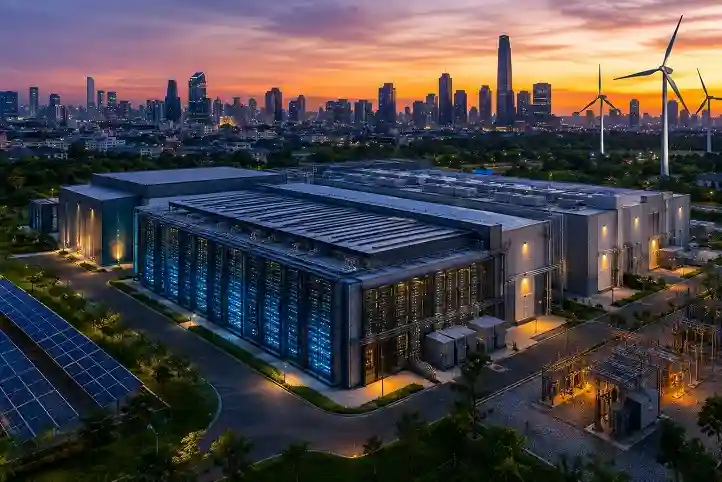
Image Credit: Thailand AI News
The change comes at a pivotal moment for Thailand’s ambitions to establish itself as one of Southeast Asia’s leading destinations for cloud computing and AI infrastructure. Investment applications submitted to the Board of Investment (BOI) exceeded 1.01 trillion baht in the first quarter of 2026, roughly 2.4 times the amount recorded a year earlier. Digital-sector applications alone accounted for 873.7 billion baht across 48 projects, dominated by data centers and cloud services. As this Thailand AI News report reveals, Thailand is now confronting the other side of that investment surge: enormous electricity requirements, rising pressure on water resources and the risk that ordinary consumers could ultimately shoulder some of the infrastructure costs created by hyperscale facilities.
Thailand Changes Its Data Centre Strategy
The scale of Thailand’s data center expansion has been remarkable. The BOI approved 26 data center projects worth approximately 498.7 billion baht in 2025 and another eight projects valued at more than 162 billion baht in 2026. Over the past three years, the agency has promoted around 40 data centre projects, while 16 companies involving Thai and foreign investors have received confirmation that electricity can be supplied to their developments.
Major international technology companies have helped drive the boom. Amazon Web Services, Google and Microsoft have announced significant investments in Thailand, while the market also includes projects associated with TikTok owner ByteDance, Alibaba Cloud and other international operators.
But the sheer volume of proposed capacity is forcing policymakers to reconsider how projects should be approved.
Instead of judging success mainly by the number of projects or their headline investment value, authorities increasingly want to determine whether new facilities are compatible with Thailand’s available infrastructure and whether they make a meaningful contribution to the domestic economy.
The shift effectively raises the entry barrier for the next generation of hyperscale projects.
Four Tests Could Decide Which Projects Move Forward
Thailand’s revised approach will assess new data center proposals across four major areas: electricity and energy readiness, water-resource management, environmental protection and tangible economic benefits for Thailand.
Electricity availability will be fundamental. Developers will need to demonstrate that their projects can be supported by the power system while also moving towards greater use of clean energy.
Water management will receive considerably greater attention because large data centers can require substantial water resources for cooling. Authorities want to prevent new developments from competing excessively with surrounding communities, agriculture and existing industries.
Projects will also be assessed for environmental impacts, including pollution and noise.
The fourth requirement could ultimately become the most important strategic test: what does Thailand actually receive in return?
Authorities want investors to contribute to areas such as developing Thai digital and AI talent, creating opportunities for local small and medium-sized enterprises, establishing centers of excellence and strengthening the country’s domestic computing capabilities.
That represents a significant change in philosophy. A multibillion-baht server complex will no longer necessarily be considered valuable simply because it involves enormous capital expenditure.
AI’s Electricity Appetite Raises the Stakes
Behind the regulatory reset is an unavoidable reality: AI infrastructure consumes enormous quantities of electricity.
Energy Minister Akanat Promphan has said future electricity demand associated with data centers and AI could reach as much as 30,000 megawatts, illustrating the scale of capacity that Thailand may eventually need to accommodate.
Data centers operate continuously, while hyperscale facilities can individually require hundreds of megawatts.
Large increases in demand can also change the economics of Thailand’s electricity system. Lower-cost sources are generally dispatched first, but additional demand can require greater use of gas-fired generation, potentially including comparatively expensive imported liquefied natural gas.
The problem therefore extends beyond whether Thailand can technically generate enough electricity. Policymakers must also decide who pays for the extra generation, substations, transmission capacity and distribution infrastructure required to support enormous new loads.
The government increasingly believes that the answer should be the data center operators themselves.
A Special Electricity Tariff Is Coming
The National Energy Policy Council has approved the principle of creating a separate electricity tariff for data centers so that the cost of serving these facilities is not transferred to ordinary electricity consumers.
https://energy.go.th/th/minister-news/30469
An initial tariff of around five to six baht per kilowatt-hour is being considered, although the final rate has not yet been determined. The general electricity rate for the September-December 2026 period is 3.95 baht per unit.
The distinction could become increasingly important as Thailand’s hyperscale market expands.
If utilities must construct expensive infrastructure specifically to serve a handful of enormous facilities, policymakers want those customers to bear the corresponding costs rather than spreading them across millions of households and smaller businesses.
That principle represents one of the clearest indications yet that Thailand wants AI infrastructure investment, but not at any price.
Developers Must Put Millions Behind Their Power Requests
Another major change targets companies that reserve large quantities of electricity before their projects become fully operational.
Large data center investors will be required to provide a bank guarantee of 4.5 million baht for every megawatt of electricity capacity reserved. The requirement is designed to prevent companies from hoarding allocations or reserving substantially more capacity than they ultimately use.
The financial implications can quickly become enormous.
A developer seeking 100 megawatts would potentially need to provide a guarantee worth 450 million baht, while a 500-megawatt reservation would translate into 2.25 billion baht.
Under the planned mechanism, half of the guarantee would be returned when actual electricity consumption reaches 50% of the proposed capacity, with the remainder refunded after utilisation reaches 70%.
For electricity authorities, the measure provides greater certainty before substantial investments are made in transmission and distribution infrastructure.
It also sends developers a straightforward message: requesting hundreds of megawatts of scarce grid capacity must be backed by genuine financial commitment.
Clean Energy Could Be Thailand’s Counteroffer
Thailand is balancing these tougher requirements with measures designed to improve access to renewable electricity.
The National Energy Policy Council has agreed to expand Direct Power Purchase Agreements, or Direct PPAs, beyond the industries initially targeted.
Direct PPAs allow a corporate electricity consumer and renewable generator to contract directly while using Thailand’s state-owned electricity network through a Third Party Access framework.
Thailand had previously been developing a 2,000-megawatt Direct PPA pilot primarily focused on data centers and semiconductor businesses. The broader approach could eventually give other industries requiring clean electricity similar access.
This matters enormously for global technology companies with carbon-reduction targets.
Reliable access to identifiable renewable electricity can influence where multinational companies locate major infrastructure. Expanding clean-energy options could therefore help Thailand remain internationally competitive even as it imposes tougher conditions on new data centers.
A New Map Could Move Data Centers Beyond the EEC
Where future facilities are constructed could also change dramatically.
Around 70% of existing data center investment is concentrated in Thailand’s Eastern Economic Corridor, according to the supplied material. That clustering has increased concern about whether electricity and water infrastructure can continue supporting rapid development in the same area.
The government is consequently preparing a “Power and Water Map” identifying locations with sufficient resources to support additional data centers.
Such planning could encourage investors to move beyond the EEC and establish facilities in other suitable parts of Thailand.
The approach could provide two benefits: reducing pressure on heavily concentrated infrastructure while spreading some of the economic benefits associated with digital investment to additional areas.
It also demonstrates how data center policy is evolving into a broader infrastructure-planning issue rather than remaining purely an investment-promotion exercise.
Water Joins Electricity as a Critical AI Resource
Electricity tends to dominate discussions about AI infrastructure, but water is becoming almost equally important in Thailand’s screening process.
Large data centers can consume significant amounts of water through cooling systems. New operators will therefore be expected to submit water-management plans addressing how their projects will operate without placing unacceptable pressure on local supplies.
This is particularly important in areas where industrial development, agriculture and growing communities already compete for available resources.
Thailand’s emerging strategy indicates that access to electricity alone will no longer be sufficient. A location that cannot sustainably provide both power and water may struggle to qualify for further hyperscale development.
Thailand Is Not Facing the AI Energy Problem Alone
The pressure created by AI infrastructure is becoming a global challenge.
The International Energy Agency expects worldwide data center electricity consumption to approximately double to around 945 terawatt-hours by 2030, with demand growing by roughly 15% annually between 2024 and 2030. Electricity consumption from data centers in Southeast Asia is also expected to more than double by the end of the decade.
Governments elsewhere have already responded in different ways. Measures cited in the supplied material include higher electricity charges in parts of the United States, requirements for investors in Ireland to support additional energy supplies and stringent project-selection and energy-efficiency requirements in Singapore.
Thailand is therefore entering a regulatory phase that other major data center markets are already confronting: deciding how much infrastructure growth can be accommodated without compromising energy security or creating excessive costs for the wider economy.
Security Rules Could Become Much Stricter
Thailand’s regulatory overhaul extends beyond electricity and water.
The National Broadcasting and Telecommunications Commission is planning to upgrade the license required by data center operators from a Type 1 license to a more demanding Type 3 license, the category used for telecommunications network providers.
The proposed change would allow regulators to apply stronger infrastructure requirements, conduct more detailed examinations of operators and obtain information about customers to assess their credibility.
Financial and security authorities have raised concerns that data center infrastructure could potentially be exploited by grey-capital networks, including call-center scam operations or digital money-laundering activities.
The NBTC plans to hold a public consultation before introducing the new regulations.
The tighter security regime demonstrates that data centers are increasingly being regarded not simply as commercial property developments but as strategically important national digital infrastructure.
Thailand Wants to Build an AI Supply Chain of Its Own
The ultimate objective extends well beyond attracting giant server farms.
Thailand wants data centers to become the foundation of a broader domestic AI ecosystem covering cloud services, advanced computing, manufacturing, skills development, research and technology transfer.
The country already occupies important positions in the global technology supply chain. Thailand is a major production base for hard-disk drives and has manufacturers producing equipment relevant to data center operations, including cooling systems and optical data-transmission technology.
The next challenge is capturing more of the value surrounding AI.
That could mean training Thai AI specialists, connecting local businesses with hyperscale supply chains, supporting research facilities and ensuring that some of the massive computing capacity being installed in Thailand contributes to domestic innovation.
The strategic argument is also connected to data sovereignty and resilience. As cloud computing and AI processing become increasingly important to businesses and government, having substantial infrastructure inside Thailand could reduce reliance on facilities elsewhere in ASEAN.
The AI Boom Is Entering a More Demanding Phase
Thailand’s data center market is projected in the supplied material to grow by an average of 27.71% annually between 2025 and 2031, potentially expanding in value from approximately 470 billion baht to 2.02 trillion baht.
Growth on that scale could transform the country’s digital economy, but it also explains why authorities are acting now.
Thailand does not appear to be shutting the door on data centers. Instead, it is attempting something considerably more complicated: keeping the investment flowing while ensuring that new facilities can actually be supported by the country’s electricity and water systems and that they contribute enough to justify their resource demands.
The success of that strategy will depend heavily on implementation. Transparent project screening, predictable electricity pricing, practical access to renewable power and clearly defined licensing requirements could give serious investors greater certainty. Poorly coordinated rules or prolonged approval delays, by contrast, could push projects towards competing Southeast Asian markets.
Thailand is therefore entering a decisive stage in its AI infrastructure transformation. The country has already demonstrated that it can attract enormous global technology investments; the next challenge is proving that it can manage them intelligently. If the new rules succeed, Thailand could emerge with something far more valuable than an impressive collection of giant data centers: a sustainable AI ecosystem that strengthens domestic skills, businesses, energy infrastructure and technological independence while protecting households and communities from carrying the hidden costs of the boom.