

What To Know
- Google has ignited a fierce controversy across the American education sector after announcing that schools choosing to completely prohibit its artificial intelligence tools could also lose access to Google Search through their student accounts.
- Chris Phillips, Google’s vice president for education, explained that artificial intelligence has become so closely integrated into the company’s search technology that schools imposing a complete ban on its AI services would also lose student access to Google Search.
Google has ignited a fierce controversy across the American education sector after announcing that schools choosing to completely prohibit its artificial intelligence tools could also lose access to Google Search through their student accounts. The technology giant recently unveiled plans to give schools greater authority over AI-powered educational services, promising that its artificial intelligence tools would be disabled by default for kindergarten through 12th-grade students beginning in early 2027. However, the announcement included a controversial condition that has alarmed educators, parents, and policymakers: institutions that reject Google’s AI services entirely will also be unable to provide students with access to the company’s widely used search engine through school-managed accounts.
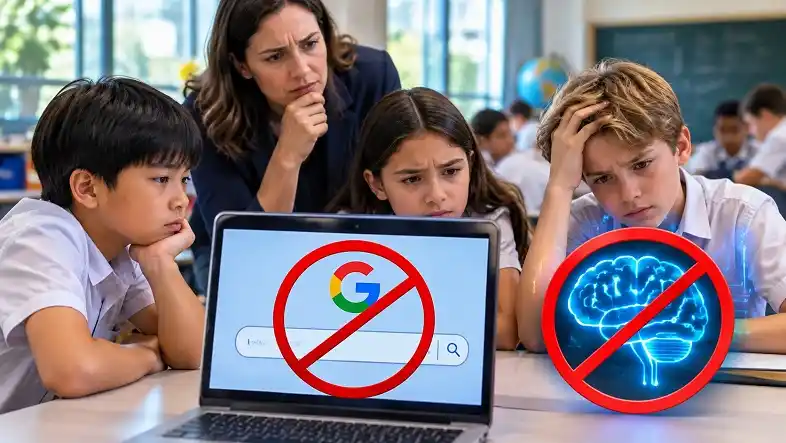
Image Credit: Thailand AI News
The unexpected restriction has raised serious questions about whether Google is genuinely empowering educators or using its dominance in online search to encourage schools to adopt artificial intelligence. With millions of students depending on Google Search for assignments, research, and everyday learning, the implications could be substantial. As this Thailand AI News report highlights, the controversy has quickly expanded beyond classroom technology policies into a broader debate over corporate influence, competition, children’s educational development, and whether schools should be forced to accept AI-powered services simply to maintain access to essential digital research tools.
Google Announces New AI Controls but Leaves Schools Facing a Difficult Choice
Google’s latest educational policy was initially presented as a significant concession to teachers and parents who have been demanding greater control over artificial intelligence in classrooms.
Under the new arrangements, AI-related services such as Gemini, Gemini Notebook, and Gemini in Classroom will remain disabled for K-12 student accounts unless school administrators explicitly authorize their use.
The company says the changes reflect feedback from educators, researchers, policymakers, and families who have expressed concerns about the rapid introduction of generative AI into children’s learning environments.
Previously, Google had taken a more aggressive approach to integrating AI into its educational ecosystem. In August, it automatically enabled certain AI features within Google Classroom for schools that had already permitted students to access the Gemini chatbot separately.
That decision frustrated some school administrators who believed that allowing one AI service should not automatically authorize additional AI capabilities across other educational applications.
Google has now reversed that approach, apparently giving educational institutions more control over individual AI services.
However, the company’s position on Google Search has created an entirely different problem.
Chris Phillips, Google’s vice president for education, explained that artificial intelligence has become so closely integrated into the company’s search technology that schools imposing a complete ban on its AI services would also lose student access to Google Search.
According to Phillips, affected students would encounter a notification explaining that search was unavailable under their school’s policies.
The arrangement effectively means that schools seeking to eliminate Google’s AI technology entirely cannot continue using Google Search through the affected educational accounts.
For administrators who want students to conduct conventional internet research without AI-generated answers, this creates a significant dilemma.
Google’s Powerful Position in Education Makes the Controversy More Serious
The backlash is particularly significant because Google has established an enormous presence in schools, especially across the United States.
Its educational ecosystem includes Google Classroom, Google Docs, Gmail, Google Drive, and numerous other services that have become deeply embedded in daily teaching activities.
Google Classroom allows teachers to distribute assignments, collect student work, provide feedback, and organize lessons, while Google’s productivity applications support collaborative writing, presentations, and classroom communication.
Chromebooks have also become among the most widely distributed student laptops in American schools, largely because of their affordability and integration with Google’s software.
According to figures previously disclosed by Google, approximately 50 million Chromebooks are used by students and educators in educational institutions, while Google Classroom has more than 150 million users worldwide.
These figures demonstrate why changes to Google’s educational services can have consequences for enormous numbers of students and teachers.
Google Search is particularly important because it serves as a fundamental research tool.
Students regularly use it to investigate scientific concepts, locate historical information, find academic references, and explore subjects beyond their textbooks.
Many teachers also incorporate online searches into assignments designed to strengthen research skills and encourage independent learning.
Consequently, removing Google Search from school-managed accounts could disrupt established educational practices.
Critics believe this dependence gives Google considerable leverage over schools that may prefer to restrict artificial intelligence while continuing to use conventional digital services.
Political Leaders Accuse Google of Exploiting Its Search Dominance
Google’s announcement has attracted sharp criticism from prominent political figures and technology policy experts who argue that the company is exploiting its powerful position in the search market.
Lina Khan, the former chair of the United States Federal Trade Commission, accused Google of using its search dominance to pressure educational institutions into accepting AI.
Khan also referred to previous antitrust rulings against the company, suggesting that the latest policy raises additional concerns about Google’s conduct in markets where it already possesses considerable influence.
New York City Mayor Zohran Mamdani also condemned the announcement, arguing that technology corporations should not determine how children are educated.
His criticism followed restrictions on generative AI in New York City public schools, including a one-year moratorium affecting students through eighth grade.
The Los Angeles Unified School District has similarly moved to restrict student access to generative artificial intelligence on school devices.
Officials in Los Angeles had reportedly hoped to maintain Google Search while disabling AI Overviews, the automatically generated summaries that appear above traditional search results.
Such summaries have become controversial among educators because they can provide immediate answers that discourage students from examining multiple sources.
The objections from political leaders and school districts suggest that Google’s policy is becoming a wider dispute about corporate influence over public education.
Although critics have characterized the arrangement as coercive, Google’s stated explanation is that AI functionality is now deeply integrated into its search products.
The disagreement centers on whether that integration justifies limiting access for schools that do not want AI-generated content.
Google Promotes Guided Learning as a Safer Alternative
Despite the growing criticism, Google continues to argue that artificial intelligence can provide substantial educational benefits when appropriately designed and supervised.
One of the company’s most important initiatives is Guided Learning, an AI-powered educational feature intended to help students understand difficult subjects through structured explanations and interactive problem-solving.
Unlike conventional chatbots that may immediately produce completed answers, Guided Learning is designed to encourage students to work through problems progressively.
For example, a student struggling with a complicated physics question might receive explanations about relevant scientific principles and prompts encouraging further reasoning.
A student preparing a history assignment could receive guidance on identifying important events, evaluating evidence, and organizing an argument.
Google intends to integrate Guided Learning into its search experience, potentially transforming how students interact with online information.
Beginning in early 2027, schools that authorize AI access are expected to have two principal search options.
One will resemble the standard consumer Google Search experience, including AI Overviews and conversational AI capabilities.
The other will emphasize Guided Learning, offering students a more structured educational experience intended to resemble personalized tutoring.
Google believes this approach can support meaningful learning while reducing the temptation to use AI simply to complete assignments.
However, the technology’s effectiveness in preventing academic dishonesty remains uncertain.
In one reported test, the consumer version of Guided Learning generated a detailed essay in response to an Advanced Placement history prompt, raising questions about whether the feature consistently prevents students from obtaining ready-made academic work.
Google says the school-focused version currently being tested includes additional safeguards.
These reportedly include tools allowing teachers to review students’ chatbot conversations and monitor how AI assistance is being used.
Parents and Teachers Fear AI Could Undermine Independent Thinking
The dispute comes amid growing concerns about the long-term effects of artificial intelligence on children’s learning habits and intellectual development.
Although AI chatbots can help students understand complex topics, translate information, and receive personalized explanations, critics warn that excessive reliance on these systems could weaken independent reasoning.
Students who repeatedly use AI to generate essays, solve mathematics problems, or summarize reading assignments may miss opportunities to develop essential academic skills.
There are also concerns about inaccurate AI-generated information, plagiarism, and students becoming overly dependent on automated assistance.
Some research has raised questions about the effects of heavy chatbot reliance on critical thinking, although the long-term educational consequences remain under investigation.
Parents advocating stricter controls believe schools should proceed cautiously until the benefits and risks are better understood.
Lila Byock, founder of Schools Beyond Screens, strongly criticized Google’s announcement, describing it as a hostile ultimatum.
Her organization advocates educational policies that prioritize children’s development and limit unnecessary screen exposure.
Richard Culatta, chief executive of the educational technology organization ISTE+ASCD, welcomed Google’s decision to disable AI tools by default but argued that schools should also be able to access search engines without AI-generated results. His position reflects an increasingly important distinction in education.
Schools may support internet-based research and digital learning without necessarily wanting artificial intelligence to generate answers on students’ behalf.
For many educators, the ability to separate these functions is essential to maintaining academic standards.
DuckDuckGo Moves Quickly to Challenge Google’s Position
Google’s controversial policy has also created an opportunity for competing search providers.
DuckDuckGo, the privacy-focused search engine, has publicly encouraged schools to consider switching away from Google rather than accepting unwanted AI integration.
Gabriel Weinberg, DuckDuckGo’s founder and chief executive, shared guidance explaining how educational institutions could change their default search engine.
The company also indicated that schools interested in making the transition could seek assistance.
Kamyl Bazbaz, DuckDuckGo’s chief public affairs officer, criticized the idea that students should be required to accept AI-powered features to maintain access to basic search functionality.
DuckDuckGo argues that educational institutions should have meaningful control over whether AI-generated responses appear in student searches.
Interestingly, DuckDuckGo is not opposed to artificial intelligence.
The company offers its own AI-powered products, including Duck.ai, which provides conversational assistance.
However, DuckDuckGo distinguishes its approach by allowing users to disable AI features.
It also operates a dedicated search interface at noai.duckduckgo.com, which removes AI-generated answers and related AI feature suggestions.
This flexibility could appeal to schools that want students to access online information without receiving automatically generated explanations.
Nevertheless, switching search engines would require institutions to consider other practical issues, including browser settings, content filtering, device management, and compatibility with existing educational systems.
The controversy could therefore encourage schools to reassess their dependence on a single technology provider rather than simply replacing one search engine with another.
The Controversy Carries Important Lessons for Thailand’s Schools
Although the immediate dispute concerns American educational institutions, its implications extend to Thailand and other countries where Google’s educational products are widely used.
Thai schools, universities, international schools, and private educational institutions increasingly depend on cloud-based applications, digital research tools, and online learning platforms.
As AI becomes embedded within these systems, administrators may encounter similar challenges involving student access, academic integrity, and institutional control.
The Google controversy demonstrates why educational institutions need to examine the conditions attached to technology services before adopting or restricting them.
A school that prohibits generative AI might reasonably expect students to retain access to conventional search functionality.
However, Google’s announced approach shows that these services may no longer be easily separated within certain managed accounts.
For Thai educators, this raises questions about whether schools should maintain alternative research tools and establish more detailed policies governing AI usage.
It also highlights the importance of training teachers to distinguish between AI applications that support understanding and those that replace students’ own intellectual work.
AI-powered tutoring could potentially benefit Thai students by providing personalized explanations, assisting with English-language learning, and helping teachers accommodate different academic abilities.
At the same time, schools must consider whether excessive dependence on AI-generated answers could undermine independent research and analytical thinking.
The challenge is not necessarily to reject artificial intelligence entirely but to ensure that educational institutions retain the authority to decide where and how it should be used.
A Wider Battle Over Control of Digital Education Is Emerging
Google’s announcement illustrates a fundamental shift in how artificial intelligence is being introduced into everyday technology.
AI is increasingly becoming a standard component of search engines, document editors, communication platforms, and productivity applications rather than remaining a separate optional service.
While this integration can improve convenience and introduce new capabilities, it can also make avoiding AI more difficult.
For educational institutions, the consequences are especially significant because technology policies directly influence how children learn, research, and interact with information.
The backlash suggests that parents, educators, and policymakers increasingly expect technology companies to offer more precise controls over AI functionality.
Schools want the freedom to adopt useful innovations without being compelled to accept features they consider inappropriate for particular age groups or learning environments.
The controversy also raises questions about competition and whether dominant technology providers should be permitted to connect access to established services with acceptance of emerging AI products.
Google maintains that its changes are intended to respond to educational concerns, but critics argue that meaningful control should include the ability to use traditional search without AI-generated responses.
Whether Google eventually introduces greater flexibility remains uncertain.
What is increasingly clear is that educational institutions are becoming less willing to allow technology companies to determine the boundaries of classroom AI adoption.
The Future of AI in Schools Must Prioritize Students
Google’s controversial policy has exposed a growing tension between the rapid commercialization of artificial intelligence and the responsibility of schools to protect educational quality. While AI-powered tutoring and research assistance may offer considerable benefits, educators must retain meaningful control over how these technologies influence students. The ability to conduct ordinary online research should not become unnecessarily dependent on accepting AI-generated content. As pressure mounts for greater flexibility and competing search providers offer alternatives, the dispute could become an important turning point in determining whether educational priorities or corporate technology strategies shape the future of digital learning.
References:
https://blog.google/products-and-platforms/products/education/ai-learning-era-updates-2026/