

What To Know
- The country’s drone industry is currently valued at approximately US$260 million, with annual growth estimated at 10 percent, according to organizers of Bangkok’s DronTech Asia exhibition.
- As Thailand confronts economic pressures, increasingly unpredictable weather, and rising demand for automation, drone technology is becoming an important tool for improving productivity.
Thailand is positioning itself for a major technological transformation as homegrown artificial intelligence (AI) developers increasingly target the country’s rapidly expanding drone industry. From precision agriculture and disaster prevention to industrial inspections and security operations, intelligent drones are creating opportunities across multiple sectors. However, despite growing domestic expertise, Thailand remains heavily dependent on Chinese-manufactured hardware, raising concerns about affordability, technological independence, and whether smaller businesses can participate in this emerging market.
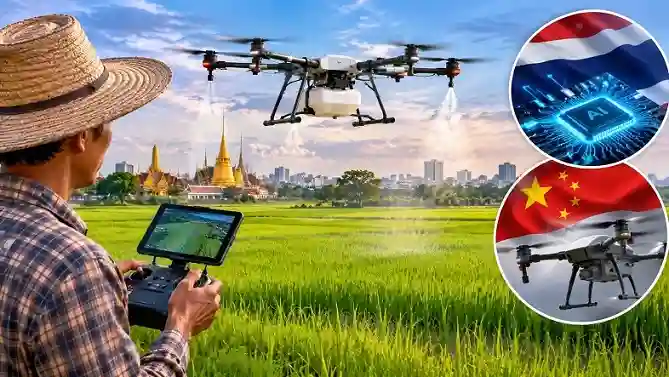
Image Credit: Thailand AI News
The country’s drone industry is currently valued at approximately US$260 million, with annual growth estimated at 10 percent, according to organizers of Bangkok’s DronTech Asia exhibition. As Thailand confronts economic pressures, increasingly unpredictable weather, and rising demand for automation, drone technology is becoming an important tool for improving productivity. Against this backdrop, this Thailand AI News report examines how Thai technology companies are developing specialized software to overcome local challenges while navigating China’s overwhelming dominance in global drone manufacturing.
Thailand’s Drone Industry Enters a New Growth Phase
The DronTech Asia exhibition in Bangkok demonstrated the remarkable diversity of applications emerging within Thailand’s unmanned aerial vehicle industry.
Visitors encountered agricultural spraying drones with wingspans reaching 15 meters, compact surveillance aircraft, and specialized rescue drones designed to navigate dangerous environments.
Some models featured protective coverings around their propellers, allowing them to operate inside caves, flooded passageways, and confined industrial facilities.
Other technologies focused on military surveillance, border monitoring, and emergency response operations.
These developments demonstrate how drones are evolving beyond aerial photography into sophisticated platforms capable of supporting critical economic activities.
AI-Powered Agriculture Offers Major Economic Benefits
Agriculture represents one of the most promising opportunities for Thailand’s expanding drone ecosystem.
Farmers increasingly face severe weather disruptions, including destructive monsoon flooding and drought conditions that threaten rice, sugarcane, and fruit production.
AI-assisted aerial imaging can help agricultural operators identify crop diseases, assess soil moisture patterns, and optimize fertilizer distribution.
Piyadol Hirunjaruwong, chief operating officer of drone imaging company SkyVIV, explained that drones can survey nearly 10,000 rai, equivalent to approximately 4,000 acres, in a single day.
Such capabilities allow farmers to identify specific problem areas rather than applying fertilizers and other agricultural treatments uniformly across entire plantations.
The resulting improvements in precision could reduce operating expenses, conserve resources, and minimize unnecessary chemical applications.
Drone-generated mapping data can also identify areas particularly vulnerable to flooding, supporting earlier interventions and potentially reducing agricultural losses.
Chinese Manufacturers Maintain Their Powerful Advantage
Despite Thailand’s growing interest in intelligent aerial systems, Chinese companies continue to dominate the hardware supply chain.
China reportedly manufactures between seven million and eight million drones annually, while its civil aviation authorities recorded approximately 3.29 million registered drones by the end of 2025.
Chinese manufacturers have also pioneered commercial drone delivery networks transporting food, medicine, and consumer goods.
For Thai businesses, however, sophisticated industrial drones remain expensive investments.
Equipment prices typically range from US$3,000 to more than US$50,000, effectively restricting widespread adoption among smaller agricultural enterprises and independent operators.
This financial barrier creates a significant challenge for policymakers seeking to distribute the benefits of technological modernization throughout Thailand’s economy.
Homegrown AI Becomes Thailand’s Strategic Priority
Rather than directly competing with China’s established manufacturing capabilities, Thailand is increasingly concentrating on developing locally designed AI software.
Speaking at DronTech Asia, Deputy Digital Economy and Society Minister Nan Boontida Somchai emphasized the importance of building domestic technological capabilities rather than simply importing advanced equipment.
Thai developers are exploring intelligent applications for solar farm cleaning, infrastructure inspections, environmental monitoring, and disaster management.
These systems can analyze aerial imagery, identify equipment defects, and generate actionable information for industrial operators.
Asawan Reungchoo, managing director of Thai robotics company Systronics, acknowledged that Thailand still relies heavily on imported hardware.
Nevertheless, he identified physical AI, which enables intelligent machines to perceive and interact with their surroundings, as an important opportunity for domestic software engineers.
The exhibition also featured robotic dogs and remotely operated humanoid robots, highlighting the broader potential of intelligent automation.
The Future Depends on Making AI Accessible
Thailand’s emerging drone revolution could reshape agriculture, infrastructure management, disaster preparedness, and industrial productivity.
However, achieving widespread adoption will require more affordable equipment, stronger domestic engineering capabilities, and practical software solutions tailored to local needs.
While Chinese manufacturers retain their considerable hardware advantage, Thailand has an opportunity to establish its own competitive position through specialized AI development.
The country’s long-term success will depend on transforming technological experimentation into commercially viable applications that benefit businesses of every size. If Thai developers can deliver affordable, reliable, and locally relevant intelligent systems, the nation could become an important regional center for drone software innovation, even without dominating aircraft manufacturing.