

What To Know
- Nvidia, the American semiconductor giant at the center of the global artificial intelligence revolution, has launched an independent investigation after its chief executive, Jensen Huang, acknowledged an extramarital affair amid allegations that a woman linked to him was working for Chinese intelligence.
- According to reporting by The New York Times, American intelligence agencies had monitored Alice Huang, also known as Huang Le, and concluded that she was operating on behalf of the Chinese government.
Nvidia, the American semiconductor giant at the center of the global artificial intelligence revolution, has launched an independent investigation after its chief executive, Jensen Huang, acknowledged an extramarital affair amid allegations that a woman linked to him was working for Chinese intelligence. The revelations have raised serious questions about whether sensitive information concerning America’s AI industry could have been exposed to Beijing.
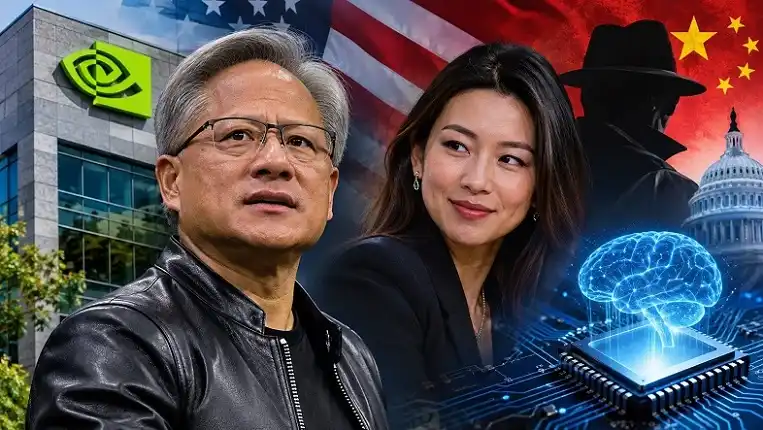
Image Credit: Thailand AI News
The controversy involves Alice Huang, a businesswoman formerly associated with Singapore-based data center company Megaspeed, whom American intelligence officials reportedly suspected of acting on behalf of China. As this Thailand AI News report examines, the allegations have triggered congressional scrutiny, concerns about Nvidia’s security procedures, and uncertainty surrounding the future of one of the technology industry’s most influential executives. However, no evidence of compromised Nvidia secrets has been publicly established.
Nvidia Launches Independent Security Investigation
Nvidia’s board announced on Sunday, November 8th, that independent directors, supported by outside legal counsel, would investigate reports that Jensen Huang had been targeted by a foreign intelligence operation.
The company emphasized that protecting American national and economic security remained fundamental to its responsibilities.
Importantly, Nvidia stated that its board had no reason to believe either national security or proprietary company information had been compromised.
Nevertheless, directors pledged to examine all available evidence.
Huang, 63, separately acknowledged being unfaithful to his wife and apologized for hurting his family.
He accepted responsibility for his conduct and promised full cooperation with the investigation. He also reaffirmed his commitment to Nvidia and American national security.
The chief executive did not publicly identify his extramarital partner in his apology.
Alleged Chinese Intelligence Operation Raises Questions
According to reporting by The New York Times, American intelligence agencies had monitored Alice Huang, also known as Huang Le, and concluded that she was operating on behalf of the Chinese government.
Investigators reportedly intercepted communications between the businesswoman and an American citizen subsequently identified as Jensen Huang through an intelligence identification procedure known as unmasking.
Alice Huang’s former association with Megaspeed has attracted particular attention because the Singapore-based company purchases Nvidia technology.
Reports suggest investigators were concerned about potential efforts to obtain information concerning advanced American semiconductors and influence access to restricted AI chips.
However, substantial uncertainties remain. Authorities have not publicly established what information Alice Huang allegedly collected, whether confidential Nvidia material reached Chinese officials, or whether any classified American technology was exposed.
China has rejected the espionage allegations, describing them as groundless speculation.
Megaspeed has reportedly appointed external legal advisers to investigate the allegations involving its former executive.
America’s AI Technology Leadership Faces Potential Risks
The controversy carries implications far beyond Huang’s personal conduct because Nvidia occupies an exceptionally influential position in global artificial intelligence development.
Founded in 1993, the company transformed graphics processors originally developed for gaming into powerful computing systems essential for training and operating sophisticated AI models.
Its customers include major technology companies such as OpenAI and Meta, while its market capitalization has exceeded $4 trillion.
Nvidia’s advanced processors have consequently become strategically important assets in the intensifying technological competition between Washington and Beijing.
American authorities have imposed restrictions on exporting certain advanced semiconductors to China, fearing that access could strengthen Chinese military capabilities and accelerate competing AI development.
The Trump administration subsequently permitted conditional sales of Nvidia’s H200 processors to approved Chinese customers.
Any confirmed intelligence penetration involving Nvidia’s leadership could therefore have consequences for semiconductor export policies, corporate cybersecurity, and America’s technological competitiveness.
At present, however, such consequences remain hypothetical rather than established findings.
Congressional Leaders Demand Answers
Three influential Republican congressional committee chairmen have requested that Huang participate in a closed-door briefing scheduled for November 18.
The lawmakers represent committees overseeing foreign affairs, intelligence, and strategic competition with China.
Their concerns center on Nvidia’s safeguards against foreign espionage, Huang’s reported relationship with Alice Huang, and possible vulnerabilities involving sensitive American technology.
Congressional investigators are particularly interested in whether commercial relationships involving overseas data center operators could create opportunities to circumvent semiconductor export restrictions.
Nvidia previously maintained that Huang routinely meets numerous customers and executives, describing such interactions as ordinary business activities.
The company has also disputed earlier allegations involving illegal chip diversion.
Huang’s Leadership Future Comes Under Scrutiny
The investigation has generated speculation about whether Huang can remain Nvidia’s chief executive despite his extraordinary contribution to the company’s growth.
Gary Black, managing partner at investment firm The Future Fund, suggested that questions surrounding Huang’s judgment could ultimately prompt directors to remove him.
Black acknowledged that Huang had not been shown to have committed a criminal offense or civil wrongdoing.
Nevertheless, he warned that leadership uncertainty could place short-term pressure on Nvidia shares, particularly because the company lacks an obvious successor.
Technology analyst Dan Ives similarly characterized the revelations as damaging to Huang’s reputation and potentially disruptive for investors.
Nvidia has maintained that Huang intends to continue leading the company without interruption.
President Donald Trump also defended Huang’s character, praising his contributions to America’s technology industry while acknowledging that he had not recently spoken with him.
A Critical Test for Nvidia and American AI Security
The unfolding investigation represents a significant test of corporate governance, intelligence safeguards, and public confidence in America’s AI industry. Whether sensitive information was actually compromised remains unanswered, and Nvidia continues to deny having evidence of such exposure. The investigation’s findings will be crucial in determining whether this controversy remains primarily a leadership scandal or develops into a broader national security crisis.