

What To Know
- As this Thailand AI News report examines, the strategy has created an interconnected financial ecosystem in which Nvidia’s continued success depends partly on the ability of its customers to generate sufficient revenue from massive investments in computing capacity.
- Its disclosed arrangements include $36 billion in AI cloud backstop agreements and a potential guarantee of up to $105 billion associated with a proposed OpenAI data center in Ohio.
Nvidia’s extraordinary transformation from a semiconductor manufacturer into one of the artificial intelligence industry’s most powerful financiers is encountering a serious test. As shares of specialized AI cloud providers tumble and borrowing costs climb, investors are questioning whether the chipmaking giant has assumed excessive financial risks while helping fund the global expansion of artificial intelligence infrastructure.
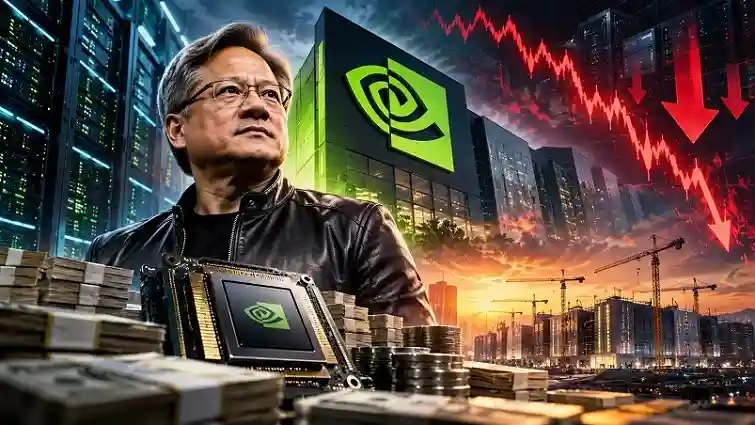
Image Credit: Thailand AI News
The concerns extend beyond ordinary stock market volatility. Nvidia has increasingly supported customers through investments, financing guarantees, and commitments designed to accelerate purchases of its expensive computing systems. As this Thailand AI News report examines, the strategy has created an interconnected financial ecosystem in which Nvidia’s continued success depends partly on the ability of its customers to generate sufficient revenue from massive investments in computing capacity.
Neocloud Stocks Collapse as Financial Pressures Mount
The immediate warning signs have emerged among specialized cloud infrastructure companies, commonly called neoclouds, which provide powerful computing resources to artificial intelligence developers.
Shares of CoreWeave, Nebius, and IREN, all companies backed by Nvidia, have declined at least 30% during October. Their difficulties have intensified concerns about businesses that are spending enormous amounts on infrastructure while continuing to consume cash.
CoreWeave has attracted particular scrutiny. Its credit default swap spreads have exceeded 11%, indicating that investors are demanding substantially greater compensation to insure against potential default.
The company reportedly carries approximately $51.6 billion in total debt, including roughly $35 billion in notes, bonds, and loans. Yields on certain bonds maturing in 2031 and 2032 have surpassed 15%, reflecting considerable financing pressure.
Other Nvidia-supported companies have encountered obstacles. Australian cloud provider Firmus recently withdrew its planned initial public offering, while Nscale and SB Energy have yet to provide meaningful updates following their September filings for American stock market listings.
Nvidia itself has experienced three consecutive declining trading weeks, with its shares falling 7.6% during October.
Nvidia’s Financial Commitments Raise Questions
Nvidia’s growing involvement in infrastructure financing represents a fundamental departure from its traditional business model.
The company previously concentrated on selling graphics processors to technology companies. Today, it increasingly provides financial support intended to ensure those customers can afford its products.
Its disclosed arrangements include $36 billion in AI cloud backstop agreements and a potential guarantee of up to $105 billion associated with a proposed OpenAI data center in Ohio.
Nvidia has also committed to approximately $20 billion in future data center leases intended for eventual assignment to third parties.
These obligations generally do not require immediate payments. Instead, Nvidia becomes financially exposed if customers default or specified contractual conditions arise.
Financial research firm New Constructs estimates that the present value of Nvidia’s off-balance-sheet liabilities exceeded $153 billion in fiscal 2026, increasing by more than $100 billion from the previous year.
Such figures have prompted questions about whether conventional financial statements adequately communicate the risks associated with increasingly complicated AI infrastructure agreements.
A Massive Bet on OpenAI Infrastructure
One of Nvidia’s most consequential arrangements involves OpenAI’s proposed 10-gigawatt data center development in Pike County, Ohio.
The project could become one of the world’s largest computing facilities and reportedly requires Nvidia hardware to remain in use for at least two decades.
Under the arrangement, Nvidia could face substantial obligations if OpenAI encounters financial difficulties.
Depending on the circumstances, Nvidia could assume the lease, secure another tenant, or support a sale of the facility. Certain outcomes could require the company to cover financial shortfalls, subject to its $105 billion guarantee.
However, the guarantee could terminate if OpenAI provides sufficient collateral or achieves an appropriate credit rating.
This arrangement illustrates how Nvidia is using its financial strength to make ambitious infrastructure projects possible while accepting risks traditionally associated with lenders, insurers, and property investors.
Why Nvidia Keeps Financing Its Customers
Despite mounting concerns, Nvidia has compelling commercial reasons to support its customers.
Artificial intelligence infrastructure has become extraordinarily expensive. Nvidia’s Vera Rubin computing rack reportedly contains 72 graphics processors, stands approximately seven feet tall, and carries an estimated price exceeding $7 million.
Such systems require enormous investments in electricity, cooling, buildings, networking equipment, and supporting infrastructure.
Even companies experiencing strong demand may struggle to obtain sufficient financing to expand rapidly.
Nvidia Chief Executive Jensen Huang has argued that demand for specialized AI computing services remains exceptionally strong, while the availability of working capital represents a significant constraint.
By helping customers secure financing, Nvidia can accelerate infrastructure construction, increase hardware sales, and strengthen demand for its broader technology platform.
The company possesses substantial resources to pursue this strategy. It generated approximately $70 billion in free cash flow during the first half of 2026, giving it considerable financial flexibility.
Its investment portfolio was valued at approximately $99 billion during the second quarter.
Wall Street Joins the AI Financing Race
Nvidia is also encouraging institutional investors to treat computing infrastructure as a distinct investment category.
An initiative involving six major asset managers targets approximately $500 billion in financing, supported by arrangements that could provide up to $125 billion in residual-value guarantees for graphics processors.
The company has additionally committed $2 billion to Brookfield’s AI Infrastructure Partners Fund and participated in investment vehicles associated with KKR and Valor Equity Partners.
These arrangements aim to attract institutional capital by reducing uncertainty surrounding the future resale value of expensive computing equipment.
Nevertheless, the strategy introduces an important question: how much will today’s AI processors be worth after newer, more powerful generations become available?
Insurers and Credit Agencies Examine the Risks
Insurance providers and credit rating agencies are increasingly examining the financial structures supporting artificial intelligence expansion.
Nvidia has reportedly sought insurers willing to absorb some risks associated with declining equipment values.
However, insurance specialists caution that coverage cannot eliminate every uncertainty surrounding rapidly evolving computing hardware.
Moody’s has also highlighted the growing importance of off-balance-sheet guarantees across the technology industry.
Although such guarantees are not automatically classified as conventional debt, they remain relevant when assessing corporate financial resilience.
The concern is particularly significant because several financing arrangements depend on sustained customer demand, reliable contract payments, and reasonable equipment resale values.
A slowdown in any of these areas could expose vulnerabilities across multiple interconnected companies.
The Next Phase Could Reshape AI Investment
Nvidia’s financing strategy has helped accelerate artificial intelligence development, but the recent neocloud selloff demonstrates that technological enthusiasm cannot eliminate financial risk. The coming months could reveal whether expanding computing demand is sufficient to support enormous infrastructure commitments, or whether lenders, investors, and technology companies must reconsider how aggressively they finance future growth. For Nvidia, maintaining confidence in both its products and its financial guarantees may prove equally important.
References:
https://www.reuters.com/commentary/breakingviews/nvidia-emerges-central-bank-ai-2026-10-20
https://www.moodys.com/web/en/us/insights/credit-risk/private-credit/power-without-delivery.html