
What To Know
- Is the government becoming too preoccupied with positioning the country as a regional AI powerhouse while overlooking industries that could deliver broader and more immediate economic benefits.
- The danger lies in treating AI as an economic miracle rather than one component of a diversified development strategy.
Thailand’s growing enthusiasm for artificial intelligence (AI) is raising an important economic question: Is the government becoming too preoccupied with positioning the country as a regional AI powerhouse while overlooking industries that could deliver broader and more immediate economic benefits? AI undoubtedly offers enormous opportunities, but excessive dependence on one emerging technology could prove costly for a country already struggling with sluggish growth, household debt, declining competitiveness, and structural economic weaknesses.
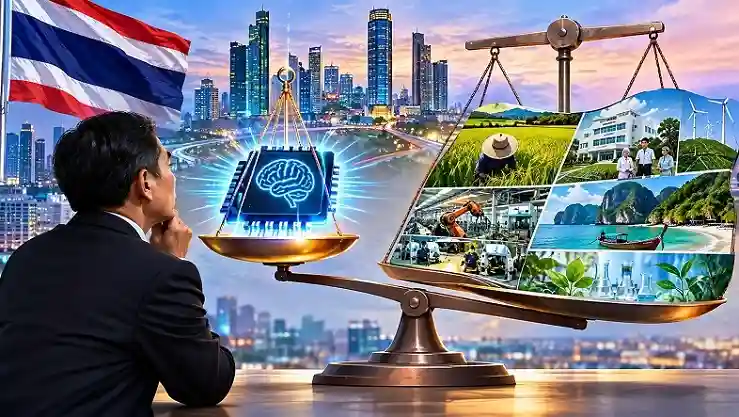
Image Credit: Thailand AI News
The government’s ambitions to attract technology investments, expand digital infrastructure, and encourage AI adoption are understandable. However, the danger lies in treating AI as an economic miracle rather than one component of a diversified development strategy. As this Thailand AI News report examines, Thailand possesses considerable untapped opportunities across agriculture, healthcare, biotechnology, renewable energy, advanced manufacturing, and specialized tourism. Neglecting these sectors while concentrating political attention and investment incentives on AI could ultimately undermine the economic transformation policymakers hope to achieve.
Thailand’s Economic Problems Require More Than Artificial Intelligence
Thailand’s economic difficulties extend far beyond technological competitiveness. The Bank of Thailand’s October 2026 outlook projects economic growth of just 2.4 percent in 2026 and 2.1 percent in 2027, despite stronger exports and investments associated with the technology and AI cycle.
Importantly, the central bank acknowledges that these benefits remain concentrated among particular businesses and workers, while household debt, weak purchasing power, and difficulties confronting smaller enterprises continue restricting economic activity.
These findings suggest that attracting AI investments does not automatically translate into widespread prosperity. Large technology projects can generate impressive investment figures without creating sufficient employment opportunities or meaningful income improvements for ordinary households.
Government Policies Already Favor Digital Transformation
Thailand’s government has explicitly identified AI and the digital economy as national development priorities. Prime Minister Anutin Charnvirakul’s five-cluster development framework, announced in April 2026, incorporates artificial intelligence alongside investment promotion and future industries.
Nevertheless, the framework also includes agriculture, manufacturing, tourism, environmental protection, and support for smaller businesses. Consequently, describing these industries as completely abandoned would be inaccurate. The more legitimate concern involves whether government resources, implementation efforts, and investment incentives are being distributed effectively.
Agriculture and Food Innovation Offer Enormous Opportunities
Agriculture remains one of Thailand’s most important economic foundations, employing approximately 30 percent of the workforce while contributing less than 10 percent of GDP, according to the World Bank.
Rather than concentrating disproportionately on AI startups and digital infrastructure, policymakers could accelerate agricultural modernization through irrigation improvements, food-processing facilities, agricultural biotechnology, and stronger export distribution networks.
High-value opportunities include functional foods, plant-based proteins, precision fermentation, premium tropical fruit processing, and specialized nutritional ingredients.
Thailand could also develop agricultural waste into biodegradable packaging, biofertilizers, and industrial biomaterials, creating additional income streams for farming communities.
Healthcare, Biotechnology, and Aging Populations
Thailand’s established medical infrastructure offers another promising foundation for economic expansion.
Investments in pharmaceutical manufacturing, clinical research, medical devices, rehabilitation services, and biotechnology could strengthen domestic capabilities while attracting international customers.
An aging population also creates opportunities for specialized eldercare facilities, assisted-living technologies, preventive healthcare, and long-term rehabilitation services.
Synthetic biology, regenerative medicine research, and advanced diagnostic manufacturing represent additional possibilities, although their development requires substantial scientific investment, regulatory oversight, and specialized training.
Thailand’s science and innovation authorities have already identified synthetic biology, future foods, and healthcare innovation as important emerging opportunities.
Renewable Energy and Advanced Manufacturing Deserve Greater Attention
Thailand could strengthen its industrial competitiveness by expanding solar equipment manufacturing, energy storage, industrial recycling, and energy-efficient technologies.
The World Bank’s February 2026 economic assessment specifically identified advanced green manufacturing as a potential growth engine, noting that manufacturing accounts for approximately 25 percent of national GDP and supports 6.2 million jobs.
Opportunities extend beyond electric vehicle assembly into battery recycling, power electronics, precision engineering, semiconductor testing, and specialized industrial components.
Such industries could support regional employment while strengthening Thailand’s participation in international supply chains.
Overlooked Industries Could Become Tomorrow’s Growth Engines
Several less-developed sectors also deserve serious consideration.
Marine biotechnology could support pharmaceutical ingredients, sustainable aquaculture, and valuable compounds derived from marine organisms. The circular economy could generate businesses specializing in electronic waste recovery, industrial material reuse, and environmentally sustainable construction products.
Thailand’s creative economy offers further potential through animation, gaming, digital entertainment, film production, fashion, and intellectual property development.
Meanwhile, specialized tourism involving wellness retreats, retirement communities, ecological experiences, and cultural education could attract higher-spending visitors without depending entirely on mass tourism.
The World Bank’s September 2026 development report identifies advanced manufacturing, sustainable and wellness tourism, digital services, agrifood, and creative industries as five promising economic growth areas.
Why Excessive AI Dependence Could Backfire
Overemphasizing AI carries several economic risks.
First, AI infrastructure can demand substantial electricity, water, specialized equipment, and imported technology. Large investments may therefore deliver fewer domestic economic benefits than headline figures suggest.
Second, automation could displace certain administrative and service-sector jobs before sufficient alternative employment becomes available.
Third, Thailand faces intense competition from countries possessing larger research budgets, stronger semiconductor ecosystems, and more established technology companies.
Finally, allocating excessive incentives toward AI-related projects could divert limited public resources from education, transportation, agricultural modernization, and smaller enterprises.
The problem is not AI investment itself, but the possibility of prioritizing technological prestige over measurable economic returns.
Thailand Needs a More Balanced Economic Strategy
Thailand should pursue AI development without allowing it to overshadow the industries supporting millions of livelihoods.
A stronger strategy would integrate AI into agriculture, healthcare, manufacturing, tourism, and logistics while simultaneously investing in their underlying infrastructure, workforce capabilities, and commercial competitiveness.
Government incentives should be assessed against employment creation, domestic value added, productivity improvements, and regional economic benefits rather than investment announcements alone.
Thailand’s future prosperity will depend on building a diversified economy capable of creating opportunities across society. AI can contribute significantly to that transformation, but making it the dominant economic priority risks repeating familiar development mistakes. Sustainable growth requires strengthening established industries, cultivating overlooked opportunities, and ensuring technological progress produces tangible benefits beyond a relatively narrow group of investors and corporations.
References:
https://www.bot.or.th/en/thai-economy.html
https://thailand.prd.go.th/en/content/category/detail/id/52/iid/493140
https://www.worldbank.org/ext/en/country/thailand
https://www.nxpo.or.th/th/en/47618/