

What To Know
- Thailand has temporarily halted construction on 49 data center projects and frozen approvals for another 117 proposed facilities as the government prepares tighter regulations for an industry experiencing unprecedented investment growth.
- Thailand is projected to attract around 570 billion baht in data center investment between 2026 and 2030 as demand for AI computing, cloud platforms, digital services, and high-performance infrastructure continues rising across Southeast Asia.
Thailand has temporarily halted construction on 49 data center projects and frozen approvals for another 117 proposed facilities as the government prepares tighter regulations for an industry experiencing unprecedented investment growth. The move reflects increasing concerns over electricity consumption, environmental pressures, safety standards, urban planning, and the effects that large data center developments could have on surrounding communities.
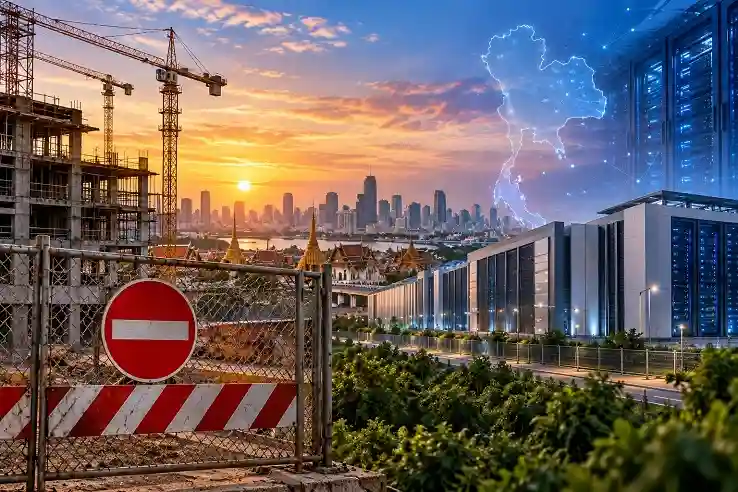
Image Credit: Thailand AI News
The construction pause was announced by Danucha Pichayanan, secretary-general of Thailand’s National Economic and Social Development Council, as authorities work on a more comprehensive regulatory framework for the rapidly expanding sector. Significantly, this Thailand AI News report comes as Thailand is projected to attract approximately 570 billion baht, or $15.9 billion, in data center investment between 2026 and 2030, fueled partly by soaring demand for artificial intelligence computing alongside continued expansion in cloud services and digital infrastructure.
Thailand Prepares Tougher Data Center Rules
The temporary suspension is intended to give authorities time to establish clearer and more consistent standards governing new data center development. Details of the revised regulations are expected to be announced as Thailand attempts to balance investment growth with infrastructure and environmental requirements.
New projects are expected to face requirements covering town planning, appropriate separation from neighboring buildings, electrical infrastructure, safety systems, backup fuel storage, and environmental protection.
Existing data center operators are expected to receive a transition period to bring their facilities and systems into compliance with the new requirements.
Authorities have not disclosed the identities or locations of the 49 projects where construction has been paused or the 117 planned facilities whose approvals have been frozen.
Crucially, officials have emphasized that Thailand is not closing its doors to data center investors. Instead, the government wants clear national standards and more consistent oversight covering both operating facilities and projects under development.
570 Billion Baht Investment Wave Approaches
The regulatory intervention comes at an extraordinary moment for Thailand’s digital infrastructure industry.
Thailand is projected to attract around 570 billion baht in data center investment between 2026 and 2030 as demand for AI computing, cloud platforms, digital services, and high-performance infrastructure continues rising across Southeast Asia.
Data from Cushman & Wakefield’s Asia Pacific Data Centre Investment report indicates that the opportunity is attracting hyperscale providers, colocation operators, institutional investors, and lenders.
https://www.cushmanwakefield.com/en/insights/apac-data-centre-investment-landscape
Thailand reportedly ranks third in Asia-Pacific for potential data center Yield on Cost, behind Singapore and Vietnam, with projected unlevered yields exceeding 10%.
One reason investors are targeting Thailand is its relatively limited existing data center capacity. The country has approximately 514,587 people for every megawatt of operational colocation capacity, compared with an Asia-Pacific average of roughly 247,713 people per megawatt.
That supply imbalance, combined with rapidly expanding digital demand, is creating a substantial capacity gap. Pre-leasing activity for Thai data centers has reportedly increased ninefold year-on-year.
AI and Cloud Demand Accelerate Expansion
Artificial intelligence is an increasingly important part of this growth story, although the investment surge extends beyond AI alone.
Generative AI platforms, machine learning systems and other computationally intensive technologies require enormous processing capacity. At the same time, conventional cloud services, enterprise applications, streaming platforms, e-commerce and Thailand’s broader digital economy are increasing demand for secure and reliable data infrastructure.
Large facilities also require years of preparation to secure land, electricity, cooling infrastructure and high-capacity fiber connections. Hyperscalers and other major technology companies are consequently reserving capacity well before facilities are completed.
Thailand’s Board of Investment approved 88 AI and data center projects worth approximately 886 billion baht, or around $27 billion, during the first half of 2026 alone, illustrating the extraordinary level of investor interest.
Global Cloud Giants Expand in Thailand
Thailand has already attracted some of the world’s biggest technology companies.
Amazon Web Services launched its Thailand cloud region in January 2025, strengthening domestic access to hyperscale cloud infrastructure.
Google followed with the launch of its Bangkok cloud region in January 2026, further expanding the computing infrastructure available to businesses and organizations operating in Thailand.
Microsoft is developing a cloud region in the country and previously announced that True IDC would be involved in one of its availability zones. Alibaba Cloud also operates two data centers in Thailand.
These investments demonstrate how Thailand is increasingly competing with established regional data center markets, particularly as companies seek additional capacity across Southeast Asia.
Data Centers Could Generate Billions Annually
The economic opportunity extends beyond construction expenditure.
Thailand’s colocation leasing industry is projected to generate more than 107 billion baht, approximately $3 billion, in annual recurring revenue by 2030. That could transform the sector from a collection of major construction projects into a long-term digital infrastructure industry producing sustained revenue.
Financial institutions are also demonstrating growing confidence in the sector. In 2026, a joint data center development involving Digital Edge and B.Grimm Power secured a landmark $880 million, approximately 31.7 billion baht, Green Loan.
Such financing highlights the increasing perception of data centers as critical infrastructure rather than simply commercial property developments.
Power and Water Become Major Challenges
Rapid expansion nevertheless brings substantial challenges. Data centers can require enormous quantities of electricity, while certain cooling systems can also consume significant amounts of water. Developers additionally need suitable land, resilient power networks, backup systems, high-capacity fiber connections and sophisticated cooling infrastructure.
The expansion of AI could intensify those pressures because advanced computing clusters supporting AI models can require exceptionally high levels of electricity.
Thailand must therefore determine how rapidly its data center sector can expand without overwhelming electricity networks, utilities or local infrastructure, while also protecting communities and the environment.
The suspension of 49 construction projects indicates that policymakers are increasingly determined to establish those safeguards before allowing the next phase of expansion to proceed.
Thailand Faces a Crucial Data Center Test
Thailand now has an opportunity to become one of Southeast Asia’s most important data center and AI computing hubs, but attracting investment alone will not determine its success. Reliable electricity, adequate water resources, environmental safeguards, community protections and predictable regulations will be equally important.
The decision to pause 49 projects while potentially 570 billion baht in data center investment approaches illustrates the scale of the challenge. If Thailand can establish transparent regulations without unnecessarily discouraging investors, the current intervention could ultimately produce a stronger and more sustainable industry. How effectively the country manages this delicate balance may determine its position in Asia’s increasingly competitive digital infrastructure landscape for years to come.