
What To Know
- The findings come from Deloitte’s Thailand Digital Transformation Survey 2026 – Enterprise AI Focus, which found that the proportion of Thai organizations reaching the “Becoming Digital” stage jumped from 28% to 42% in a single year, representing a 50% increase.
- Telecommunications Leader at Deloitte Thailand, said companies are increasingly investing in AI to improve operations, but transformational results remain limited because AI is still often treated as an IT project rather than a business-led priority.
Thailand’s digital transformation is accelerating as businesses increase technology investment and embrace artificial intelligence, but the financial rewards from AI have yet to match the enthusiasm surrounding it. New research from Deloitte shows that Thai organizations are making significant progress in digital maturity and AI adoption, while most companies are still struggling to turn experimentation into scalable business results and new sources of revenue.

Image Credit: Deloitte Thailand
The findings come from Deloitte’s Thailand Digital Transformation Survey 2026 – Enterprise AI Focus, which found that the proportion of Thai organizations reaching the “Becoming Digital” stage jumped from 28% to 42% in a single year, representing a 50% increase. More companies are using digital technologies across their operations and becoming less siloed as transformation moves deeper into the business. However, this Thailand AI PR News report highlights a widening gap between adopting AI and extracting substantial commercial value from it.
Thailand’s AI Adoption Accelerates
Investment figures show that digital transformation is becoming a bigger corporate priority. Deloitte found that 48% of Thai organizations are allocating budget to digital operations in 2026, up from 39% last year.
AI has emerged as the biggest area of focus, with 61% of organizations now reporting AI implementation, compared with 47% a year earlier.
The increase demonstrates how quickly AI has moved from experimentation into mainstream corporate planning. Businesses are exploring the technology to automate processes, increase productivity, analyze information and support employees.
Yet adoption does not necessarily equal transformation. Only 19% of Thai organizations have successfully scaled AI across their operations, according to Deloitte. That leaves 81% still largely operating through experiments and pilot projects.
Meanwhile, 71% of organizations said they had achieved only part of the AI outcomes they originally planned.
The figures suggest that Thailand has moved beyond the question of whether companies should explore AI. The challenge now is determining how to turn successful experiments into capabilities that can operate across entire organizations.
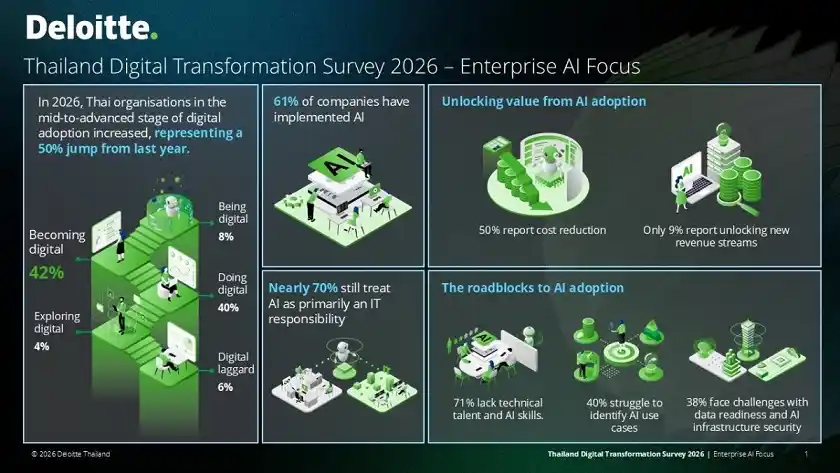
Image Credit: Deloitte Thailand
AI Remains Too Closely Tied to IT
One of the biggest barriers identified by Deloitte is organizational rather than technological.
Nearly 70% of Thai organizations continue to view AI primarily as the responsibility of their IT departments instead of treating it as a cross-functional business priority.
Robert Gallagher, Technology, Media & Telecommunications Leader at Deloitte Thailand, said companies are increasingly investing in AI to improve operations, but transformational results remain limited because AI is still often treated as an IT project rather than a business-led priority.
He said business leaders need to take ownership of where and how AI is applied, while IT teams focus on delivering the required technology.
That distinction matters because some of the biggest AI opportunities could emerge from marketing, finance, sales, customer service, logistics, manufacturing and other operational functions rather than from technology departments themselves.
Talent Shortages Create Another Roadblock
Thailand’s shortage of AI-related expertise is another major challenge.
Deloitte found that 71% of organizations identified insufficient technical talent and skills as a major obstacle to AI adoption, while 40% reported difficulty identifying appropriate AI use cases.
Workforce training also remains limited. The majority of Thai organizations surveyed had provided AI-related training to fewer than 30% of their employees.
That could become increasingly important as AI moves beyond specialist technology teams and becomes part of everyday work.
Companies may need employees throughout their organizations to understand how to work with AI systems, evaluate AI-generated information and recognize where the technology can improve existing processes.
Infrastructure presents additional challenges. Some 38% of organizations said their data was not sufficiently prepared to maximize AI, while the same percentage identified AI infrastructure security as an issue requiring attention.
Human AI Collaboration Becomes the Next Step
Deloitte argues that training employees alone will not be enough to unlock the full potential of artificial intelligence.
Businesses also need to redesign workflows so that people and AI systems complement one another. AI can handle routine and repeatable activities, potentially allowing employees to devote more time to judgement, creativity, strategic thinking and complex problem-solving.
Tawin Tusnajareon, Director, Technology & Transformation at Deloitte Thailand, said upskilling teams is a vital first step but represents only part of the equation.
He said companies capturing greater value are moving beyond treating AI as a software upgrade and are instead redesigning operational flows, business models and customer interactions around the technology’s strengths.
This could become an important competitive dividing line. Adding AI to an existing process can generate incremental improvements, while redesigning the process around AI could create substantially greater gains.
AI Cuts Costs but Revenue Gains Remain Small
Deloitte’s findings reveal a striking divide between AI’s ability to improve existing operations and its success in creating new business.
Half of surveyed companies said AI had enabled them to reduce costs, while 48% reported improvements in efficiency and productivity. Another 48% said AI had made adopting new systems or software easier.
However, only 9% said AI had helped unlock new revenue.
That figure illustrates why the bigger AI payoff remains elusive for much of Thailand’s corporate sector.
Companies are learning how to use AI to make existing operations cheaper and more productive, but relatively few have successfully transformed the technology into new products, services, customer experiences or business models.
The next stage of Thailand’s AI development could therefore depend on whether businesses can move beyond the efficiency benefits of AI and begin using it as an engine for growth.
Stronger AI Foundations Will Be Critical
Deloitte says organizations need reliable and actionable data, redesigned working practices and clear governance frameworks if they want to expand the value generated by AI.
Gallagher also stressed the importance of establishing strong, centralized AI foundations and integrating individual initiatives into a cohesive operating model.
Such an approach could help companies avoid having multiple disconnected AI pilots operating across different departments without common standards, infrastructure or strategic objectives.
Effective governance will also become increasingly important as AI enters business-critical processes. Companies need clear rules governing responsibility, data usage, security, monitoring and accountability.
Thailand Now Faces the Harder Part of the AI Race
The sixth annual Deloitte Thailand Digital Transformation Survey covered business leaders across six industries and was conducted between January and May 2026, alongside in-depth interviews with executives.
Its findings show that Thailand’s digital momentum is real. Digital maturity is improving rapidly, AI implementation has risen significantly and businesses are already seeing measurable gains in efficiency and costs.
However, the bigger commercial opportunity remains largely untapped. With 81% of organizations still unable to scale AI beyond pilots and only 9% reporting new revenue from the technology, the next stage will require more than simply buying AI tools.
Thailand’s AI leaders are likely to be businesses that combine technology with skilled employees, reliable data, secure infrastructure, effective governance and stronger involvement from business executives. If companies can make that transition, AI could evolve from a cost-saving tool into a genuine driver of innovation, competitiveness and sustainable revenue growth across Thailand’s economy.
The Deloitte’s Thailand Digital Transformation Survey 2026 – Enterprise AI Focus report can be found here: