

What To Know
- Thailand is strengthening its position in the fast-growing global artificial intelligence supply chain, emerging as a key manufacturing hub for the essential infrastructure that powers AI systems rather than the advanced processors themselves.
- Although Thailand is not yet producing the sophisticated graphics processors and AI chips used to train cutting-edge artificial intelligence models, it has carved out a significant role by manufacturing and assembling many of the systems required to support them.
Thailand AI News: Thailand is strengthening its position in the fast-growing global artificial intelligence supply chain, emerging as a key manufacturing hub for the essential infrastructure that powers AI systems rather than the advanced processors themselves. As worldwide investment in AI accelerates, the country is increasingly benefiting from rising demand for data-center equipment, networking technologies, storage solutions, optical communications, and power management systems. This Thailand AI News report highlights how Thailand’s established electronics industry is enabling the nation to compete with regional technology leaders while laying the groundwork for future expansion into higher-value engineering and semiconductor development.
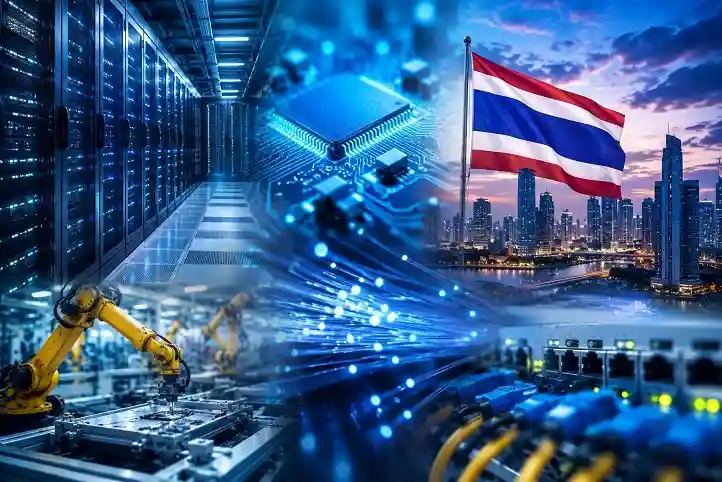
Image Credit: Thailand AI News
Although Thailand is not yet producing the sophisticated graphics processors and AI chips used to train cutting-edge artificial intelligence models, it has carved out a significant role by manufacturing and assembling many of the systems required to support them. These include power-conversion equipment, liquid-cooling technologies, networking hardware, server components, optical communications products, and data-storage devices that collectively form the backbone of modern AI infrastructure. This growing capability places Thailand firmly within one of the world’s fastest-expanding technology sectors.
Thailand Builds Critical AI Infrastructure
The explosive growth of artificial intelligence has transformed the demands placed on digital infrastructure. AI servers consume significantly more electricity than conventional computing systems and generate substantially higher levels of heat, requiring sophisticated cooling technologies alongside reliable power management.
Thailand has become an important production base for these critical systems through the operations of several major multinational companies. Delta Electronics manufactures advanced power solutions and cooling equipment designed specifically for high-density AI data centers, including liquid-cooling technologies increasingly required for next-generation computing facilities.
Schneider Electric also maintains significant operations supporting data-center automation, electrical distribution, cooling, and energy management. While Thailand does not fabricate the advanced AI processors themselves, these supporting technologies are indispensable for ensuring AI facilities operate efficiently, reliably, and sustainably.
The country’s growing participation in these specialized segments has elevated its strategic importance within the broader AI ecosystem, particularly as global demand for hyperscale data centers continues to surge.
Massive Investment Fuels Digital Expansion
Thailand’s rapidly expanding digital infrastructure sector is driving unprecedented levels of investment across the economy.
According to figures from the Thailand Board of Investment (BOI), investment applications reached approximately 1.47 trillion baht during the first half of 2026, with digital infrastructure accounting for around 1.12 trillion baht of that total. This remarkable level of investment underscores the confidence global technology companies have in Thailand’s manufacturing capabilities and long-term digital potential.
The BOI also received applications for 36 data-center projects valued at more than 728 billion baht throughout 2025. During early 2026, another seven data-center and hosting projects worth approximately 96.88 billion baht received approval.
These projects are expected to significantly increase domestic demand for electrical systems, advanced cooling equipment, servers, networking products, and storage hardware manufactured or assembled within Thailand.
At the same time, government authorities are paying closer attention to the environmental implications of rapid expansion. Increased electricity consumption, water usage, and access to cleaner energy sources have become major considerations as officials carefully evaluate future data-center proposals to ensure long-term sustainability.
Optical Communications and Networking Drive Growth
Artificial intelligence depends on the rapid movement of enormous volumes of data between processors, servers, storage systems, and multiple data-center locations. This has made optical communications and high-capacity networking technologies some of the most valuable components within the AI supply chain.
Thailand has developed impressive capabilities in these sectors through companies such as Fabrinet, which operates advanced optical manufacturing facilities serving global telecommunications and data-center markets.
Additional industry leaders including Lumentum and Coherent manufacture photonics technologies, lasers, and optical communications equipment essential for supporting high-speed AI computing networks.
Meanwhile, Celestica contributes electronics engineering expertise, networking equipment assembly, and sophisticated supply-chain services, while Cal-Comp Electronics and Quanta Computer strengthen Thailand’s manufacturing capacity for servers, computing equipment, and related technologies.
Although not every product manufactured by these companies is destined specifically for AI applications, their extensive production capabilities allow Thailand to respond rapidly as demand from cloud-computing providers and hyperscale data-center operators continues to accelerate.
Data Storage Remains a Vital AI Component
While graphics processors often dominate discussions surrounding artificial intelligence, storage technology remains equally critical to the AI ecosystem.
AI platforms require enormous storage capacity for training datasets, operational applications, archived information, machine learning models, and the growing volumes of content generated by artificial intelligence systems.
Thailand’s well-established hard-disk-drive industry continues to play a major role in meeting these requirements. Western Digital and Seagate Technology both maintain substantial manufacturing operations in the country, reinforcing Thailand’s long-standing reputation as one of the world’s leading storage production centers.
Hard drives continue to complement solid-state storage solutions by providing cost-effective, large-capacity storage for AI infrastructure, ensuring Thailand remains deeply embedded within multiple layers of the global AI hardware supply chain.
Regional Competition Intensifies
Thailand’s expanding role comes amid increasingly fierce competition across Southeast Asia.
Malaysia continues strengthening its semiconductor ecosystem through integrated-circuit design, assembly, packaging, testing, printed circuit board manufacturing, and expanding data-center investments.
Singapore remains a regional technology powerhouse with strengths in semiconductor fabrication, research and development, manufacturing equipment, and regional headquarters operations. Its highly skilled workforce and advanced research capabilities continue attracting investments focused on intellectual property and innovation.
Vietnam has also emerged rapidly as a competitive electronics manufacturing destination, supported by government incentives encouraging investment in semiconductors, electronic components, and advanced technology industries.
Despite this intense regional rivalry, Thailand maintains several competitive advantages, including mature industrial estates, sophisticated automotive and electronics supply chains, strong export infrastructure, and an extensive network of multinational manufacturers already operating throughout the country.
Long-Term Vision Focuses on Higher-Value Innovation
While Thailand’s manufacturing capabilities continue expanding, much of its current contribution remains centered on foreign-owned manufacturing, contract production, and assembly operations.
Industry experts recognize that the greatest economic value lies in product design, advanced engineering, research, intellectual property development, and technology innovation rather than manufacturing alone.
To address this challenge, Thailand’s long-term semiconductor strategy focuses on sectors closely aligned with existing industrial strengths, including power semiconductors, analogue chips, photonics, sensors, and discrete electronic devices.
The national strategy aims to attract more than 2.5 trillion baht in investment while developing approximately 230,000 highly skilled workers by 2050. Achieving these ambitions would strengthen Thailand’s domestic engineering capabilities, expand local supplier networks, and encourage greater development of homegrown technologies capable of competing internationally.
Thailand’s growing participation across multiple segments of the AI hardware ecosystem demonstrates that the country is becoming far more than a traditional electronics manufacturing base. By capitalizing on strong industrial foundations while investing in advanced skills, research, and innovation, Thailand is positioning itself to capture a larger share of the global AI economy. Success will ultimately depend on its ability to move beyond manufacturing into higher-value technology development, creating long-term economic resilience and strengthening its competitive position within an increasingly important regional AI landscape.
For the latest developments in the AI industry in Asia, keep on logging to Thailand AI News.