What To Know
- Google Cloud has unveiled an ambitious new Gemini AI agent designed to handle complex workplace assignments, coordinate digital coworkers, analyze business information, and execute tasks across multiple enterprise applications.
- Announced during Gemini at Work 2026, the technology represents a significant expansion of Google’s enterprise artificial intelligence strategy, moving beyond conventional chatbots toward autonomous systems capable of completing substantial assignments with limited human intervention.
Google Cloud has unveiled an ambitious new Gemini AI agent designed to handle complex workplace assignments, coordinate digital coworkers, analyze business information, and execute tasks across multiple enterprise applications.
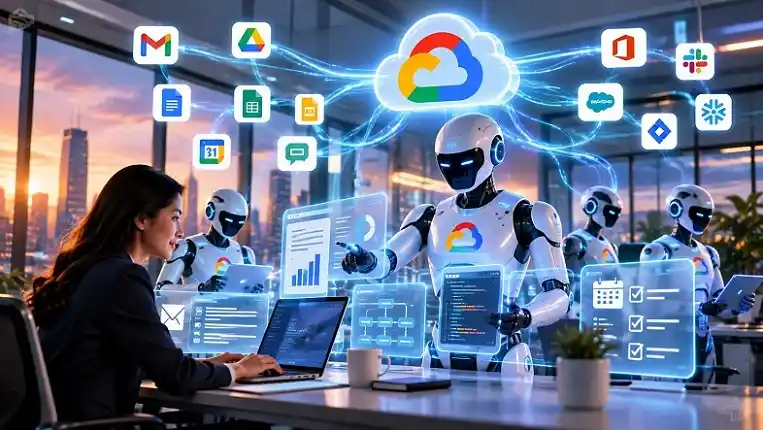
Image Credit: Thailand AI News
Announced during Gemini at Work 2026, the technology represents a significant expansion of Google’s enterprise artificial intelligence strategy, moving beyond conventional chatbots toward autonomous systems capable of completing substantial assignments with limited human intervention.
The announcement arrives as competition intensifies among technology giants seeking to control the next generation of workplace automation. As highlighted in this AI Agents news report, Google’s latest offering introduces persistent digital workers that can maintain organizational context, access authorized business systems, and continue operating even after employees disconnect their devices. The development could fundamentally change how businesses distribute responsibilities between human employees and increasingly capable AI systems.
A Major Shift Toward Autonomous Workplace AI
Unlike traditional AI assistants that primarily respond to individual questions, Google’s new Gemini agent can plan assignments, identify necessary resources, execute multiple steps, and deliver completed work.
Employees can request financial reports, marketing presentations, software development assistance, or detailed business research without manually coordinating every stage.
The system integrates with Gmail, Google Docs, Sheets, Slides, Calendar, Drive, and Chat. Connections also extend to Microsoft 365, Slack, Salesforce, ServiceNow, Jira, and enterprise databases.
Google says the agent can operate across these environments while maintaining relevant context, eliminating much of the repetitive information sharing associated with conventional AI tools.
Its cloud-based architecture allows assignments to continue running for hours or potentially days, even when employees switch devices or stop actively interacting with the system.
Digital Coworkers Receive Their Own Workplace Identities
One particularly striking innovation involves persistent AI coworkers that function as recognizable members of an organization’s workforce.
Businesses can configure specialized agents with dedicated email addresses, calendars, storage resources, and organizational identities.
An event-planning agent, for example, could coordinate schedules, prepare documentation, communicate with colleagues, and manage assigned responsibilities across multiple working sessions.
Employees could interact with these digital coworkers through Google Chat or assign responsibilities by mentioning them in shared documents.
Unlike temporary assistants, persistent agents retain defined responsibilities and contextual information across assignments.
Google also allows its universal agent to create temporary specialized agents that work simultaneously or sequentially on complicated projects.
This coordinated approach could enable organizations to automate workflows that previously required several employees using different software applications.
However, questions remain regarding account provisioning, licensing requirements, and administrative controls governing these persistent digital identities.
Gemini and Claude Models Work Within One Platform
Google’s architecture introduces another important development by supporting AI models from competing technology providers.
The new agent currently operates with Google’s Gemini models and Anthropic’s Claude models, while additional proprietary and open models are planned.
A capability called Smart Routing selects suitable models according to assignment complexity, performance requirements, and operating costs.
Businesses can also restrict which models their agents are permitted to access.
This flexibility could prove attractive to enterprises seeking to avoid dependence on a single AI model provider.
Instead of rebuilding automation systems whenever models improve, organizations could potentially retain their established workflows, integrations, and security arrangements while changing the underlying intelligence. Microsoft is pursuing similar multi-model capabilities, making model flexibility an increasingly important competitive battleground.
Security Controls Target Enterprise Concerns
Allowing autonomous systems to access confidential documents, financial records, and customer databases introduces considerable security challenges.
Google says its agents receive cryptographically verified identities governed by enterprise permissions and administrative policies.
An Agent Sandbox isolates execution environments, while Agent Gateway controls interactions with external systems.
Administrators can restrict access to sensitive resources, establish authorization requirements, and review audit logs documenting agent activities.
Google also says agents can access Workspace files only when appropriate permissions have been granted.
These protections are particularly important because autonomous agents may execute numerous interconnected actions without requiring approval at every stage.
Nevertheless, organizations handling regulated information will need greater clarity regarding external model processing, data residency, retention policies, and accountability when automated decisions produce errors.
Spending Limits Address Rising Automation Costs
Google is also introducing financial controls intended to prevent autonomous workflows from generating unexpected expenses.
Administrators can establish project-level spending limits covering AI model usage and computing resources.
When configured thresholds are reached, agent activities can be paused until administrators authorize further execution.
Organizations can monitor consumption by project and allocate expenses across departments.
Combined with Smart Routing, these capabilities could help businesses balance automation performance against operating budgets.
Google has indicated that the universal agent will be included within eligible existing Gemini Enterprise subscriptions without an additional access charge.
However, the company has not fully clarified potential licensing expenses for persistent coworker accounts or usage charges associated with extensive autonomous operations.
Financial Services Show Practical Business Applications
Google highlighted several organizations already implementing existing Gemini Enterprise capabilities, although these deployments should not be confused with production adoption of the newly announced universal agent.
Singapore’s DBS Bank is developing coordinated workflows involving approximately 70 to 80 specialized agents to prepare corporate credit memorandums.
These systems combine financial information, regulatory requirements, and market intelligence while retaining human review.
Australian financial technology company Airwallex has also implemented Gemini Enterprise for customer service and dispute management.
According to Google, Airwallex reduced dispute-processing time by 40% and accelerated customer issue resolution tenfold.
Those performance claims have not been independently verified.
Google is additionally expanding specialized AI capabilities for financial services and legal operations, with future offerings planned for healthcare, government, and retail.
Competition Intensifies Across the AI Industry
Google’s announcement follows significant developments from Microsoft, OpenAI, Anthropic, and other companies pursuing persistent AI agents.
Microsoft has expanded Copilot with capabilities supporting delegated assignments, programming, and background automation.
OpenAI has introduced persistent agents designed to pursue ongoing objectives across connected applications.
Anthropic has strengthened Claude’s integration with Google Workspace, allowing users to interact directly with productivity documents.
These developments demonstrate that competition is shifting beyond chatbot intelligence toward platforms capable of managing actual business operations.
For Google, integration with established workplace applications represents a potentially substantial advantage.
However, the ultimate commercial success of its approach will depend on reliability, measurable productivity improvements, administrative simplicity, and enterprise trust.
What This Means for the Future of Work
Google’s universal Gemini agent is currently available through private preview, with broader availability expected later.
The technology promises to transform workplace automation by allowing AI systems to undertake responsibilities previously distributed across multiple employees and applications.
Nevertheless, independent evidence demonstrating reliable performance across lengthy, complicated assignments remains limited. Organizations must also evaluate security exposure, operational accountability, and total deployment costs before expanding adoption.
The emerging contest will ultimately determine whether autonomous digital coworkers become dependable enterprise infrastructure or remain experimental productivity tools requiring extensive supervision.
For more details, visit:
https://blog.google/innovation-and-ai/infrastructure-and-cloud/google-cloud/gemini-at-work