What To Know
- As highlighted in this Thailand AI News report, Apple’s ambitions extend beyond improving Siri, potentially introducing an entirely new way for consumers and businesses to interact with computers through intelligent automation.
- According to the recruitment advertisements, Apple is developing what it describes as general-purpose computer-use agents capable of navigating operating systems and interacting with multiple software applications.
Apple is reportedly developing a powerful new artificial intelligence agent that could fundamentally transform how people use their Mac computers. Unlike conventional digital assistants that simply answer questions or respond to commands, the proposed technology would independently navigate applications, browse websites, write software code, and complete complicated tasks on behalf of users. The initiative signals Apple’s growing determination to compete in the rapidly expanding market for autonomous AI agents.
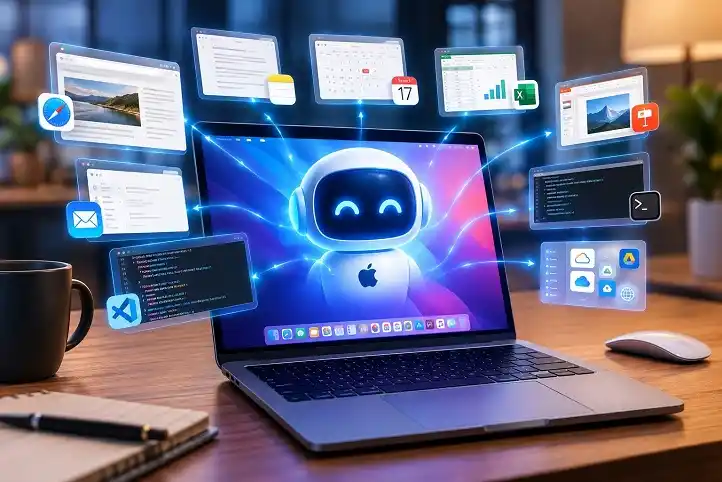
Image Credit: Thailand AI News
The development emerged after the discovery of recruitment advertisements revealing Apple’s plans to create sophisticated computer-operating artificial intelligence systems. The company is seeking experienced engineering leadership to build technology capable of performing tasks much like a skilled computer user. As highlighted in this Thailand AI News report, Apple’s ambitions extend beyond improving Siri, potentially introducing an entirely new way for consumers and businesses to interact with computers through intelligent automation.
Apple Wants AI That Can Actually Perform Computer Tasks
According to the recruitment advertisements, Apple is developing what it describes as general-purpose computer-use agents capable of navigating operating systems and interacting with multiple software applications.
These agents would perform activities traditionally requiring human involvement, including opening programs, managing documents, executing commands, browsing online resources, and debugging software.
More importantly, the technology would understand complicated instructions and determine which applications or tools are necessary to complete an assignment.
Apple also wants its agents to coordinate specialized AI subagents, allowing different automated systems to collaborate on larger projects.
For example, a user could potentially instruct the system to research competitors, organize findings, analyze spreadsheets, and prepare a business presentation without manually switching between applications.
Such capabilities would move artificial intelligence beyond conversational assistance toward genuine computer automation.
A Major Expansion Beyond Apple’s Siri Assistant
Apple’s initiative represents a potentially significant expansion of its artificial intelligence strategy as competitors introduce increasingly sophisticated autonomous systems.
Under chief executive John Ternus, the company is reportedly accelerating efforts to develop more ambitious AI products, with software engineering chief Craig Federighi playing a central role.
Apple has already been working to integrate Siri more deeply with third-party applications, allowing its digital assistant to perform activities such as arranging transportation and making restaurant reservations.
However, these improvements remain considerably narrower than the capabilities envisioned for a fully autonomous computer-use agent.
An advanced agent could potentially complete lengthy assignments involving numerous applications, websites, programming environments, and online services with minimal additional instructions.
Media reports indicate that Apple has considered introducing the technology as early as late 2027, although development remains in its preliminary stages.
No official launch date has been announced.
Fierce Competition from OpenAI, Google, Anthropic and Meta
Apple’s reported plans arrive as major technology companies compete to dominate the emerging autonomous AI market.
Meta has attracted considerable attention with its Muse agent, which can assist users with travel arrangements, restaurant reservations, and personalized information briefings.
OpenAI has expanded its agent capabilities through products including Dots, while Anthropic has been developing sophisticated computer-use technologies and its Duet agent.
Google has also strengthened its agent offerings, including Gemini features designed to operate Mac computers on behalf of users.
These competing technologies demonstrate how artificial intelligence is progressing from generating responses to independently executing real-world digital activities.
Apple could possess a substantial advantage through its existing ecosystem of computers, mobile devices, applications, and operating systems.
Deep integration with macOS could potentially provide smoother interactions than competing services that require additional permissions or external software.
Nevertheless, Apple must demonstrate that its technology can perform reliably while protecting sensitive information.
Privacy and Security Are Central to Apple’s Plans
One of the most significant challenges involves ensuring that autonomous AI agents do not compromise computer security.
Unlike ordinary chatbots, these systems may require access to personal documents, authentication credentials, command-line tools, and confidential business information.
Apple’s recruitment materials emphasize strong permission systems, sandboxing, and transparency as essential components of its proposed architecture.
Sandboxing isolates software activities within controlled environments, reducing the possibility that potentially harmful operations could affect other applications or sensitive system resources.
Such protections become particularly important when AI agents can execute commands, modify files, or interact with financial and business platforms.
A poorly designed agent could accidentally delete important information, expose confidential records, or perform actions users never intended.
Apple appears determined to address these concerns during development rather than treating security as an afterthought.
New macOS Restrictions Spark Competition Concerns
Interestingly, Apple’s internal AI development coincides with tighter restrictions on third-party agents seeking extensive control over Mac computers.
According to tech analysts, the forthcoming macOS 27.3 introduces additional warnings when users attempt to authorize external AI systems to operate their devices.
The report indicates that enabling certain third-party computer-control features now requires approximately 14 steps, compared with four previously.
Apple argues that these safeguards protect consumers from granting potentially dangerous permissions without fully understanding the consequences.
However, competing developers may view the additional restrictions as obstacles that could favor Apple’s future proprietary technology.
The situation raises important questions about competition, platform access, and whether operating system providers should impose different requirements on their own services and external developers.
A Potential Turning Point for Personal Computing
If Apple successfully delivers its proposed AI agent, Mac computers could evolve into intelligent assistants capable of completing substantial amounts of work independently. Businesses, developers, students, and everyday consumers could benefit from faster workflows and reduced administrative burdens.
However, the technology remains under development, and its eventual capabilities, reliability, and commercial availability are uncertain. Apple’s greatest challenge will be combining meaningful automation with the security, privacy, and simplicity that users expect from its products.