What To Know
- Friedman also revealed that he purchased hundreds of Mac minis for the Meta Superintelligence Labs team as employees explored OpenClaw and other personal AI agents.
- The bigger question is whether Muse can transform those concepts into a secure and dependable assistant for a vastly larger audience.
Meta has acknowledged that its fast-rising Muse artificial intelligence assistant was heavily influenced by OpenClaw, the open-source personal AI agent that became one of the technology sector’s surprise successes. The admission follows days of online scrutiny from developers who noticed striking similarities between the way the two AI agents organize their internal workspaces and configuration files.
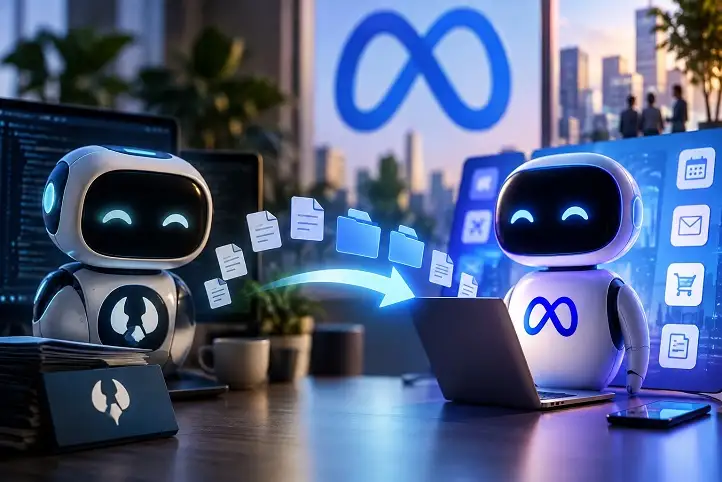
Image Credit: Thailand AI News
Nat Friedman, head of product at Meta Superintelligence Labs and the former CEO of GitHub, confirmed the connection while responding to the growing debate online. As this AI News report examines, Friedman stressed an important distinction: Meta built Muse from scratch, but the product was deliberately inspired by OpenClaw and the ideas behind its agent architecture.
Developers Spot Familiar OpenClaw DNA
Questions surrounding Muse intensified after AI application co-founder Ansh Nanda posted comparisons suggesting that Muse appeared remarkably similar to OpenClaw. Other developers subsequently began examining the assistant and sharing their own observations.
One particularly notable similarity involved SOUL.md, a Markdown configuration file associated with an AI agent’s personality, communication style, behavioral boundaries, expertise, and other characteristics. Developers claimed Muse not only used similarly named files but that some of their contents closely resembled those found in OpenClaw.
Rather than rejecting the comparisons, Friedman explained that Meta believed OpenClaw creator Peter Steinberger had made particularly good design choices. He said Meta’s team became enthusiastic OpenClaw users after he experimented with the technology in January.
Friedman also revealed that he purchased hundreds of Mac minis for the Meta Superintelligence Labs team as employees explored OpenClaw and other personal AI agents. The experience apparently helped shape Meta’s thinking about what a mass-market autonomous assistant should look like.
Meta Wants Agentic AI for Billions
Meta’s larger ambition goes well beyond recreating the experience of an open-source project. Friedman said the objective was to develop something resembling OpenClaw while making it secure, safe, simple enough for mainstream consumers, and capable of eventually operating at enormous scale.
That strategy is particularly significant because Muse represents a shift from conventional conversational chatbots toward AI systems capable of taking actions. Meta launched Muse as an assistant that can connect with services and handle practical tasks such as email, travel arrangements, forms, planning, shopping, and other everyday activities.
OpenClaw’s influence also illustrates how quickly successful ideas can spread throughout the rapidly developing AI-agent industry. As an open-source project, its architecture can be inspected, modified, and studied by developers, making its concepts potentially influential far beyond the original software.
Muse Is Already Surging
The controversy has emerged just as Muse is attracting substantial consumer attention. The app recently climbed to No. 1 on the U.S. App Store, while third-party market intelligence suggests its early mobile adoption has exceeded ChatGPT’s launch when comparable markets and platforms are examined.
Apptopia estimated that, when comparing iOS users in the United States and Canada during each product’s first 12 days, Muse generated about 1.8 million downloads against approximately 1.3 million for ChatGPT. The analytics company also estimated higher daily active user figures for Muse at the equivalent stage, although these remain third-party estimates rather than Meta’s internal numbers.
OpenClaw’s Influence May Reach Far Beyond Meta
Meta’s admission provides an unusually clear glimpse into how influential open-source experimentation can become when major technology companies race to commercialize autonomous AI. Muse may have been independently engineered, but Meta is openly acknowledging that OpenClaw helped establish ideas its developers considered worth carrying into a consumer product.
The bigger question is whether Muse can transform those concepts into a secure and dependable assistant for a vastly larger audience. Its explosive early adoption gives Meta momentum, but long-term success will depend on reliability, user trust, security, and whether autonomous agents genuinely become part of everyday digital life.
For more on Meta’s Muse, visit: