What To Know
- The development marks a significant expansion of the Claude developer’s growing involvement in life sciences and could provide a practical bridge between AI reasoning and experimental biology.
- Novo Nordisk announced a collaboration with the AI company on September 16 aimed at using Anthropic models and Claude Science to tackle drug-discovery challenges and accelerate medicine development.
Anthropic has taken its artificial intelligence ambitions beyond software and into physical biology, operating a wet laboratory in the San Francisco Bay Area where AI-generated scientific ideas can be tested through real-world experiments. The development marks a significant expansion of the Claude developer’s growing involvement in life sciences and could provide a practical bridge between AI reasoning and experimental biology.
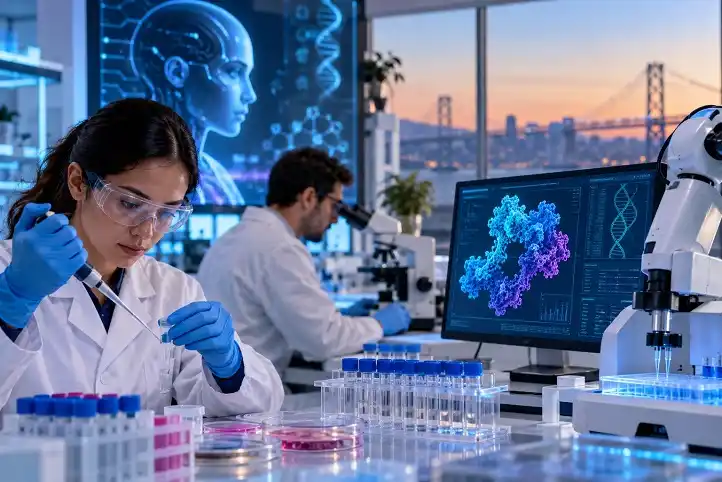
Image Credit: Thailand AI News
The laboratory was confirmed by Anthropic’s head of life sciences, Eric Kauderer-Abrams, who said real laboratory work remains the ultimate test for biological research. As this AI News report highlights, the facility allows Anthropic to conduct some research directly while collaborating with outside laboratories and research partners. The company has not disclosed detailed projects underway at the facility, but says its primary focus is fundamental biology rather than developing drugs itself.
From AI Predictions to Physical Experiments
The move gives Anthropic something increasingly important as frontier AI systems become more capable in science: a way to determine whether predictions produced computationally actually work in biological systems.
Anthropic has already demonstrated Claude’s growing capabilities in this field. In August, the company reported that Claude-designed protein binders succeeded against 14 of 15 tested targets, with individual design success rates ranging from 22% to 35% depending on the experimental setup. More recently, Anthropic said Claude optimized more than 30 open-source biomolecular models in under four weeks, producing an average speed improvement of roughly fourfold.
Pharmaceutical Partnerships Expand
Anthropic is simultaneously strengthening its relationship with the pharmaceutical industry. Novo Nordisk announced a collaboration with the AI company on September 16 aimed at using Anthropic models and Claude Science to tackle drug-discovery challenges and accelerate medicine development.
That relationship helps explain Anthropic’s careful distinction between fundamental biological research and direct drug discovery. The company has major pharmaceutical customers and partners, making any perception that it intends to become their competitor potentially sensitive.
Anthropic has also introduced its Life Sciences Verification Program, providing vetted professionals with access to powerful models under safeguards designed specifically for advanced biological work. The beta program covers areas including research biology, drug discovery, clinical development, and manufacturing.
Promise Meets a Difficult Safety Question
The wet lab nevertheless creates an intriguing tension. Anthropic has repeatedly emphasized the enormous potential of AI-assisted biology while simultaneously warning that increasingly capable models could introduce serious biological misuse risks. Its decision to combine frontier AI with experimental laboratory infrastructure therefore places the company directly at the intersection of scientific acceleration and AI safety.
Ultimately, Anthropic’s laboratory could become an important test of whether AI can move successfully from generating scientific hypotheses to producing experimentally validated discoveries. It will also intensify scrutiny over how companies should control increasingly powerful biological AI capabilities while pursuing potentially transformative medical advances.