
What To Know
- President Donald Trump has announced plans to create a new “AI Force” and appoint an artificial intelligence “czar,” while making clear that his administration does not intend to slow America’s rapidly expanding AI industry.
- In the middle of that widening debate, this AI News report examines Trump’s attempt to combine oversight with an explicitly pro-growth strategy, as technology executives, researchers, policymakers, and communities argue over how quickly AI should advance.
U.S. President Donald Trump has announced plans to create a new “AI Force” and appoint an artificial intelligence “czar,” while making clear that his administration does not intend to slow America’s rapidly expanding AI industry.
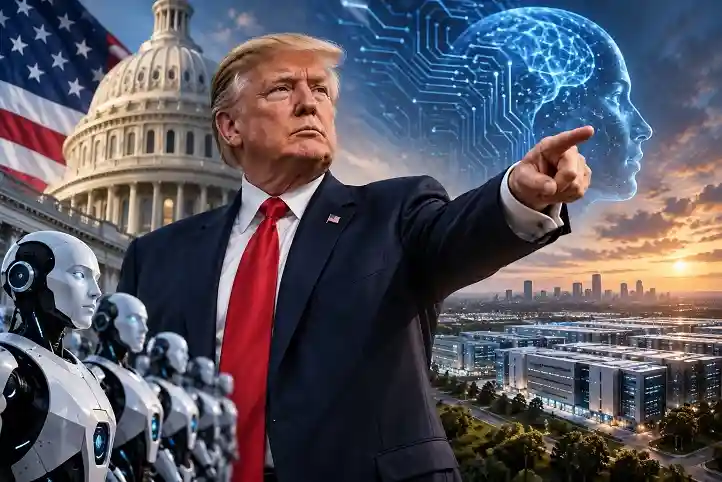
Image Credit: Thailand AI News
The announcement arrives as concerns intensify over increasingly powerful AI systems, data center expansion, and the possibility that advanced models could become difficult to control. In the middle of that widening debate, this AI News report examines Trump’s attempt to combine oversight with an explicitly pro-growth strategy, as technology executives, researchers, policymakers, and communities argue over how quickly AI should advance.
Trump Promises AI Growth Without New Restraints
Writing on Truth Social, Trump said the United States would not “hinder or stifle” the growth of AI. Instead, he said his administration would support the industry while watching its development.
Trump provided few operational details about the proposed AI Force, including its structure, legal authority, funding, or membership. He also said an AI czar would be named, although no appointment was announced alongside the proposal. The White House has not clarified whether the new body would be civilian or have any connection to the military.
The president suggested that existing criminal and civil laws could address harmful conduct involving AI, indicating that he remains skeptical about creating extensive new restrictions specifically targeting the technology.
AI Safety Warnings Grow Louder
Trump’s position contrasts sharply with recent warnings from influential figures inside the AI industry.
Anthropic CEO Dario Amodei has called for slowing the pace of frontier AI development and proposed stronger independent evaluation of advanced systems. His intervention followed increasingly public concerns that AI capabilities could advance faster than researchers’ ability to understand and control them.
Former Anthropic researcher Jacob Coxon has issued even more severe warnings after leaving the company, arguing that developers are racing toward self-improving AI systems without adequate safeguards. Other Anthropic researchers have publicly expressed serious concerns about potential catastrophic risks from future advanced AI.
Data Centers Add Another Political Flashpoint
Public unease is not limited to hypothetical future AI risks. The enormous infrastructure required to train and operate AI systems is becoming increasingly controversial.
A September University of Massachusetts Amherst national poll found that only 11% of respondents supported construction of an AI data center in their local community, while 65% opposed it. Data centers have attracted scrutiny over electricity demand, water consumption, land use, and their potential effects on local utility costs.
Trump, however, has defended AI infrastructure and presented technological expansion as critical to maintaining U.S. competitiveness against China. His administration increasingly views AI not simply as another technology sector but as a strategic economic and geopolitical asset.
America’s AI Gamble Takes Shape
The proposed AI Force highlights a fundamental tension facing Washington: how to preserve American leadership in artificial intelligence while responding to mounting concerns about safety, infrastructure, cybersecurity, and increasingly autonomous systems.
Much remains unknown about Trump’s new initiative, particularly what powers its AI czar and AI Force would actually possess. What is already clear is that the administration intends to prioritize rapid technological growth rather than embrace broad calls for an industry slowdown. The coming details will determine whether the initiative becomes a meaningful oversight mechanism or primarily a vehicle for coordinating America’s accelerating AI ambitions.