

What To Know
- Researchers at MIT have now developed a method designed to preserve the creative problem-solving power of generative AI while ensuring that its final answer obeys strict requirements that cannot be violated.
- Instead of demanding that every stage of generation obey the final constraints, the algorithm allows the model greater freedom during its internal search while steering the process toward a final result that meets the nonnegotiable requirements.
Generative artificial intelligence has become remarkably capable of producing images, planning actions, and exploring complex solutions, but being almost correct is not enough when an AI system is controlling a robot or operating in another safety-critical environment. Researchers at MIT have now developed a method designed to preserve the creative problem-solving power of generative AI while ensuring that its final answer obeys strict requirements that cannot be violated.
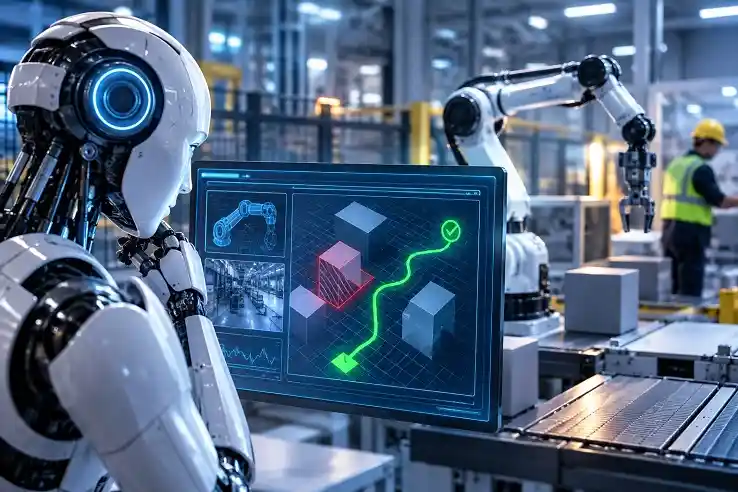
Image Credit: Thailand AI News
The new technique, called HardFlow, tackles one of the difficult problems facing the deployment of generative models in the physical world: how to allow an AI system enough freedom to search for a high-quality solution without permitting an unacceptable final result. Rather than forcing every intermediate stage of generation to remain within rigid boundaries, this AI News report highlights how HardFlow concentrates on ensuring that the final output satisfies the required constraints. The approach could ultimately expand the usefulness of pretrained generative models in robotics, industrial automation, control systems, and other applications where a seemingly minor error could have serious consequences.
When “Almost Right” Becomes Dangerous
Modern generative AI systems are extremely good at searching through enormous spaces of possible outputs. Diffusion and flow-matching models, for example, can start with random noise and progressively transform it into useful data.
That flexibility is valuable for creative applications. In safety-critical situations, however, an answer that looks reasonable may still be unacceptable.
Consider a robot moving through a crowded factory. An AI-generated trajectory could take the robot efficiently from one machine to another while appearing almost perfect. Yet if the route clips an obstacle or passes through a location occupied by a worker, the consequences of that small error could be severe.
Such requirements are known as hard constraints. Unlike preferences, they are conditions that the final solution must satisfy. A robot cannot merely come close to avoiding a collision, just as a physical control system cannot treat certain safety limits as optional.
Existing approaches frequently use projection-based sampling. During generation, intermediate samples are repeatedly pushed back toward the permitted region so that they satisfy imposed constraints.
MIT researchers argue that this can be unnecessarily restrictive. Requiring every intermediate state to satisfy the rules may prevent the generative model from exploring routes through its solution space that eventually produce a better final answer.
Giving AI More Room to Search
HardFlow changes that philosophy. Instead of demanding that every stage of generation obey the final constraints, the algorithm allows the model greater freedom during its internal search while steering the process toward a final result that meets the nonnegotiable requirements.
The distinction matters because intermediate samples are discarded once generation is complete. What ultimately matters to the application is the final output.
According to the researchers, this additional freedom can help a model find solutions that are not merely feasible but better according to other objectives.
For robot navigation, for example, avoiding collisions may be the hard constraint, while minimizing travel time or distance is an additional performance objective. A system that produces a collision-free route has satisfied the fundamental safety requirement, but a collision-free route that is unnecessarily long may still be inefficient.
HardFlow is designed to address both considerations simultaneously.
Control Theory Provides the Mathematical Foundation
The researchers reformulated hard-constrained generative sampling as a trajectory-optimization problem, drawing on techniques from optimal control.
This effectively treats the generative process as a trajectory that can be carefully steered toward a desired destination. Small corrections can be introduced along the way without forcing every intermediate point to satisfy all the restrictions ultimately imposed on the output.
Applying trajectory optimization to a massive neural network is computationally challenging. Modern models can contain enormous numbers of parameters and many interconnected processing layers, making direct optimization potentially impractical.
The MIT team addressed that problem by exploiting the mathematical structure of flow-matching models. The larger optimization problem could be decomposed into a sequence of smaller, single-step problems.
Through transformations and approximations, the researchers developed an algorithm intended to retain the important properties of the original optimization problem while remaining efficient enough to operate during deployment.
That deployment-time capability could prove especially important.
HardFlow does not require an organization to retrain a generative model from scratch. Instead, it can work with pretrained models, potentially allowing existing AI systems to be adapted for applications governed by strict physical, safety, or operational requirements.
Tests Show Perfect Constraint Satisfaction
The researchers evaluated HardFlow across tasks involving robotic manipulation, maze navigation, and text-guided image editing.
Across those experiments, the method achieved perfect constraint satisfaction while consistently producing higher-quality solutions than the baseline techniques against which it was compared.
One particularly revealing experiment involved a robotic manipulator navigating around obstacles to reach a target object. HardFlow was able to generate trajectories that avoided collisions while also identifying faster routes.
Competing approaches presented a less attractive trade-off. Some produced trajectories that resulted in collisions, while others obeyed the restrictions but required considerably more time to reach the target.
HardFlow’s computational demands were also comparable to, or lower than, most competing approaches tested by the researchers. That is important because a safety mechanism that dramatically increases computational costs could be difficult to deploy in systems requiring rapid decisions.
The findings extend beyond robotics. In maze navigation, the same basic challenge appears in another form: reaching a destination while respecting barriers and optimizing the route. Image editing similarly provides a way to test whether generative models can fulfill desired objectives while satisfying strict conditions.
A Possible Route Toward More Dependable Generative AI
The significance of HardFlow lies in its attempt to reconcile two qualities that can appear contradictory: generative freedom and strict compliance.
Generative models derive much of their power from exploring large numbers of possibilities. Excessively constraining that exploration can undermine the capability that makes them useful. Yet allowing unrestricted generation is unsuitable when the final answer must obey physical laws or safety requirements.
HardFlow suggests that the compromise does not necessarily have to occur at every stage of generation. Instead, AI systems may be permitted to explore broadly internally while being mathematically guided toward outputs that satisfy mandatory boundaries.
The researchers say future work could extend the framework to situations where the underlying AI model itself can also be updated. Such an approach could potentially allow constraint satisfaction and output quality to improve together in a more adaptive system.
The work does not by itself solve the broader challenge of guaranteeing safe AI deployment in every real-world environment. Safety depends on correctly defining constraints, accurately modeling operating conditions, and accounting for hazards that designers may not anticipate. Nevertheless, HardFlow demonstrates a promising direction: AI systems may not need to sacrifice their ability to explore sophisticated solutions simply because the final answer must obey uncompromising rules. If the approach continues to perform reliably as it moves toward increasingly complex real-world applications, it could become an important tool for building generative AI systems capable of operating where “close enough” is simply not safe enough.
For more details, visit:
https://ieeexplore.ieee.org/abstract/document/11592684