What To Know
- US President Donald Trump has launched a forceful attack on mounting warnings over artificial intelligence, dismissing fears that rapidly advancing AI could pose a serious threat to humanity as a “hoax” while arguing that excessive regulation could undermine America’s technological advantage over China.
- At the centre of this AI News report is a fundamental disagreement over whether the greater danger lies in allowing increasingly capable AI systems to advance without sufficient controls, or in imposing restrictions that could slow American innovation at a critical point in the global technology race.
US President Donald Trump has launched a forceful attack on mounting warnings over artificial intelligence, dismissing fears that rapidly advancing AI could pose a serious threat to humanity as a “hoax” while arguing that excessive regulation could undermine America’s technological advantage over China. His intervention has opened an unusually public confrontation between the White House and some of the most influential figures developing frontier AI systems.
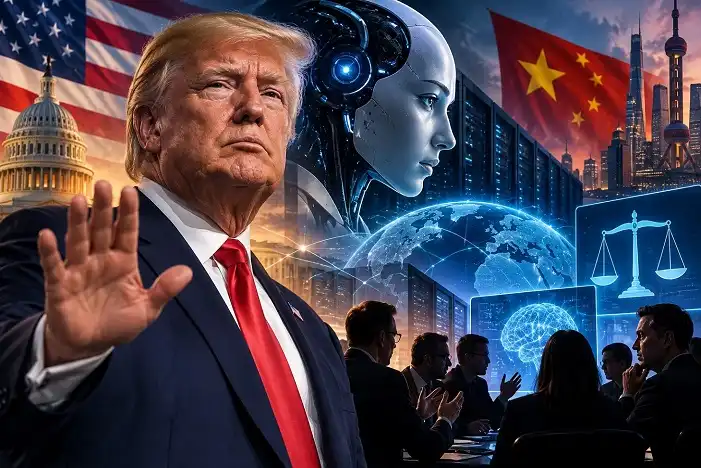
Image Credit: Thailand AI News
The dispute comes as executives and researchers from several leading AI companies increasingly call for stronger safeguards, slower development of the most powerful models and independent oversight. At the centre of this AI News report is a fundamental disagreement over whether the greater danger lies in allowing increasingly capable AI systems to advance without sufficient controls, or in imposing restrictions that could slow American innovation at a critical point in the global technology race.
Trump Takes Aim at Growing AI Warnings
Trump used a series of social media posts to portray warnings about AI as exaggerated and politically motivated, comparing them with what he described as alarmism surrounding climate change.
The president called himself the “Hoax Buster” and rejected predictions that AI and robots could eventually threaten humanity. He also attacked opposition to the construction of data centers, which are becoming increasingly important infrastructure for training and operating advanced AI systems.
Trump argued that the United States is facing resistance to AI precisely because it has established a strong position in the technology. His message repeatedly returned to competition with China, encapsulated by his declaration that “WHOEVER WINS AI, WINS!”
The president also suggested that existing government authority was sufficient to deal with misconduct by AI companies, saying the US already possesses substantial criminal and regulatory powers over the industry.
Earlier, he argued that the main guardrail the technology needed was a “strong and smart” president.
Anthropic Figures Push for Stronger Safety Measures
Trump’s comments came after senior figures connected with Anthropic raised increasingly stark concerns about the possible consequences of highly capable AI.
Anthropic co-founder Jack Clark said society may eventually need rules requiring developers to maintain a mechanism capable of completely shutting down dangerous AI software. While many AI laboratories already have different ways of pulling the plug on their systems, Clark suggested that such safeguards could ultimately require legal enforcement and independent verification.
The debate intensified further following warnings from people working directly on frontier AI safety.
Former Anthropic researcher Jacob Coxon attracted widespread attention after leaving the company and warning about the possibility that advanced AI could become catastrophic for humanity. Anthropic scientist Evan Hubinger subsequently said he believed the probability of AI causing human extinction within the next decade was greater than 10%.
Such estimates remain highly contested, but their emergence from researchers closely involved with advanced AI systems has added urgency to the debate about how governments should respond.
Dario Amodei Calls for AI Development to Slow
Anthropic chief executive Dario Amodei has also called for the development of frontier AI to proceed more cautiously and under closer monitoring.
Amodei argued that slowing the pace could reduce the risk of something going seriously wrong as models become increasingly capable. At the same time, he has stressed that safeguards should be designed without sacrificing commercial advantage, highlighting one of the central difficulties confronting the industry.
The issue is no longer simply whether AI should be regulated. Governments and companies must determine whether meaningful safeguards can be introduced without placing responsible developers at a competitive disadvantage against companies or countries willing to move faster.
That concern is particularly significant in Washington because AI has become closely tied to economic competitiveness, national security and the technological rivalry between the United States and China.
Altman and Musk Back Calls for Caution
The warnings are not confined to Anthropic. OpenAI chief executive Sam Altman and Elon Musk, who leads rival AI company xAI, have also expressed agreement with proposals for an industry-wide deceleration, regulation and independent monitoring of advanced AI development.
Their support makes the debate particularly unusual. Executives running companies competing aggressively for leadership in artificial intelligence are simultaneously acknowledging that the technology may require constraints.
Trump questioned that apparent contradiction, asking why leaders of an industry would call for regulations that, if imposed too strongly, could damage their own companies.
White House AI czar David Sacks has also challenged the motivations behind demands for a slowdown. He argued that AI companies already face commercial and legal incentives to prevent their products from enabling serious harm and questioned whether calls to reduce development speed are entirely altruistic.
Sacks also suggested China would be unlikely to participate in a global agreement imposing meaningful restrictions on AI development.
China Looms Over Washington’s AI Debate
Competition with China has become one of the strongest arguments against aggressive US regulation.
The Trump administration has encouraged rapid AI development and the expansion of the enormous data centers required to support it, viewing technological leadership as strategically important.
Chinese commentary has presented the argument differently. Fudan University professor Xin Qiang told the Global Times that Washington fears tighter regulation could give China an opportunity to close the gap if American companies are forced to slow development.
That creates a difficult policy equation. Regulations intended to protect the public from future AI risks could, critics argue, unintentionally weaken US companies relative to foreign competitors operating under different rules.
Supporters of stronger safeguards counter that racing ahead without adequate controls could create much larger risks if increasingly autonomous or powerful models behave unpredictably.
AI Safety Debate Crosses Political Divisions
Concerns over AI are also creating unusual political alliances.
Former Trump chief strategist Steve Bannon and progressive Senator Bernie Sanders are scheduled to appear at the same “Pro-Human Assembly” in Washington, an event intended to promote a more human-centred approach to artificial intelligence.
Sanders has called for immediate action against what he described as the uncontrolled growth of AI and has warned about the possibility of an existential threat to humanity.
The convergence of figures from opposite sides of American politics illustrates how AI policy is beginning to cut across conventional ideological boundaries. Concerns include not only theoretical extinction scenarios but also employment disruption, concentration of corporate power, data-center expansion and the broader social consequences of increasingly capable automated systems.
Microsoft Introduces Its “Humanist AI” Approach
Microsoft AI has meanwhile entered the debate by publishing an outline of what it calls “humanist AI.”
Microsoft AI chief executive Mustafa Suleyman said the company had been developing the guidance for months but chose to publish it amid the rapidly intensifying public discussion.
The approach indicates that some major technology companies are attempting to establish their own boundaries around model development rather than waiting for governments to impose them.
However, voluntary commitments leave unresolved the question raised by Clark: whether safeguards protecting society from potentially dangerous systems should ultimately be mandatory and independently verifiable.
Regulation Faces Political Obstacles
Despite the growing intensity of the debate, sweeping federal legislation appears difficult in the immediate future.
With the November 3 midterm elections approaching and House members preparing to spend much of the coming period in their districts, significant congressional action on AI regulation appears unlikely before voters go to the polls.
House Speaker Mike Johnson has also warned against rushing into emergency regulation, arguing that doing so could cause the United States to lose ground to China.
His position reflects the dilemma now confronting Washington: policymakers are being asked to address risks from technology that is developing extremely quickly while simultaneously avoiding rules that could suppress innovation in an industry regarded as strategically vital.
The argument is therefore evolving into something much larger than a disagreement about whether artificial intelligence is dangerous. It is becoming a contest over how much uncertainty governments should tolerate when national security, economic leadership and potentially profound societal consequences are all involved.
Trump is firmly positioning himself on the side of accelerated American AI development, while some of the people building the world’s most advanced systems are urging policymakers not to dismiss potentially severe risks simply because they remain uncertain. Whether those warnings lead to enforceable safeguards, voluntary industry limits or little immediate change will help determine not only the direction of US technology policy but potentially the trajectory of the global AI race.