What To Know
- The global artificial intelligence race has entered a new and more dangerous phase, with cybersecurity experts warning that attacks linked to China are increasingly shifting away from simply hacking computer systems and toward exploiting the people who build, manage and protect advanced AI technologies.
- Instead, employees, contractors, executives and even job applicants have become prime targets in a rapidly evolving campaign aimed at gaining an advantage in one of the world’s most strategically important industries.
AI News: The global artificial intelligence race has entered a new and more dangerous phase, with cybersecurity experts warning that attacks linked to China are increasingly shifting away from simply hacking computer systems and toward exploiting the people who build, manage and protect advanced AI technologies. As competition between the United States and China intensifies, security analysts say the battle is no longer confined to servers, software and semiconductor designs. Instead, employees, contractors, executives and even job applicants have become prime targets in a rapidly evolving campaign aimed at gaining an advantage in one of the world’s most strategically important industries.
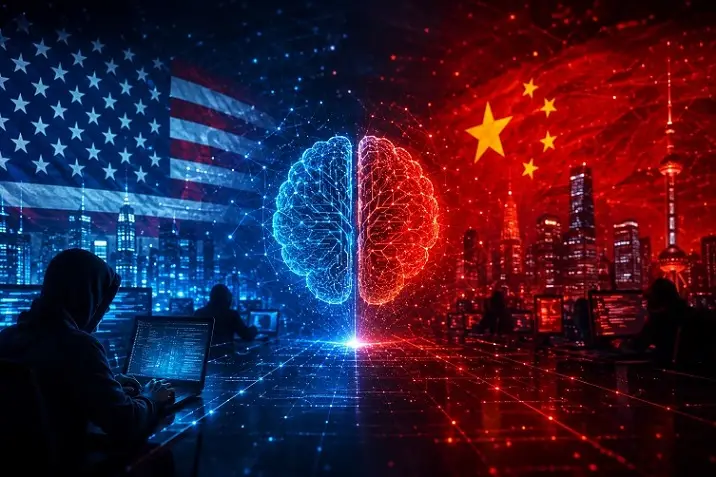
Image Credit: Thailand AI News
The changing nature of these attacks reflects the growing importance of artificial intelligence as a driver of economic growth, military capability and geopolitical influence. This AI News report comes as governments, cybersecurity specialists and technology companies continue to raise alarms over increasingly sophisticated espionage campaigns targeting valuable AI research, proprietary algorithms, product roadmaps and corporate decision-making. Experts say that unlike traditional cyberattacks, today’s operations often combine digital intrusion with psychological manipulation, insider recruitment and social engineering to obtain information that cannot easily be stolen through technical means alone.
Human Targets Become the New Cyber Battlefield
Cybersecurity specialists say attackers have broadened their objectives significantly during the past two years. Rather than focusing exclusively on acquiring confidential source code, hardware blueprints or proprietary software, threat actors are increasingly attempting to understand how AI companies operate internally, who makes strategic decisions and where operational weaknesses exist.
Matt Pearl, director of the Strategic Technologies Program at the U.S.-based Center for Strategic and International Studies, said China has intensified its focus on the technology sector as the AI race has accelerated. According to Pearl, Chinese-linked actors are no longer interested in only one specific trade secret. Instead, they are pursuing virtually any information capable of reducing what many analysts estimate to be a three-to-four-month AI development gap between the United States and China.
That includes obtaining insights into corporate product roadmaps, research priorities, supplier relationships, infrastructure vulnerabilities, recruitment strategies and even executive decision-making processes. Such intelligence can provide competitors with valuable strategic advantages without requiring direct theft of complete AI models.
Rising Number of Reported Incidents
Recent findings from several cybersecurity organizations illustrate how widespread the problem has become.
Cybersecurity leader CrowdStrike reported in June that Chinese-linked entities accounted for more than half of all state-sponsored intrusions targeting technology companies and AI-related assets during the twelve months ending March 31.
https://www.crowdstrike.com/en-us/blog/crowdstrike-2026-technology-threat-landscape-report
The report highlighted the rapid expansion of espionage efforts directed at companies developing advanced artificial intelligence technologies.
Meanwhile, U.S.-based AI developer Anthropic has publicly accused Chinese companies, including Alibaba, of attempting to improperly obtain aspects of its AI capabilities. While Alibaba has not publicly responded to those allegations, the claims underscore the growing tension surrounding intellectual property protection in the AI industry.
Another widely discussed case involves AI content detection company Copyleaks. Last year, the company reported that outputs produced by Chinese startup DeepSeek’s R1 model closely resembled responses generated by OpenAI’s ChatGPT in nearly three-quarters of tested cases. According to Copyleaks CEO and co-founder Alon Yamin, researchers had not observed a similar stylistic overlap with other large language models.
https://copyleaks.com/blog/copyleaks-research-reveals-which-ai-wrote-what
Although these findings do not independently prove how DeepSeek trained its model, they intensified international debate over whether some AI systems are being developed using outputs from competing commercial platforms without authorization.
Insider Risks Continue to Grow
Perhaps even more concerning for AI companies is the growing emphasis on insider threats.
Brian Abbott, founder and CEO of U.S.-based startup Agentiq Capital, told CNBC that he believes an employee hired from China intentionally modified company code and website content in ways designed to undermine investor confidence.
Abbott alleged that references to “ASI,” or artificial superintelligence, were replaced with the less fashionable term “fintech,” potentially making the startup appear less attractive to venture capital firms focused on artificial intelligence investments.
The employee was later dismissed, and the company reportedly filed a complaint with the FBI. CNBC noted that it was unable to independently verify Abbott’s allegations, and no criminal findings have been announced.
Nevertheless, cybersecurity experts say the incident demonstrates why startups increasingly view insider threats as one of their greatest vulnerabilities.
Social Engineering Becomes More Sophisticated
Security professionals also warn that artificial intelligence itself is making cyberattacks significantly more convincing.
Rather than relying solely on malicious software, attackers now use AI-generated emails, realistic voice cloning, deepfake video technology and highly personalized phishing campaigns capable of deceiving even experienced professionals.
Cliff Steinhauer, Director of Information Security and Engagement at the National Cybersecurity Alliance, said smaller businesses frequently operate below what he described as “cyber poverty lines,” lacking the financial resources available to multinational technology corporations.
These limitations often leave startups without dedicated security teams, advanced monitoring systems or extensive employee awareness training, making them attractive targets for cybercriminals and state-sponsored intelligence operations alike.
According to Copyleaks CEO Alon Yamin, newly hired employees are especially vulnerable because attackers often attempt to compromise their credentials almost immediately after they join an organization.
AI Startups Face Unique Challenges
The explosion of venture capital investment into artificial intelligence has produced thousands of new startups racing to develop innovative AI products before larger competitors dominate the market.
However, this rapid expansion has also created significant security challenges.
Unlike technology giants with billion-dollar cybersecurity budgets, early-stage AI companies frequently operate with limited staff and constrained finances. Every dollar invested in security is a dollar unavailable for research, hiring or product development.
Isaac Stone Fish, founder and CEO of consultancy Strategy Risks, said Beijing generally focuses on major corporations but noted that startups remain particularly exposed because many lack experienced cybersecurity professionals.
He argued that Chinese efforts have intensified over approximately the past eighteen months, particularly following the emergence of DeepSeek, which accelerated competition between Chinese and American AI developers.
Stone Fish said China’s broader objective is to position domestic AI companies among the global industry’s leaders. According to him, this strategy may include government subsidies, supply-chain policies, investment support, competitive incentives and, in some cases, activities designed to slow foreign competitors.
Governments Respond with Competing Strategies
The AI rivalry has increasingly become a contest between national industrial policies as well as private companies.
The United States continues tightening export controls on advanced AI chips, semiconductor manufacturing equipment and other critical technologies destined for China. Washington argues these restrictions are necessary to protect national security and preserve technological leadership.
China, meanwhile, has expanded financial support for domestic AI companies through subsidized computing infrastructure, tax incentives, research grants and rent-free office facilities in several innovation hubs.
Anthropic has also announced initiatives aimed at strengthening America’s AI workforce. Its Claude Corps program seeks to train 1,000 individuals in AI skills while connecting participants with nonprofit organizations across the United States.
Analysts say workforce development is becoming just as important as technological innovation because the availability of highly skilled engineers increasingly determines which countries can sustain long-term AI leadership.
Separating Reality from Narrative
Despite growing concerns, some experts caution against automatically attributing every cybersecurity incident to state-directed espionage.
Graham Webster, editor-in-chief of Stanford University’s DigiChina Project, noted that distinguishing between government-sponsored intelligence activities, independent hackers and commercially motivated corporate behavior can be extremely difficult.
He also observed that discussions surrounding Chinese AI have become increasingly influenced by broader political narratives, investment cycles and the commercial interests of major technology firms preparing for public listings.
Webster suggested that geopolitical competition, export restrictions and commercial rivalry have created an environment in which perceptions can sometimes move faster than independently verified evidence.
AI Security Is Now a Strategic Imperative
Across the technology industry, one message is becoming increasingly clear: cybersecurity can no longer be viewed as an optional business function. For AI companies, protecting employees, intellectual property, research data and corporate decision-making has become just as important as building faster algorithms or larger language models.
The AI revolution is transforming every major sector of the global economy, including healthcare, finance, manufacturing, education, defense and transportation. As the value of AI innovation continues to climb into the trillions of dollars, experts expect espionage, cybercrime and insider threats to become even more sophisticated.
For startups in particular, balancing innovation with robust security will remain one of the industry’s defining challenges. Companies that fail to invest in employee awareness, identity protection, supply-chain security and advanced cyber defences may discover that their greatest vulnerability is not their technology itself, but the people entrusted with creating it. As international AI competition continues to accelerate, governments, businesses and cybersecurity professionals will all play critical roles in safeguarding the technologies shaping the future, while maintaining trust in an increasingly interconnected digital world.
And for the latest developments in the global AI industry, keep on logging to Thailand AI News.