
What To Know
- OpenAI, Anthropic, Google and Meta appeared to hold an almost unassailable lead, fueled by billions of dollars in investment, access to the world’s most advanced semiconductor technology and an extraordinary concentration of engineering talent.
- Midway through this transformation, this AI News report explores why China’s latest generation of AI models is attracting serious attention from Western users, how companies such as Moonshot AI are reshaping expectations, and why the global AI industry may have entered its most competitive period since generative artificial intelligence first captured worldwide attention.
AI News: China’s AI Revolution Is No Longer a Regional Story – It Has Become a Global Business Reality
Not long ago, the artificial intelligence conversation was dominated by a handful of American technology giants whose names became almost synonymous with the industry’s astonishing progress. OpenAI, Anthropic, Google and Meta appeared to hold an almost unassailable lead, fueled by billions of dollars in investment, access to the world’s most advanced semiconductor technology and an extraordinary concentration of engineering talent. Conventional wisdom suggested that while China possessed enormous technological ambition, it remained several years behind the United States in the race to build the world’s most capable AI models.
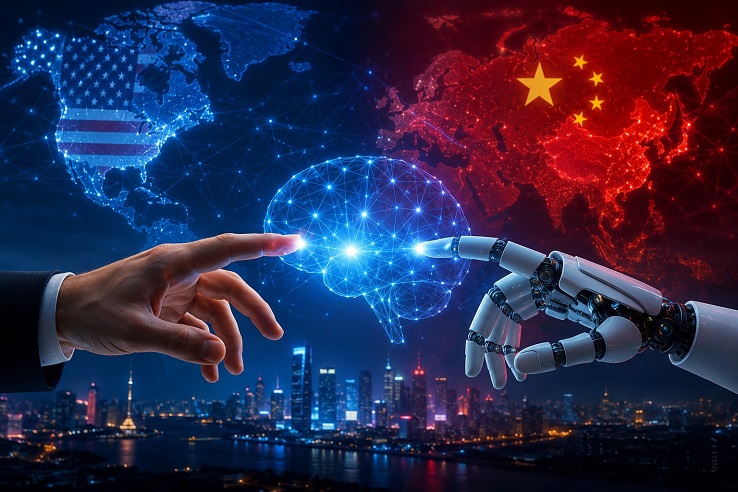
Image Credit: Thailand AI News
That narrative is now rapidly changing. Across Silicon Valley boardrooms, European software firms and thousands of independent developer communities, Chinese artificial intelligence models are no longer viewed as experimental alternatives but as genuine commercial competitors. Businesses that once defaulted to premium American AI services are quietly testing Chinese systems, while many developers have already begun integrating them into their daily workflows because they deliver impressive performance at dramatically lower costs. Midway through this transformation, this AI News report explores why China’s latest generation of AI models is attracting serious attention from Western users, how companies such as Moonshot AI are reshaping expectations, and why the global AI industry may have entered its most competitive period since generative artificial intelligence first captured worldwide attention.
The change has not happened because a single Chinese company suddenly produced a miracle breakthrough. Rather, it is the result of a steady acceleration in engineering capability across China’s rapidly expanding AI ecosystem. Over the past two years, a succession of increasingly capable models has emerged from companies including DeepSeek, Alibaba, Z.ai and Moonshot AI, each narrowing the performance gap that once separated Chinese developers from their American rivals. Together, they have created something that is proving difficult for even the biggest U.S. technology companies to ignore—a market where affordability, openness and practical performance are becoming just as influential as outright technological supremacy.
Why Businesses Are Looking Beyond Silicon Valley
Artificial intelligence has matured far beyond the stage where companies simply want to experiment with chatbots. Today, organizations expect AI to write software, analyze legal contracts, review financial reports, automate customer service, assist medical researchers, organize corporate knowledge and perform countless repetitive administrative tasks.
Every one of those activities consumes computing power. Every computation costs money.
As AI becomes embedded in everyday business operations, pricing has become almost as important as performance.
This is where Chinese developers have found their opening. Rather than competing solely on headline benchmark scores, many Chinese AI companies have focused on delivering systems that provide exceptionally strong real-world performance while significantly reducing the cost of deployment. For organizations processing millions of prompts each month, the difference between paying premium prices and paying only a fraction of those costs can translate into millions of dollars in annual savings.
Increasingly, executives are asking a straightforward question: if two AI models can complete 95 percent of the same work, why pay several times more for one of them?
That question is driving one of the biggest shifts currently taking place within the global AI marketplace.
Moonshot AI Steps into the Spotlight
Among China’s newest success stories is Moonshot AI, a company that until recently was relatively unknown outside specialist technology circles.
Its latest model, Kimi K3, has rapidly become one of the industry’s most closely watched releases. Within days of becoming available, demand surged so dramatically that the company temporarily suspended new subscriptions while additional computing capacity was brought online.
That kind of response is rare. It reflects more than curiosity surrounding a new product. It signals that developers, startups and enterprise customers have been actively searching for alternatives capable of delivering high-quality AI performance without premium pricing.
Early users have praised Kimi K3 for its coding capabilities, document comprehension, multilingual reasoning and responsiveness. While opinions naturally vary depending on workloads and applications, the broader market reaction has been remarkably consistent: Chinese AI can no longer be dismissed as a lower-tier option. Instead, it has become a legitimate competitor.
The Economics Are Becoming Impossible to Ignore
Artificial intelligence pricing is often discussed using tokens—the units of text processed by AI models during input and output. At first glance, the differences between providers may appear relatively small.
In practice, however, they become enormous. A software company operating AI-powered customer support twenty-four hours a day may process hundreds of millions of tokens every month. A financial institution analyzing thousands of reports, or a healthcare provider summarizing patient records, generates equally demanding workloads.
Multiply those usage levels across an entire enterprise and even modest reductions in token costs produce substantial savings.
This economic reality explains why developers are increasingly evaluating AI systems according to return on investment rather than brand recognition.
For many organizations, “good enough” has become commercially irresistible when “good enough” costs dramatically less.
The AI marketplace is therefore evolving in much the same way cloud computing did years earlier. Businesses initially focused on technological leadership eventually shifted toward balancing performance, reliability, scalability and price.
Artificial intelligence now appears to be following that same trajectory.
Performance Is Narrowing the Gap Faster Than Expected
Price alone would not have been enough to persuade businesses in the United States and Europe to seriously consider Chinese AI platforms. Cost savings may capture attention, but long-term adoption depends on confidence that an AI model can perform consistently under real-world conditions. That is precisely why the recent advances made by Chinese developers have become such a significant talking point throughout the technology industry. The conversation is no longer centered on whether China’s AI models are improving—it is now focused on how quickly they are catching up.
Independent benchmark testing, developer feedback and enterprise evaluations increasingly point in the same direction. Models such as Moonshot’s Kimi K3, DeepSeek’s latest releases, Alibaba’s Qwen family and Z.ai’s GLM series have all demonstrated substantial gains in reasoning, software development, mathematical problem-solving and multilingual capabilities. While American frontier models continue to lead in several specialized areas, the performance gap that once measured years is now often discussed in terms of months.
For businesses, that distinction matters enormously. If an AI platform delivers 95 percent of the required capability at a fraction of the operating cost, many organizations see little commercial justification for paying a premium simply to secure marginally better performance. Corporate technology decisions have always been driven by return on investment, and artificial intelligence is proving no different.
Open Models Are Reshaping the Rules of Competition
Another factor helping Chinese AI companies gain traction is their willingness to embrace more open development strategies.
Unlike proprietary systems that operate almost entirely behind subscription walls, several Chinese AI developers have released open-weight models that organizations can download, customize and operate within their own computing environments. For software developers, research institutions and enterprise IT departments, that flexibility is enormously attractive.
Running AI internally allows organizations to retain greater control over sensitive information, comply more easily with regulatory requirements and tailor models to highly specialized industries. A law firm can adapt a model to legal terminology. A hospital can optimize it for medical documentation. A manufacturing company can train it to understand engineering specifications unique to its own production processes.
Rather than forcing customers into a one-size-fits-all ecosystem, open models encourage innovation beyond the companies that originally created them. Every improvement contributed by developers strengthens the broader ecosystem, creating a collaborative cycle that can accelerate progress at remarkable speed.
It is this philosophy that has prompted many analysts to argue that China’s influence extends beyond building competitive AI—it is helping redefine how advanced AI software is distributed and improved globally.
Washington Watches China’s Progress with Growing Concern
The rapid rise of Chinese AI has naturally attracted close attention in Washington.
Artificial intelligence is no longer viewed solely as a commercial technology. Governments increasingly regard advanced AI as a strategic asset with implications for economic competitiveness, scientific discovery, cyber security and national defense. Consequently, every major technological breakthrough now carries geopolitical significance.
American officials have repeatedly expressed concern that Chinese AI developers may have benefited from techniques such as model distillation, in which one AI system learns from the outputs of another. Several leading U.S. AI companies have voiced similar allegations, arguing that proprietary technology deserves stronger protection.
Chinese companies, meanwhile, have firmly rejected those accusations, maintaining that their progress reflects years of research, engineering investment and domestic innovation rather than the improper use of foreign intellectual property.
Whatever the ultimate outcome of these disputes, they highlight a broader reality. The contest between the United States and China is no longer confined to semiconductors or telecommunications. Artificial intelligence has become one of the defining technological competitions of the twenty-first century, with each breakthrough carrying implications that extend well beyond the technology sector itself.
Restrictions Have Produced Unexpected Innovation
Ironically, many analysts believe that external pressure has encouraged Chinese AI companies to become more efficient rather than slowing them down.
Restrictions on access to some of the world’s most advanced AI chips forced developers to rethink how models were trained and deployed. Instead of relying exclusively on brute computing power, engineers concentrated on improving software architecture, reducing computational waste and extracting greater performance from available hardware.
The outcome has been a new generation of AI models that often achieve impressive results while consuming fewer resources than many observers expected possible.
That emphasis on efficiency could prove valuable well beyond China. As AI adoption accelerates worldwide, businesses will increasingly look for systems capable of delivering powerful performance without requiring enormous computing infrastructure. Companies seeking to manage both financial and environmental costs are likely to place growing value on models that achieve more with less.
In that respect, China’s engineering approach may influence AI development far beyond its own borders.
A New Reality for Global Technology Companies
Perhaps the greatest lesson emerging from the rise of Chinese AI is that the global technology industry has entered a genuinely competitive era.
For years, many assumed that frontier artificial intelligence would remain dominated by a relatively small group of American companies. That assumption now appears increasingly outdated.
Instead of one innovation center dictating the pace of progress, breakthroughs are emerging from multiple regions simultaneously. Competition between American and Chinese developers is accelerating product releases, encouraging lower prices and forcing every major AI company to improve at a faster pace than ever before.
History shows that industries subjected to intense competitive pressure rarely stand still for long. Rival companies are forced to innovate faster, reduce prices and introduce new capabilities simply to avoid losing market share. Artificial intelligence is now following that familiar pattern. Every significant breakthrough by one developer immediately raises expectations for every other player in the market, creating a cycle of continuous innovation that benefits the entire industry. Consumers ultimately gain access to more capable and affordable AI services, businesses enjoy a wider choice of platforms tailored to different operational needs, developers can select from an expanding ecosystem of models and tools, while researchers gain access to increasingly sophisticated systems that accelerate scientific and technological discovery. Most importantly, competition ensures that complacency becomes a liability. In today’s AI race, standing still is effectively the same as falling behind, and that relentless pressure is already evident as major new models are being introduced at a pace that would have seemed extraordinary only a year ago.
What It Means for Thailand and the Wider Region
For Thailand, the emergence of affordable, high-performing AI platforms presents opportunities that extend well beyond the technology industry itself.
Lower operating costs could allow thousands of small and medium-sized enterprises to adopt artificial intelligence for the first time. Manufacturers may automate quality control more effectively. Tourism businesses could deploy multilingual AI assistants capable of serving visitors around the clock. Financial institutions may accelerate document analysis and fraud detection, while universities gain access to increasingly sophisticated research tools without prohibitive licensing costs.
Success, however, will depend on thoughtful implementation. Organizations must balance affordability with security, governance, regulatory compliance and data protection. Choosing an AI model is no longer simply a technical decision—it is a strategic business decision that influences competitiveness, operational resilience and long-term digital transformation.
What is becoming increasingly clear is that artificial intelligence is evolving into a truly global industry. The latest advances from Moonshot AI and its Chinese competitors demonstrate that innovation can emerge from multiple centres of excellence, challenging long-held assumptions about where the world’s most influential technologies will originate. For businesses across Asia, Europe and North America alike, the smartest strategy may not be choosing sides but objectively evaluating every platform on its merits. In an industry moving at extraordinary speed, adaptability may prove to be the greatest competitive advantage of all.
The Top Five Chinese AI Models
1.Moonshot’s Kimi K3
or
2.Alibaba’s Qwen 3.7 Max
or
https://www.alibabacloud.com/en/campaign/qwen-ai-landing-page?_p_lc=1
3.Xiaomi’s Mimo-V2.5-Pro
https://mimo.mi.com/models/en-US/mimo-v2.5-pro
or
4.MiniMax’s MiniMaxM3
or
5.Z.ai’s GLM5.1
or
For the latest on Chinese AI models, keep on logging to Thailand AI News.