What To Know
- While the United States has tightened access to some of its most advanced AI technologies for many parts of the world, China is moving in the opposite direction by expanding international cooperation, offering AI training opportunities, and encouraging broader access to its own AI platforms.
- At the same time, China has been actively promoting a more open approach, inviting countries to participate in AI collaborations, training programmes, technology partnerships and the use of Chinese-developed AI models.
Two Different Paths Are Emerging in the Global AI Race
The global artificial intelligence landscape is increasingly being shaped by two sharply contrasting approaches. While the United States has tightened access to some of its most advanced AI technologies for many parts of the world, China is moving in the opposite direction by expanding international cooperation, offering AI training opportunities, and encouraging broader access to its own AI platforms. The differing strategies are creating a new dynamic that could significantly influence how developing nations adopt and benefit from artificial intelligence over the coming years.
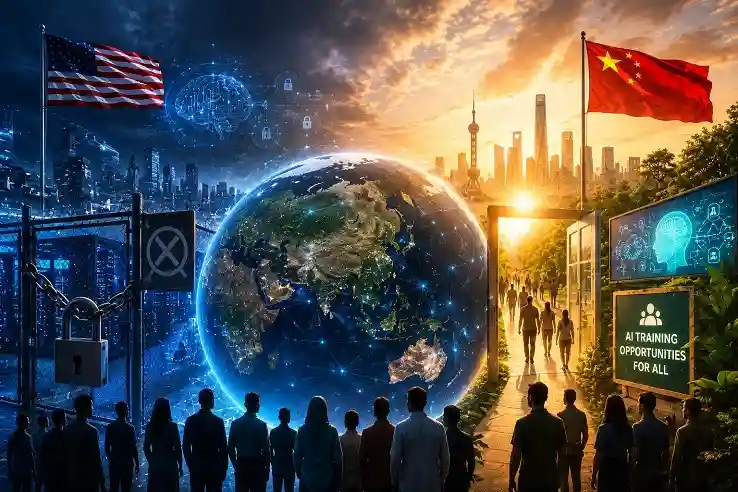
Image Credit: Thailand AI News
In recent months, the United States has introduced measures that limit access to some of the world’s leading AI models developed by companies such as OpenAI and Anthropic. This AI News report highlights that, in some instances, even where access remains available internationally, important capabilities and advanced features have reportedly been restricted or modified for users outside the United States. At the same time, China has been actively promoting a more open approach, inviting countries to participate in AI collaborations, training programmes, technology partnerships and the use of Chinese-developed AI models.
China Expands Global AI Cooperation
Speaking at the 2026 World AI Conference in Shanghai, Chinese President Xi Jinping announced that China will provide 5,000 AI training and seminar opportunities for developing countries over the next five years. The initiative is aimed at strengthening AI capabilities across emerging economies while encouraging broader international collaboration in artificial intelligence.
China also revealed plans to establish international AI application cooperation centers with major regional organizations, including ASEAN, the African Union, the League of Arab States, BRICS, the Shanghai Cooperation Organization, and the Community of Latin American and Caribbean States. In addition, China intends to help 30 countries deploy its AI-powered MAZU meteorological early warning system to improve disaster preparedness and help protect lives and property.
A Vision Built Around International Collaboration
During his keynote address, Xi described artificial intelligence as a technology that should benefit all nations rather than remain concentrated within a handful of countries. He argued that AI development should become “a symphony of international cooperation” instead of a competition dominated by individual nations.
While emphasizing that AI must remain secure, controllable and under human oversight, Xi also cautioned against expanding national security policies in ways that prevent other countries from accessing or benefiting from emerging AI technologies. His remarks were widely interpreted as contrasting with the increasingly restrictive export controls and technology limitations implemented by the United States in recent years.
US Restrictions Continue to Shape the AI Landscape
The United States has progressively strengthened export controls affecting advanced semiconductors and high-performance AI technologies, primarily citing national security concerns. These measures have influenced access to cutting-edge computing infrastructure and advanced AI capabilities in several regions, particularly China.
The restrictions have also affected major technology companies. Nvidia has acknowledged that regulatory limitations have significantly reduced its ability to compete within China’s data-center computing market, allowing domestic Chinese competitors to expand their own ecosystems. At the Shanghai conference, Huawei showcased its Atlas 950 SuperPoD supernode, highlighting China’s continuing investment in developing its own large-scale AI computing infrastructure.
Global South May Benefit from China’s Strategy
China’s latest announcements appear designed to strengthen its relationships with developing nations by providing practical AI education, technology partnerships and access to AI tools without the level of restrictions currently associated with some Western platforms. For countries seeking to accelerate digital transformation, these initiatives could provide valuable opportunities to develop local expertise while participating in international AI projects.
As artificial intelligence becomes increasingly central to economic development, education, healthcare, manufacturing and public services, the differing approaches adopted by the United States and China are likely to influence global technology alliances for many years. Whether nations prioritize tightly controlled access focused on national security or broader international collaboration centered on technology sharing may ultimately shape the future balance of AI innovation worldwide. As governments, businesses and researchers evaluate these competing models, the choices made today could determine how inclusive, accessible and globally distributed artificial intelligence becomes in the next decade.
For the latest AI developments globally, keep on logging to Thailand AI News.