
What To Know
- ” Researchers at Electronics and Telecommunications Research Institute, better known as ETRI, announced the successful development of a next-generation memory expansion platform called OmniXtend, a system designed to overcome GPU memory bottlenecks during massive AI training operations.
- Instead of relying solely on local memory directly attached to GPUs or accelerators, the system uses standard Ethernet networks to create a massive shared memory pool spanning multiple servers and computing devices.
AI News: South Korean scientists have unveiled a breakthrough technology that could dramatically reshape the future of large-scale artificial intelligence infrastructure by solving one of the industry’s most stubborn and expensive problems—the so-called “memory wall.” Researchers at Electronics and Telecommunications Research Institute, better known as ETRI, announced the successful development of a next-generation memory expansion platform called OmniXtend, a system designed to overcome GPU memory bottlenecks during massive AI training operations.

Image Credit: Thailand Medical News
As AI models continue to grow at an astonishing pace, the demand for memory capacity has become almost as important as raw computing power itself. Modern large language models, advanced recommendation systems, and high-performance computing applications now consume extraordinary amounts of memory during training and inference. In the race to build larger and smarter AI systems, companies have poured billions into faster GPUs and specialized accelerators. Yet even with those advances, memory limitations remain a severe bottleneck. In many cases, processors spend valuable time waiting for data to move between memory systems instead of performing computations. This AI News report highlights how the memory wall has become one of the biggest barriers preventing AI infrastructure from scaling efficiently.
A New Way to Share Memory Across AI Systems
ETRI’s OmniXtend technology tackles the problem from a completely different angle. Instead of relying solely on local memory directly attached to GPUs or accelerators, the system uses standard Ethernet networks to create a massive shared memory pool spanning multiple servers and computing devices.
In practical terms, this means that memory resources are no longer isolated within individual machines. Instead, distributed memory across entire data centers can be accessed dynamically and treated almost like a unified system. Researchers describe this as a “disaggregated memory architecture,” where resources can be allocated flexibly depending on AI workload requirements.
The implications are enormous for hyperscale AI systems. Current architectures often require expensive hardware upgrades whenever memory demand increases. OmniXtend allows operators to expand available memory without replacing existing servers or accelerators, potentially saving enormous deployment and operational costs for cloud providers and AI firms.
The technology also reduces the performance penalties traditionally associated with moving data between different devices. By minimizing latency and optimizing memory access across Ethernet networks, ETRI says the system can maintain high-speed AI processing even in memory-constrained environments.
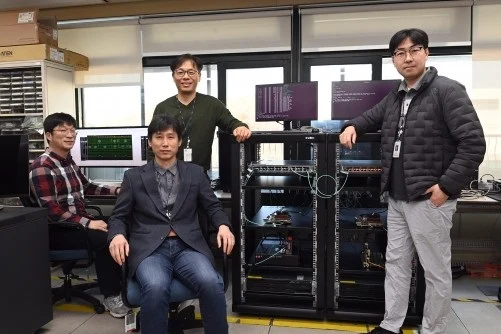
Image Credit: ETRI
Why The “Memory Wall” Matters
The “memory wall” refers to the growing mismatch between processor speeds and memory capacity. Over the years, GPU performance has advanced rapidly, but memory systems have struggled to keep pace. As a result, computational efficiency often drops sharply when memory resources become insufficient.
This problem is especially severe for large language models and generative AI systems that require enormous datasets and parameter storage. AI training jobs increasingly depend on distributed architectures involving multiple GPUs and accelerators operating simultaneously. Traditional interconnect systems like PCIe face physical limitations in connectivity range and scalability, making them less effective for future ultra-large AI deployments.
OmniXtend bypasses many of these constraints by using conventional Ethernet switches to aggregate physically separated devices into a unified memory infrastructure. This enables far greater scalability while leveraging networking hardware that is already widely deployed in data centers around the world.
Researchers believe this could accelerate the development of next-generation AI infrastructure while also lowering barriers for organizations seeking to train increasingly sophisticated AI models.
Demonstrations Show Dramatic Performance Gains
ETRI engineers developed several core technologies to make the system operational, including FPGA-based memory expansion nodes and a specialized Ethernet memory transfer engine. The research team then conducted real-world demonstrations to validate the concept.
During testing, multiple devices operating in an Ethernet environment successfully formed a shared memory pool and accessed each other’s memory in real time. The system reportedly operated stably under demanding workloads.
More importantly, ETRI evaluated OmniXtend using large language model computational tests. Results showed that when memory capacity was insufficient, LLM inference performance dropped dramatically. However, when Ethernet-based memory expansion was enabled, performance recovered to more than double the degraded levels.
Researchers said the technology allowed AI systems with limited onboard memory to maintain processing speeds comparable to environments with sufficient local memory capacity. Such results suggest the platform may provide a viable solution for scaling future AI workloads without endlessly increasing hardware costs.
Global Attention from The AI Industry
The breakthrough attracted international attention after ETRI showcased OmniXtend at major technology events including the RISC-V Summit Europe 2025 in Paris and the RISC-V Summit North America 2025 in California.
The institute is also leading the Interconnect Working Group under the CHIPS Alliance, contributing to open-source standards for AI networking and memory expansion technologies. This places ETRI at the center of emerging efforts to standardize scalable AI memory architectures globally.
Industry observers believe open standards could be critical in encouraging adoption among semiconductor companies, hyperscale cloud providers, and AI infrastructure developers.
ETRI says commercialization efforts are already being planned. The institute intends to transfer the technology to data center hardware firms and software developers targeting next-generation AI servers, network switches, and memory expansion platforms.
Future Beyond AI Data Centers
Interestingly, the researchers are not limiting the technology to AI training environments alone. ETRI plans to extend the architecture into high-reliability embedded systems including automotive and maritime applications. The institute also aims to create shared-memory architectures spanning heterogeneous accelerators such as CPUs, GPUs, and NPUs.
Kim Kang Ho, Assistant Vice President of ETRI’s Future Computing Research Division, stated that the organization intends to significantly expand research surrounding memory interconnect technologies focused on accelerators and neural processing units. He added that ETRI will continue strengthening international collaboration to ensure the technology can be integrated into future AI and semiconductor systems worldwide.
The project was conducted under South Korea’s “Research on Memory-Centric Next-Generation Computing System Architecture” initiative supported by the Ministry of Science and ICT and the Institute of Information and Communications Technology Planning and Evaluation.
What makes OmniXtend particularly significant is that it addresses a structural weakness in the AI industry rather than simply offering another incremental speed boost. The future of artificial intelligence increasingly depends on infrastructure capable of handling enormous memory demands efficiently and affordably. By transforming Ethernet into a scalable memory-sharing backbone, ETRI may have introduced a technology capable of changing how next-generation AI systems are designed and deployed across the globe. If commercial adoption succeeds, the era of memory-starved AI training systems could eventually become a thing of the past.
Visit ETRI website for more details:
https://etri.re.kr/eng/main/main.etri
For the latest innovations in the AI arena, keep on logging to Thailand AI News.