
What To Know
- In the middle of growing global competition over conversational AI systems, this AI News report highlights how OpenAI is rapidly positioning itself at the center of the emerging voice-first digital economy.
- By bundling voice reasoning, live translation, and transcription into a single Realtime API ecosystem, the company is giving developers access to tools that could simplify the creation of advanced AI assistants and automated communication platforms.
AI News: OpenAI has unveiled a powerful new suite of voice intelligence tools that could dramatically reshape how businesses, developers, and digital platforms communicate with users in real time. The company announced that its API will now support advanced conversational voice features capable of speaking, translating, transcribing, and responding with significantly improved reasoning abilities.
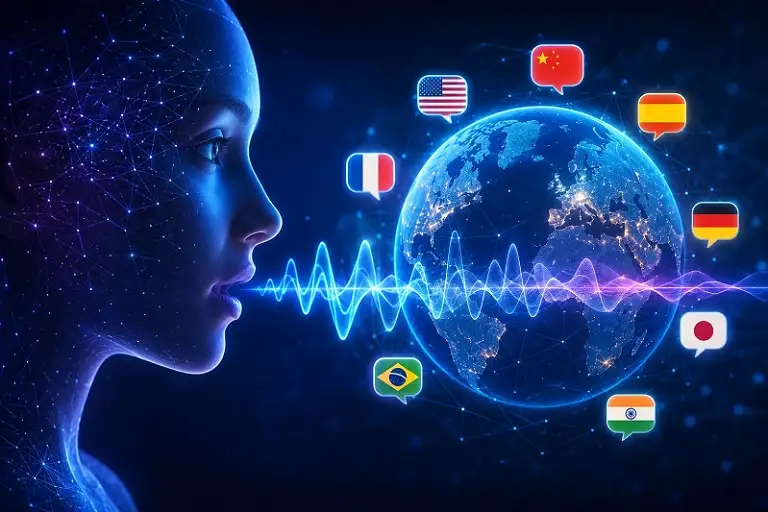
Image Credit: Thailand AI News
The centerpiece of the launch is GPT-Realtime-2, a next-generation voice model engineered to create more natural and lifelike vocal interactions. Unlike the earlier GPT-Realtime-1.5 model, the upgraded version has been enhanced with GPT-5 class reasoning capabilities, enabling it to handle more sophisticated user requests and complex conversational flows. OpenAI claims the technology can now move beyond simple voice responses into systems capable of understanding context, interpreting intent, and reacting intelligently as conversations develop. In the middle of growing global competition over conversational AI systems, this AI News report highlights how OpenAI is rapidly positioning itself at the center of the emerging voice-first digital economy.
Real Time Translation Expands AI Communication
Another major addition is GPT Realtime Translate, a tool designed to deliver live conversational translation with minimal delay. The system supports more than 70 input languages and can currently provide spoken output in 13 languages. OpenAI says the platform was developed to “keep pace” with natural conversation, making interactions feel fluid rather than robotic.
The implications for international communication could be enormous. Customer service operations, global business meetings, online education platforms, creator communities, and multilingual events may all benefit from near-instant AI translation capabilities. Industry observers believe such tools could accelerate the replacement of traditional translation workflows with AI-powered real-time systems.
OpenAI also launched GPT-Realtime-Whisper, a live speech-to-text system capable of transcribing spoken conversations instantly as interactions happen. The company says the tool was built for applications requiring rapid documentation, accessibility support, meeting records, and interactive voice-based systems.
Businesses And Developers Expected to Benefit
OpenAI appears to be aggressively targeting enterprise adoption with these releases. By bundling voice reasoning, live translation, and transcription into a single Realtime API ecosystem, the company is giving developers access to tools that could simplify the creation of advanced AI assistants and automated communication platforms.
The company stated that the models are designed to help voice interfaces “actually do work” by listening, reasoning, translating, transcribing, and taking actions during live conversations. That shift could significantly expand AI’s role in sectors such as healthcare support, education, live media production, virtual events, and online customer engagement.
However, concerns surrounding misuse remain significant. Real-time voice systems capable of generating convincing speech could potentially be exploited for fraud, misinformation, impersonation, or spam activities. OpenAI acknowledged these concerns and said it has integrated safeguards and monitoring systems intended to detect harmful behavior and automatically halt conversations that violate company safety guidelines.
Pricing for the new services varies depending on usage. GPT-Realtime-2 will be billed according to token consumption, while the translation and transcription tools will be charged by usage time measured in minutes.
As competition intensifies between major AI firms racing to dominate voice-driven computing, OpenAI’s latest launch signals that conversational AI is entering a much more advanced phase. The ability for machines to understand, translate, transcribe, and reason simultaneously may soon become a standard feature of digital communication worldwide, potentially transforming how humans interact with technology on a daily basis.
For more details, visit:
https://openai.com/index/advancing-voice-intelligence-with-new-models-in-the-api
https://developers.openai.com/api/docs/guides/realtime
For the latest on new developments in the AI world, keep on logging to Thailand AI News.