What To Know
- A simple request like “Design my dream home” can result in an image shaped by past interests, such as hobbies, lifestyle choices, or even aesthetic preferences inferred from connected apps like Gmail and Google Photos.
- Currently, the personalized image-generation feature is rolling out to Plus, Pro, and Ultra subscribers in the United States, with plans to expand to other regions and platforms, including Chrome desktop, in the near future.
AI News: A New Era of Personalized Image Creation
Google has taken a bold step forward in artificial intelligence by integrating its Nano Banana-powered image generation into Gemini’s Personal Intelligence feature, signaling a deeper shift toward hyper-personalized AI experiences. The update allows users to generate images that reflect their real-life preferences, habits, and memories—without needing to spell everything out in detail.
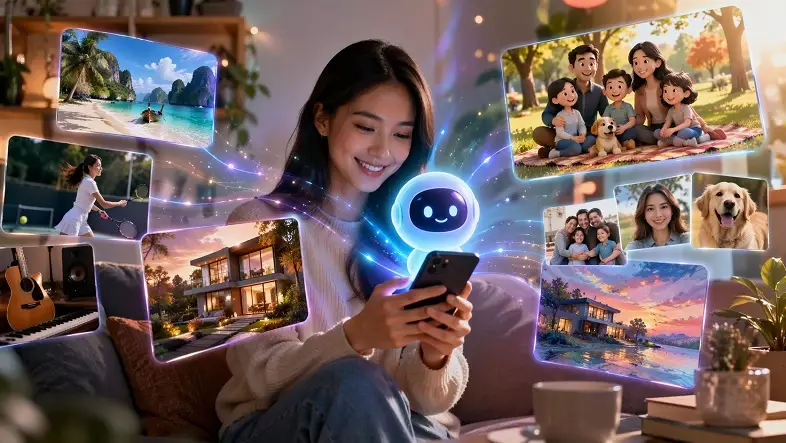
Image Credit: Thailand AI News
Instead of crafting long prompts, users can now rely on Gemini’s understanding of their digital footprint. For example, a simple request like “Design my dream home” can result in an image shaped by past interests, such as hobbies, lifestyle choices, or even aesthetic preferences inferred from connected apps like Gmail and Google Photos. This AI News report highlights how the feature removes friction from creativity, letting users interact with AI more naturally than ever before.
How Nano Banana Enhances Gemini’s Capabilities
At the heart of this innovation is Nano Banana, an image-generation tool that gained massive popularity after its earlier release. Now more advanced, it works seamlessly with Gemini to create visuals based on personal data connections—if users choose to opt in.
By tapping into labeled photos, such as “Family” or specific names in Google Photos, Gemini can produce highly tailored images. Users can request something like “Create a claymation image of my family enjoying our favorite activity,” and the AI will generate a scene that reflects familiar faces and shared experiences.
Importantly, Google emphasizes that the system does not directly train on personal photos. Instead, it uses limited contextual information, such as prompts and responses, to guide image creation. Users also retain control, with options to provide feedback, refine outputs, or upload reference images manually for better accuracy.
Privacy, Control, and Transparency
As personalization deepens, so do questions about privacy. Google has addressed this by making the feature strictly opt-in. Users must actively enable Personal Intelligence to allow Gemini access to connected apps and data.
To maintain transparency, a “sources” button has been introduced. This lets users see how Gemini derived the context behind each generated image. While the system aims for accuracy, Google acknowledges that it may occasionally misinterpret details, encouraging users to provide feedback to improve results.
This balance between personalization and privacy reflects a broader industry trend, where AI tools are becoming more integrated into daily life while attempting to maintain user trust.
Growing Popularity and Strategic Expansion
Nano Banana itself has already proven to be a viral success. When it first launched, users flooded the platform with creative experiments, from miniature figurines to stylized personal avatars. The surge in demand was so intense that it temporarily strained Google’s infrastructure, even requiring usage limits.
The popularity also helped push the Gemini app to the top of the Apple App Store rankings, surpassing competitors like OpenAI’s ChatGPT. This latest integration is expected to strengthen Gemini’s competitive edge even further.
Currently, the personalized image-generation feature is rolling out to Plus, Pro, and Ultra subscribers in the United States, with plans to expand to other regions and platforms, including Chrome desktop, in the near future.
A More Personal Future for AI
The integration of Nano Banana into Gemini’s Personal Intelligence marks a significant evolution in how users interact with artificial intelligence. By blending personal data with creative tools, Google is moving toward an AI ecosystem that feels less like software and more like a digital extension of the user’s identity.
While challenges around accuracy and privacy remain, the direction is clear—AI is becoming increasingly intuitive, contextual, and deeply personal. As these systems continue to evolve, they are likely to redefine not just how we create images, but how we connect with technology itself in everyday life.
Reference:
https://blog.google/innovation-and-ai/products/gemini-app/personal-intelligence-nano-banana
For the latest AI tools or apps, keep on logging to Thailand AI News