What To Know
- AIS Academy is placing that challenge at the center of “AIS ACADEMY for THAIs 2026,” a major two-day gathering under the theme “MASTERING AI BEYOND BORDERS” at Samyan Mitrtown Hall in Bangkok.
- Instead of concentrating only on teaching people how to operate popular AI tools, the program is focused on developing the ability to understand artificial intelligence, apply it appropriately, generate useful outcomes, and ultimately create new opportunities.
Thailand’s artificial intelligence ambitions are entering a more demanding phase, with the conversation shifting from simply gaining access to AI tools toward proving that the technology can produce measurable economic, educational, and social benefits. AIS Academy is placing that challenge at the center of “AIS ACADEMY for THAIs 2026,” a major two-day gathering under the theme “MASTERING AI BEYOND BORDERS” at Samyan Mitrtown Hall in Bangkok.
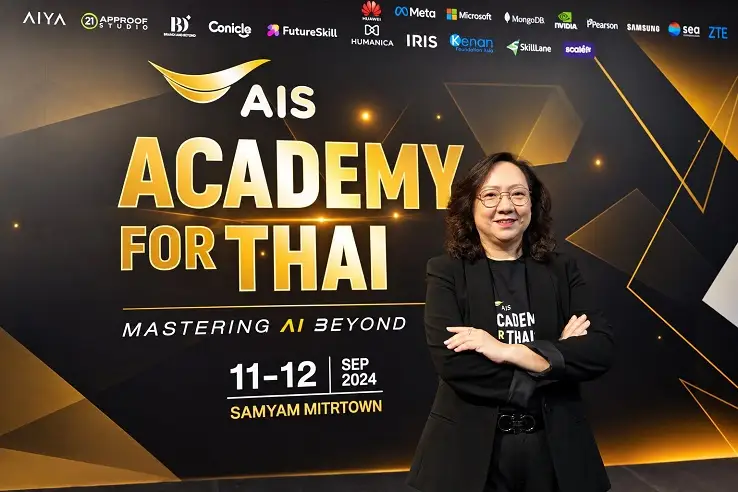
Image Credit: AIS
The event brings together government representatives, businesses, educational institutions, technology specialists, and global partners to examine how Thailand can convert rapidly expanding AI adoption into practical capabilities. More importantly, this Thailand AI News report highlights how the initiative is attempting to connect individual skills, organizational transformation, urban development, and national competitiveness rather than treating artificial intelligence as another isolated technology trend.
Thailand Moves Beyond Simply Having Access to AI
Kantima Lerlertyuttitham, Deputy Chief Executive Officer and Chief Corporate Officer at AIS, said sustainable business growth must advance alongside Thai society, the economy, and the development of people.
That philosophy underpins the company’s “Think Ahead for Thais” mission and the latest AIS Academy initiative. Instead of concentrating only on teaching people how to operate popular AI tools, the program is focused on developing the ability to understand artificial intelligence, apply it appropriately, generate useful outcomes, and ultimately create new opportunities.
The distinction could become increasingly important as AI technology progresses beyond the current wave of generative AI systems toward more sophisticated capabilities, including the longer-term possibility of artificial general intelligence, or AGI.
For Thailand, that means investment in digital infrastructure alone will not be enough. Workers and organizations will also need analytical thinking, stronger questioning skills, data-driven decision-making, adaptability, creativity, and an understanding of responsible AI use.
AIS argues that national AI readiness ultimately begins with people capable of working effectively alongside increasingly powerful technology.
Three AI Transitions Could Define Thailand’s Next Phase
AIS ACADEMY for THAIs 2026 features more than 30 speakers addressing practical ways to turn AI investment into real-world results. Much of the program revolves around three transitions that could determine whether Thailand becomes a serious beneficiary of the global AI transformation.
The first is a shift from individual adoption toward organization-wide transformation. Businesses cannot expect meaningful gains merely because employees have started experimenting with chatbots or generative AI platforms. Successful deployment requires clearly identified problems, measurable objectives, suitable data, redesigned workflows, and employees capable of incorporating AI into everyday operations.
The second transition is from learning specific AI tools toward developing durable, future-ready capabilities. Individual platforms can change rapidly, making skills such as critical thinking, creativity, data interpretation, effective prompting, and responsible decision-making potentially more valuable than proficiency with any single application.

Image Credit: AIS
The third involves moving away from fragmented projects toward a connected national AI ecosystem. Government agencies, universities, businesses, technology developers, cities, and communities will need greater collaboration if access to knowledge and AI-driven opportunities is to extend beyond major corporations and specialist technology circles.
Young Thai Innovators Put AI to Work in Education
The event also provides a glimpse of how younger Thai innovators are already applying AI to practical problems.
Its opening program included the final innovation pitching round of the JUMP Thailand Hackathon 2026. Ten finalist teams were selected from 603 teams involving 2,504 participants representing 67 educational institutions nationwide.
Under the theme “AI for the Future of Thai Education,” participants developed technologies intended to improve learning, broaden educational access, and address challenges experienced by teachers and students.
Team MAMO from Prince of Songkla University won with “Wathasin,” an AI Speech Coach. Fellow Prince of Songkla University team Rub Mao Kor Rueng secured first runner-up with “BrailleBox.”
Team MR. BOBO, representing Chulalongkorn University and King Mongkut’s University of Technology North Bangkok, took second runner-up with “DEAFIN Education,” while Khon Kaen University’s Team TLDR received the Popular Vote Award for its “LearnLy” platform.
The competition illustrates an important element of Thailand’s AI challenge: turning technical knowledge into products capable of addressing identifiable human needs.
Businesses Face Pressure to Prove AI Delivers Results
The conference’s Thailand AI Readiness stage expands the discussion beyond education, examining national transformation, changing workplace practices, urban applications of artificial intelligence, and the adjustments organizations will need to make as AI becomes embedded across the economy.
The second day places additional emphasis on “AI Ready Business” and “AI Ready Skills,” with case studies showing how organizations can pursue measurable outcomes rather than adopting artificial intelligence simply because competitors are doing so.
This is particularly significant for small and medium-sized enterprises. SMEs may lack the budgets, specialist personnel, and large datasets available to major corporations, making the selection of realistic AI use cases critical. Starting with a clearly defined operational problem could deliver greater value than attempting an expensive, organization-wide transformation without measurable objectives.
Sessions also explore preparations for future AI development, the potential progression toward AGI, changes in design and creative work, and the capabilities Thai workers may need as automation alters existing jobs while creating new forms of employment.
Workshops Turn AI Discussions into Practical Experience
AIS Academy is complementing the conference sessions with more than 20 workshops and masterclasses, alongside interactive AI experiences provided by participating partners.
The hands-on format is intended to prevent the event from becoming purely theoretical. Participants can experiment with tools, examine actual applications, and consider how particular technologies might fit into their businesses, professions, educational environments, or daily activities.
This practical emphasis reflects a broader challenge facing countries worldwide. Access to sophisticated AI models is expanding quickly, but access by itself does not guarantee higher productivity, stronger companies, better education, or improved public services. Those benefits depend heavily on implementation.
AIS is positioning itself in this process as more than a telecommunications and digital infrastructure provider. The company describes its evolving role as a cognitive technology organization capable of combining infrastructure, expertise, partnerships, and human-capital development to support Thailand’s AI transition.
Thailand’s AI Test Is Now About What the Technology Delivers
The central message emerging from AIS ACADEMY for THAIs 2026 is that Thailand has reached a point where enthusiasm about artificial intelligence must increasingly be matched by evidence of what it can accomplish. AI literacy, organizational preparedness, responsible deployment, and collaboration across sectors will determine whether widespread access translates into lasting national advantage.
If Thailand can connect infrastructure with skilled people, useful data, practical business applications, educational innovation, and coordinated public-private action, artificial intelligence could become considerably more than a fashionable technology investment. It could strengthen productivity, expand opportunities, improve learning, and support a more competitive economy. The difficult task now is ensuring those benefits move from conference stages and experimental projects into everyday Thai businesses, schools, workplaces, cities, and communities. For more details on AIS Academy, visit: https://www.aisacademy.com/home/