
What To Know
- A little-known but increasingly significant business arrangement has placed Microsoft at the center of one of the most consequential developments in the global artificial intelligence industry.
- While OpenAI and Anthropic have largely kept their advanced AI models out of China due to concerns over intellectual property protection, misuse risks, and geopolitical tensions, Microsoft has quietly emerged as the primary channel through which Chinese technology giants gain access to some of the world’s most advanced AI systems.
AI News: A little-known but increasingly significant business arrangement has placed Microsoft at the center of one of the most consequential developments in the global artificial intelligence industry. While OpenAI and Anthropic have largely kept their advanced AI models out of China due to concerns over intellectual property protection, misuse risks, and geopolitical tensions, Microsoft has quietly emerged as the primary channel through which Chinese technology giants gain access to some of the world’s most advanced AI systems.
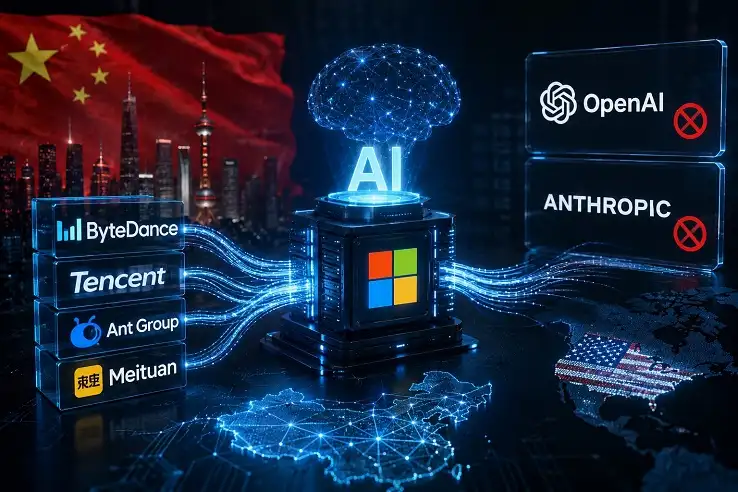
Image Credit: Thailand AI News
The situation has created a unique dynamic in the rapidly evolving AI landscape. Microsoft, through its exclusive commercial relationship with OpenAI, has become the only major American technology company actively supplying OpenAI’s GPT models to Chinese enterprises. In effect, the software giant is selling AI technologies in a market that the creator of those technologies has chosen not to serve directly. This unusual arrangement has elevated Microsoft into a powerful intermediary role that few analysts anticipated when the company first invested heavily in OpenAI.
The scale of the business is becoming increasingly difficult to ignore. Chinese technology firms have emerged as major buyers of Microsoft’s AI-related services, with ByteDance reportedly becoming one of the company’s largest artificial intelligence customers globally. According to industry sources, ByteDance is expected to spend more than US$1 billion annually on Microsoft’s AI and cloud offerings. Other major Chinese firms, including Ant Group, Meituan, and Tencent, have also purchased AI capabilities through Microsoft’s Azure platform. While Ant Group has emphasized that it develops its own AI models and that core products do not depend on external systems, Microsoft’s growing influence across China’s technology sector remains evident. In examining this expanding relationship, this AI News report highlights how Microsoft has positioned itself at the crossroads of competing technological and geopolitical interests.
Azure’s Explosive Growth in China
Internally, Microsoft appears to view its Chinese AI business as one of its most successful growth stories. Company executives reportedly informed employees that Azure’s AI revenue in China grew faster than in any other global territory. Revenue from AI services in the region roughly tripled during the financial year ending June 2025, following an extraordinary increase of approximately 400 percent in the previous year.
Former Chief Commercial Officer Judson Althoff reportedly described Microsoft as the company uniquely capable of connecting the AI innovation hubs of the American West Coast with China’s powerful technology ecosystem. Although China represented only a small percentage of Microsoft’s overall revenue, the growth trajectory underscores the increasing importance of AI-related services in the company’s international strategy.
Why Microsoft Holds a Unique Position
The foundation of Microsoft’s advantage lies in its contractual relationship with OpenAI. That agreement grants Microsoft considerable flexibility in determining how GPT models are marketed and distributed internationally. Since OpenAI has declined to directly offer its services in China, and Anthropic has similarly stayed away from the market, Microsoft effectively operates as the sole gateway through which major Chinese corporations can legally access OpenAI technology.
This arrangement has also generated friction. Reports indicate that OpenAI has privately urged Microsoft to strengthen safeguards against model “distillation,” a process in which outputs generated by advanced AI systems are used to train competing models. Such practices have become a growing concern within the AI industry as companies seek to protect the value of their intellectual property.
Microsoft has responded by emphasizing its monitoring systems and stating that it works primarily with established corporate customers rather than individual developers. However, critics argue that regulating the downstream use of AI-generated synthetic data remains a significant challenge.
Balancing Between American and Chinese AI Ecosystems
Adding another layer of complexity, Microsoft has simultaneously embraced Chinese-developed AI technologies. In January 2025, the company added DeepSeek’s R1 model to Azure AI Foundry. More recently, Microsoft confirmed that it has been testing a customized Azure-hosted version of DeepSeek-V4 as a lower-cost alternative for enterprise applications.
The result is a remarkable balancing act. Microsoft is helping Chinese firms gain access to American-developed AI models while also introducing Chinese-developed AI systems to Western business customers. Few companies occupy such a strategic position within the global AI supply chain.
To mitigate regulatory and security concerns, Microsoft does not host OpenAI models within mainland China. Instead, Chinese customers access the systems through overseas data centers, including facilities located in Singapore and other regions. This approach allows Microsoft to continue servicing customers while maintaining compliance with existing restrictions.
Political Pressures Could Reshape the Market
The sustainability of this strategy remains uncertain. Washington policymakers increasingly view China’s AI ambitions as a strategic challenge to American technological leadership. As AI becomes more closely linked to national competitiveness and security, political scrutiny of Microsoft’s China operations could intensify.
At the same time, OpenAI’s concerns regarding intellectual property protection and model misuse may place additional pressure on Microsoft to tighten controls. The company currently enjoys a rare position as a trusted partner on both sides of the technological divide, but maintaining that balance may become increasingly difficult as geopolitical tensions continue to rise.
For now, Microsoft occupies an enviable and highly profitable position. It remains the dominant supplier of OpenAI-powered services to China while simultaneously integrating Chinese AI innovations into Western-facing platforms. Whether this delicate arrangement survives future regulatory and political challenges will be one of the most closely watched stories in the global artificial intelligence industry. What is clear today is that Microsoft has successfully transformed itself from a software provider into one of the most influential gatekeepers in the emerging AI economy, profiting from both sides of an increasingly competitive technological rivalry.
For the latest news, keep on logging to Thailand AI News.