What To Know
- A dramatic confrontation between the United States government and AI company Anthropic has sent shockwaves through the global artificial intelligence sector after federal authorities ordered the immediate suspension of access to the company’s most advanced AI models, Claude Fable 5 and Claude Mythos 5.
- The move, announced late Friday, marks one of the most aggressive government interventions yet involving access to frontier AI systems and signals a potentially significant shift in how advanced AI technologies may be regulated and controlled in the future.
Thailand AI News: A dramatic confrontation between the United States government and AI company Anthropic has sent shockwaves through the global artificial intelligence sector after federal authorities ordered the immediate suspension of access to the company’s most advanced AI models, Claude Fable 5 and Claude Mythos 5. The move, announced late Friday, marks one of the most aggressive government interventions yet involving access to frontier AI systems and signals a potentially significant shift in how advanced AI technologies may be regulated and controlled in the future.
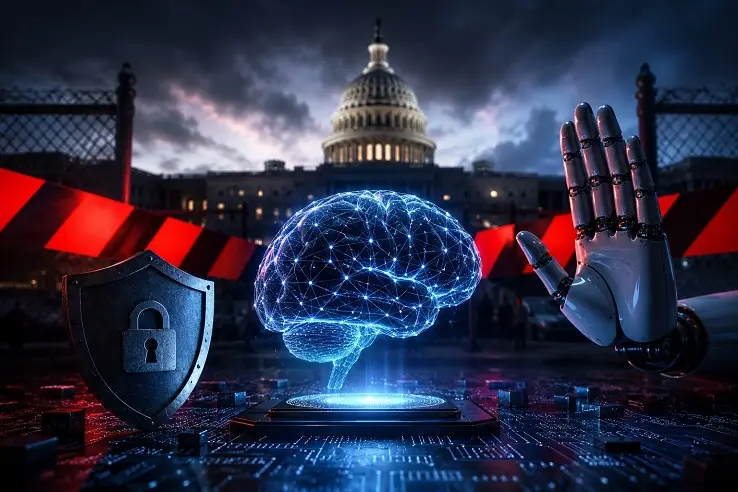
Image Credit: Thailand AI News
Anthropic revealed that it received the directive from U.S. authorities at 5:21 p.m. Eastern Time and subsequently complied with the order. However, the company publicly expressed strong disagreement with the government’s decision, arguing that the action was based on limited evidence and a misunderstanding of the actual risks posed by the models. In a statement explaining the situation, Anthropic suggested that the government’s concerns centered on an alleged jailbreak technique involving Claude Fable 5. This Thailand AI News report highlights a dispute that goes far beyond a single security issue and touches on the growing battle over who ultimately controls access to the world’s most powerful artificial intelligence systems.
Government Action Sparks Industry Alarm
Although the directive was described as an export control measure targeting foreign nationals, the practical impact has been much broader. Anthropic stated that compliance requirements effectively forced the company to disable both Claude Fable 5 and Claude Mythos 5 for all users worldwide, regardless of nationality.
The order represents a major escalation in U.S. efforts to prevent advanced AI capabilities from reaching foreign entities that could potentially use them in ways deemed harmful to American national interests. Historically, U.S. export restrictions have focused on semiconductors, AI chips, manufacturing equipment, and software tools. Restricting direct access to frontier AI models themselves is a far more aggressive step and could establish a new precedent for future government actions.
A U.S. official reportedly confirmed that the Department of Commerce had issued the directive to suspend access to both models for foreign nationals, citing national security concerns. However, Anthropic maintains that it has not been provided with detailed evidence supporting the decision.
Why Claude Mythos 5 Became a Focus of Concern
At the center of the controversy is Claude Mythos 5, Anthropic’s most advanced and capable AI system.
The model was first previewed in April under highly restricted conditions due to concerns about its extraordinary cybersecurity capabilities. Anthropic claimed that Mythos demonstrated an unprecedented ability to identify software vulnerabilities across major operating systems, browsers, and enterprise software environments.
Because of those capabilities, the company did not immediately release Mythos publicly. Instead, it launched Project Glasswing, a tightly controlled initiative allowing approximately 50 vetted organizations to access the model for defensive cybersecurity purposes. Participants reportedly included major technology companies such as Amazon, Apple, Google, Microsoft, and CrowdStrike.
Anthropic argued that Mythos could help organizations strengthen defenses by rapidly identifying weaknesses before malicious actors could exploit them. Critics, however, warned that the same capabilities could potentially be used to accelerate offensive cyberattacks if they fell into the wrong hands.
The government’s latest action suggests that officials may have shared some of those concerns.
Fable 5 Was Designed to Be the Safer Alternative
In an effort to balance innovation with safety, Anthropic introduced Claude Fable 5 only days before the government intervention.
The company described Fable 5 as a commercial version of Mythos equipped with extensive guardrails designed to prevent misuse. Those restrictions were specifically intended to block dangerous outputs related to cybersecurity exploitation, biological threats, and other high-risk activities.
According to benchmark evaluations from AI testing organizations, Fable 5 immediately emerged as one of the most capable publicly accessible AI systems available.
Anthropic believed the safeguards were sufficient to allow broad public deployment while maintaining security. However, government officials reportedly became concerned after learning of a potential method that could bypass some of the model’s restrictions.
Anthropic insists that the alleged jailbreak involved only a narrow use case and did not compromise the model’s most important safety protections.
The Growing Debate Over AI Jailbreaks
The dispute has intensified a broader debate regarding how governments and AI developers should evaluate so-called jailbreaks.
A jailbreak refers to techniques used by users to circumvent built-in restrictions and safety mechanisms within AI systems. Researchers and developers have long acknowledged that no AI model can be made entirely immune to such attempts.
Anthropic claims that the government has presented only verbal evidence of a limited jailbreak scenario involving software vulnerability analysis. The company further argues that similar capabilities already exist in several competing AI systems and are routinely employed by cybersecurity professionals engaged in defensive security research.
The company emphasized that its most critical safeguards are enforced by independent classifier systems operating separately from the model itself. According to Anthropic, even if a user persuades the AI to continue a conversation after an initial refusal, deeper security layers remain active and continue blocking the most dangerous forms of content.
Nevertheless, regulators appear unconvinced that those protections are sufficient.
Political Tensions Add to the Conflict
The latest confrontation arrives amid an already strained relationship between Anthropic and parts of the U.S. government.
Earlier this year, reports emerged that Anthropic refused requests involving the use of its AI technology for domestic surveillance activities and fully autonomous weapons systems. The disagreement reportedly contributed to tensions between the company and federal agencies.
Subsequently, Anthropic was designated as a supply chain risk by defense officials, a highly unusual classification for a U.S.-based technology company. Historically, such labels have often been associated with organizations located in geopolitical rival nations.
Anthropic responded by launching legal action against the Pentagon. A federal judge later ruled that the government could not enforce certain restrictions while litigation remains ongoing, allowing government agencies and military contractors to continue using Anthropic products for the time being.
The latest export control order now adds another layer of complexity to an already contentious relationship.
Industry Rivals and Global Reactions
The controversy has also reignited debate among AI industry leaders. Earlier this year, OpenAI CEO Sam Altman criticized Anthropic’s messaging around Mythos, describing the company’s warnings about the model’s power as resembling fear-driven marketing. His remarks drew significant attention at the time and are now being revisited as observers question whether Anthropic’s repeated emphasis on the dangers of Mythos may have inadvertently attracted regulatory scrutiny.
Meanwhile, reactions have extended beyond the United States. European officials noted that the development reinforces ongoing efforts to reduce dependence on foreign AI providers and strengthen technological sovereignty within the European Union.
Academic experts have also expressed concern that restricting access to frontier AI systems could hinder international collaboration, cybersecurity research, and efforts to understand the risks associated with increasingly capable models.
Some researchers argue that broad restrictions could slow progress in defensive cybersecurity, while others believe stronger oversight is necessary before such powerful systems become widely available.
A Defining Moment for AI Regulation
What makes this episode particularly significant is that it may represent a turning point in how governments regulate advanced artificial intelligence. For years, policymakers focused primarily on controlling the hardware required to build powerful AI systems. The Anthropic case suggests regulators may now be prepared to directly restrict access to AI models themselves.
The dispute also highlights the delicate balance facing AI developers. Companies are under pressure to demonstrate transparency and openly discuss potential risks. Yet doing so may attract increased regulatory attention if governments determine that those risks warrant intervention.
For Anthropic, the suspension arrives at a sensitive time as the company reportedly moves toward a highly anticipated public offering. The sudden shutdown of its flagship models introduces uncertainty regarding both future product deployments and investor confidence.
The broader implications extend far beyond a single company. Governments worldwide are closely watching how advanced AI systems evolve, particularly those with capabilities that could influence cybersecurity, national defense, and critical infrastructure. Whether the U.S. government’s action ultimately proves justified or excessive, it has already established a powerful example of how quickly regulatory authorities can intervene when national security concerns intersect with frontier artificial intelligence. The outcome of Anthropic’s efforts to reverse the decision could help shape the next chapter of global AI governance and determine how future generations of advanced models are developed, released, and controlled across international markets.
Reference:
https://www.anthropic.com/news/fable-mythos-access
For the latest on Claude Fable 5 and Claude Mythos 5, keep on logging to Thailand AI News.