What To Know
- The decision lands at a moment of acute geopolitical tension and signals a decisive shift in how the United States intends to harness AI for military operations.
- In the midst of that debate, this AI News report has learned, senior Pentagon officials were already pressing AI firms to clarify their positions as military planners prepared for potential escalation in the Middle East.
AI News: In a dramatic escalation of Washington’s intensifying AI power struggle, former U.S. President Donald Trump has ordered all federal agencies to blacklist Anthropic, just hours before OpenAI secured a landmark agreement to deploy its artificial intelligence systems within classified Pentagon environments. The decision lands at a moment of acute geopolitical tension and signals a decisive shift in how the United States intends to harness AI for military operations.
The move follows a highly publicized clash over the ethical limits of AI in warfare. Last week, Anthropic CEO Dario Amodei outlined firm “red lines” restricting the use of the company’s AI models for domestic mass surveillance and fully autonomous weapons systems. In the midst of that debate, this AI News report has learned, senior Pentagon officials were already pressing AI firms to clarify their positions as military planners prepared for potential escalation in the Middle East.
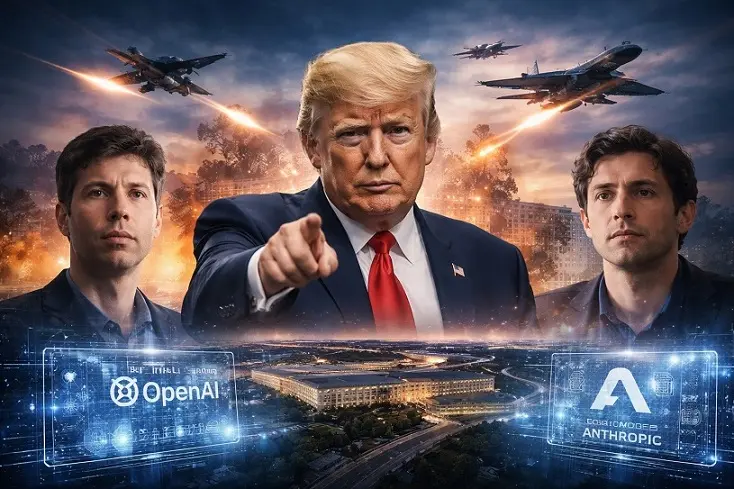
Image Credit: Thailand AI News
Trump reacted sharply, branding Anthropic’s leadership as ideologically driven and declaring the company a “supply-chain risk.” Under that designation, defense contractors and federal agencies seeking Pentagon business would be required to sever ties with Anthropic. The administration’s directive effectively freezes the company out of federal procurement pipelines, potentially reshaping the competitive landscape of frontier AI development.
OpenAI Steps in as Pentagon Realigns
Within hours of the blacklist order, OpenAI signed an agreement with the U.S. Department of Defense approving its technology for “all legal uses” in classified systems. The timing — reportedly just before U.S. military strikes on Iran — has intensified scrutiny over whether AI capabilities are now becoming deeply embedded in real-time operational planning.
OpenAI CEO Sam Altman had previously expressed alignment with Anthropic’s principles, stating that he “mostly trusted” the rival firm’s ethical boundaries. However, the newly signed Pentagon agreement underscores a pragmatic pivot. In public statements, Altman emphasized that OpenAI maintains prohibitions on domestic mass surveillance and insists on human responsibility in the use of force, including in autonomous weapons systems. According to OpenAI, these safeguards are reflected in U.S. defense policy and embedded within the contract framework.
Yet questions remain. It is unclear how OpenAI’s operational guardrails differ in practice from those proposed by Anthropic. Analysts note that the Pentagon’s interpretation of “legal uses” could evolve rapidly under wartime pressure.
High-Stakes Technology Battle
The standoff reflects a deeper and increasingly personal rivalry over who controls what many describe as the most transformative technology since electricity. AI is no longer confined to commercial chatbots or productivity tools; it is now intertwined with intelligence analysis, logistics optimization, cybersecurity defense, and battlefield decision support.
For Anthropic, the implications could be severe. The company’s existing $200 million defense contract may represent only a fraction of the broader commercial impact. Partnerships with defense-sector heavyweights such as Palantir and Nvidia could face disruption depending on how strictly the “supply-chain risk” designation is enforced.
Meanwhile, the Pentagon faces its own operational headaches. Until recently, Anthropic’s Claude model was the only frontier AI operating within certain classified environments. Transitioning to OpenAI’s systems — particularly if those systems are not yet fully integrated with Amazon’s cloud infrastructure — could take months. Ironically, OpenAI also signed a multibillion-dollar partnership with Amazon, but technical alignment may not be immediate.
Strategic Signals and Global Implications
Defense Secretary Pete Hegseth’s posture suggests a broader signal: that the United States is prepared to prioritize speed and strategic dominance over extended ethical deliberation. Critics argue this approach risks normalizing the rapid militarization of AI without robust international safeguards. Supporters counter that hesitation could hand strategic advantage to rival powers investing aggressively in military AI capabilities.
Complicating matters further, Elon Musk’s xAI recently secured approval to deploy its Grok model within classified systems, despite reported concerns among federal agencies about reliability and susceptibility to manipulation. The convergence of multiple frontier AI systems inside national security infrastructure underscores the urgency — and volatility — of this technological arms race.
What emerges from this episode is more than a contract reshuffle. It marks a turning point in how governments interact with private AI developers and how ethical commitments withstand political pressure. The balance between innovation, security, and restraint is being tested in real time. If current trends continue, AI companies may increasingly face stark choices: adapt to state security priorities or risk exclusion from the world’s most lucrative defense markets.
The broader ramifications extend well beyond U.S. borders. Allies and adversaries alike will interpret this episode as a barometer of Washington’s willingness to deploy cutting-edge AI under crisis conditions. For policymakers, technologists, and global observers, the stakes are no longer theoretical. The decisions made today will shape the architecture of digital warfare for decades.
As the dust settles, one thing is certain: the battle over AI’s role in warfare has moved from academic panels to the center of geopolitical strategy, with consequences that will reverberate far beyond Silicon Valley and the Pentagon.
For the latest Anthropic and Open AI, keep on logging to Thailand AI News.