
What To Know
- Thailand is particularly interested in establishing itself as a major global production center for printed circuit boards, which are essential components in AI servers, telecommunications equipment, and advanced computing systems.
- If Thailand successfully addresses its engineering talent shortages and improves investment administration, its growing partnership with Taiwanese manufacturers could establish the country as an increasingly influential participant in global AI hardware production while maintaining its delicate geopolitical balance.
Thailand’s growing importance in the global artificial intelligence supply chain is quietly reshaping its economic relationship with Taiwan. During the first half of 2026, Taiwan emerged as Thailand’s third-largest trading partner, reflecting a remarkable expansion in electronics trade, semiconductor demand, and high-technology investment. The development highlights Thailand’s increasingly important position as international manufacturers reorganize production networks amid geopolitical uncertainty.
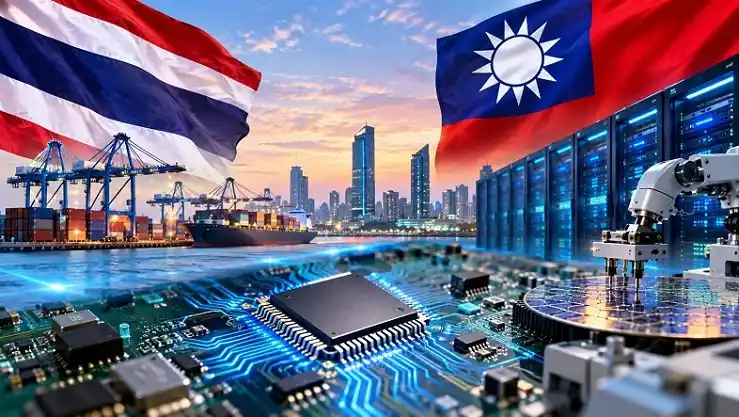
Image Credit: Thailand AI News
The shift is particularly significant because Thailand has traditionally maintained a cautious diplomatic approach toward Taiwan while preserving strong economic relationships with China. However, as this Thailand AI News report reveals, rising demand for AI infrastructure and advanced electronic components is encouraging closer commercial cooperation between Bangkok and Taipei, creating opportunities that extend well beyond conventional manufacturing.
AI Boom Transforms Taiwanese Investment
Taiwanese investment in Thailand has undergone a substantial transformation. Earlier investment waves concentrated on labor-intensive industries, including conventional manufacturing and assembly operations. Today, Taiwanese companies are increasingly pursuing sophisticated electronics production, particularly printed circuit boards, AI server components, and semiconductor-related equipment.
According to Taiwan’s representative to Thailand, Lan Hsia-li, more than 200,000 Taiwanese businesspeople and enterprises are already operating in the country. Their expanding commercial presence reflects Thailand’s attractiveness as a regional manufacturing destination.
Thailand is particularly interested in establishing itself as a major global production center for printed circuit boards, which are essential components in AI servers, telecommunications equipment, and advanced computing systems.
Trade Figures Reveal Growing Economic Dependence
Bilateral trade reached approximately US$19.4 billion in 2025, including Taiwanese exports worth around US$12.8 billion.
Momentum accelerated during the first quarter of 2026, when bilateral trade reportedly increased by approximately 47.8 percent compared with the corresponding period in 2025.
Taiwan has also become Thailand’s sixth-largest source of foreign direct investment, strengthening its influence across the country’s rapidly developing electronics industry.
Much of this expansion involves intermediate goods, including integrated circuits, processors, and electronic components used in sophisticated manufacturing operations.
Geopolitical Pressures Accelerate Supply Chain Diversification
The growing relationship also reflects the international China+1 strategy, under which manufacturers diversify production beyond mainland China to reduce geopolitical and operational risks. Thailand offers several advantages, including established industrial infrastructure, investment incentives administered through the Board of Investment, and access to Southeast Asian markets.
Nevertheless, significant challenges remain. Industry representatives have emphasized administrative inefficiencies and shortages of highly skilled engineers and technology specialists.
Taiwan is supporting educational exchanges and technology talent development initiatives intended to strengthen Thailand’s advanced manufacturing workforce.
Thailand’s Emerging Role in Global AI Manufacturing
Thailand’s expanding economic relationship with Taiwan demonstrates how artificial intelligence is influencing regional trade patterns and industrial priorities.
The challenge now involves converting increased investment into sustainable technological capabilities, stronger domestic supply chains, and higher-value employment opportunities.
If Thailand successfully addresses its engineering talent shortages and improves investment administration, its growing partnership with Taiwanese manufacturers could establish the country as an increasingly influential participant in global AI hardware production while maintaining its delicate geopolitical balance.
Media References:
https://ec.ltn.com.tw/article/breakingnews/5624754
https://www.digitimes.com/news/a20261102PD231/taiwan-2026-fdi-investment-growth.html
https://finance.biggo.com/news/570424bb-229f-4f0b-90b0-1f58010875e7
https://www.boi.go.th/upload/content/PR117_2569EN.pdf