

What To Know
- This AI News report highlights how OpenAI is positioning Frontier as a way to deploy AI agents that function like real coworkers—capable of being onboarded, assigned tasks, given permissions, and evaluated based on performance outcomes.
- OpenAI leadership has indicated that enterprise revenue is becoming an increasingly important pillar of the company’s growth strategy, with Frontier acting as a key driver in expanding that segment.
AI News: When OpenAI introduced Frontier in February, the announcement appeared at first glance to be another product launch in the rapidly evolving artificial intelligence space. However, beneath that surface lies a much deeper disruption—one that could fundamentally reshape how enterprise software is built, sold, and used. Frontier is not just another AI tool; it represents a new operating layer for businesses, one where intelligent agents begin to take on roles traditionally performed by human employees and the software they rely on.

Image Credit: StockShots
At its core, Frontier is designed as a semantic intelligence layer that integrates across an organization’s existing systems. It connects data warehouses, customer relationship management platforms, internal applications, and operational tools into a unified environment. This AI News report highlights how OpenAI is positioning Frontier as a way to deploy AI agents that function like real coworkers—capable of being onboarded, assigned tasks, given permissions, and evaluated based on performance outcomes. This marks a transition from software as a tool to AI as an active participant within business operations.
Early enterprise adopters such as Uber, State Farm, Intuit, and Thermo Fisher Scientific demonstrate that Frontier is already being tested in high-stakes environments. These companies are not experimenting casually; they are integrating AI into core workflows. OpenAI leadership has indicated that enterprise revenue is becoming an increasingly important pillar of the company’s growth strategy, with Frontier acting as a key driver in expanding that segment.
Building a Shared Intelligence Layer
One of the major challenges enterprises face when adopting AI is fragmentation. Deploying multiple AI agents often leads to disconnected systems, each requiring separate integrations, governance policies, and data pipelines. Instead of simplifying operations, this can create additional complexity.
Frontier attempts to solve this by introducing a shared business context. Rather than each AI agent independently learning how an organization functions, all agents operate within a centralized framework. This ensures consistency, reduces duplication, and allows agents to collaborate more effectively.
Fidji Simo, OpenAI’s CEO of Applications, has emphasized that past attempts to integrate multiple tools often resulted in siloed systems that failed to communicate. Frontier’s design directly addresses this issue by enabling interoperability across different tools and platforms.
The results from early deployments suggest significant gains. A global investment firm reported that Frontier agents reduced administrative workloads for sales teams by over 90 percent. A technology company achieved savings of approximately 1,500 hours per month in product development processes.
Meanwhile, a manufacturing organization managed to compress a production optimization timeline from six weeks to just one day. These examples highlight not only efficiency improvements but also a dramatic acceleration in business operations.
A Direct Threat to the SaaS Model
Perhaps the most disruptive aspect of Frontier lies in its potential impact on the traditional software-as-a-service business model. For years, SaaS companies have relied on per-seat licensing, where revenue scales with the number of users. This model assumes that each employee requires access to specific software tools.
However, AI agents challenge this assumption. If an agent can perform the same tasks as a human user—such as managing customer data, generating reports, or handling support tickets—the need for individual licenses diminishes. This raises a critical question: what happens to software pricing when the “user” is no longer human?
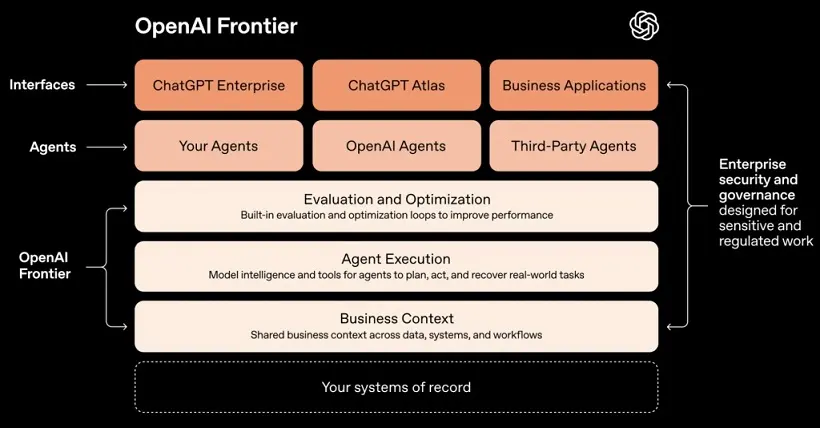
Image Credit: Thailand AI News
The market is already reacting to this shift. Salesforce, a leading SaaS provider, has experienced notable stock pressure, with analysts pointing to concerns about AI-driven disruption. This is despite strong financial performance and continued growth in its own AI initiatives.
In response, SaaS companies are beginning to rethink their pricing strategies. Salesforce has introduced a fixed-price licensing model designed for AI-driven usage. ServiceNow is moving toward consumption-based pricing, allowing customers to pay based on how much AI they use rather than how many employees they have. Microsoft is also experimenting with hybrid pricing models through its Copilot offerings.
These changes indicate a broader realization across the industry: the traditional seat-based model may no longer be sustainable in an AI-first world.
Competing Visions for AI Integration
As the enterprise AI landscape evolves, two distinct approaches are emerging regarding where AI agents should operate within an organization’s technology stack.
One approach, championed by companies like Salesforce and ServiceNow, involves embedding AI agents directly into their existing platforms. This strategy emphasizes tight integration, strong governance, and leveraging established customer trust. By keeping AI within their ecosystems, these companies aim to maintain control over both data and workflows.
The alternative approach, represented by OpenAI’s Frontier, places AI agents above existing systems as an overlay. This model prioritizes flexibility, allowing organizations to deploy AI without restructuring their entire infrastructure. It also reduces dependence on a single vendor by enabling agents to interact with multiple systems simultaneously.

Image Credit: Thailand AI News
Both approaches offer clear advantages. Embedded systems provide tighter control and faster implementation within known environments, while overlay systems offer greater adaptability and cross-platform functionality. For enterprises, choosing between these models will involve balancing control, flexibility, and long-term strategic goals.
Intensifying Competition in the Enterprise Market
Frontier is also central to OpenAI’s broader ambition to dominate the enterprise AI market. This segment represents a lucrative opportunity, with long-term contracts and recurring revenue streams. As OpenAI and its rivals move closer to potential public listings, competition is intensifying.
Anthropic, one of OpenAI’s primary competitors, is also focusing heavily on enterprise customers. The rivalry extends beyond technology into branding, marketing, and investor positioning. Both companies are racing to establish themselves as the leading provider of enterprise AI solutions.
OpenAI’s strategy with Frontier emphasizes compatibility and ease of adoption. By supporting third-party agents and existing infrastructure, the company is reducing barriers for organizations looking to integrate AI into their operations. This approach positions Frontier not just as a product, but as a unifying layer that can orchestrate multiple systems and tools.
The Future of Enterprise Software
The emergence of platforms like Frontier signals a turning point for enterprise software. Instead of relying solely on applications that require human interaction, organizations are beginning to adopt systems where AI agents perform tasks autonomously.
This shift raises important questions about the future role of traditional software providers. Will they adapt quickly enough to remain relevant, or will AI-native platforms redefine the industry?
While established SaaS companies still hold advantages in terms of trust, infrastructure, and customer relationships, OpenAI’s strength lies in its advanced AI capabilities and its ability to operate across multiple systems. If Frontier continues to deliver measurable results, it could become a central layer in enterprise technology rather than just another tool.
The transformation underway is not incremental—it is structural. Businesses are rethinking how work is performed, how software is valued, and how productivity is measured. AI agents are moving from experimental tools to essential components of modern operations, and platforms like Frontier are accelerating that transition at a pace few anticipated.
What is becoming increasingly clear is that the battle for the enterprise intelligence layer will define the next era of technology. Companies that successfully adapt to this shift will shape the future of digital work, while those that fail to evolve risk being left behind in a rapidly changing landscape. The coming years will determine whether AI becomes an enhancement to existing systems or the foundation of an entirely new paradigm.
For more details, visit:
https://openai.com/business/frontier
For the latest from OpenAI, keep on logging to Thailand AI News.