

What To Know
- LattePanda’s new Sigma 2 combines up to 180 TOPS of AI performance, 64GB of memory, and server-class connectivity in a compact board designed for local AI applicationsImage Credit.
- As highlighted in this AI Hardware news report, the device’s biggest attraction is its ability to combine substantial computing power, high-speed networking, extensive expansion options, and real-time hardware control on a single board designed for direct integration into commercial products.
LattePanda has unveiled its powerful new Sigma 2, an embeddable x86 single-board server designed to bring advanced artificial intelligence processing directly into intelligent devices, autonomous robots, industrial equipment, and private AI systems. Despite measuring just 146 × 102 millimeters, the compact board promises computing capabilities typically associated with much larger systems, potentially opening new opportunities for developers seeking high-performance AI hardware without relying on cloud infrastructure.
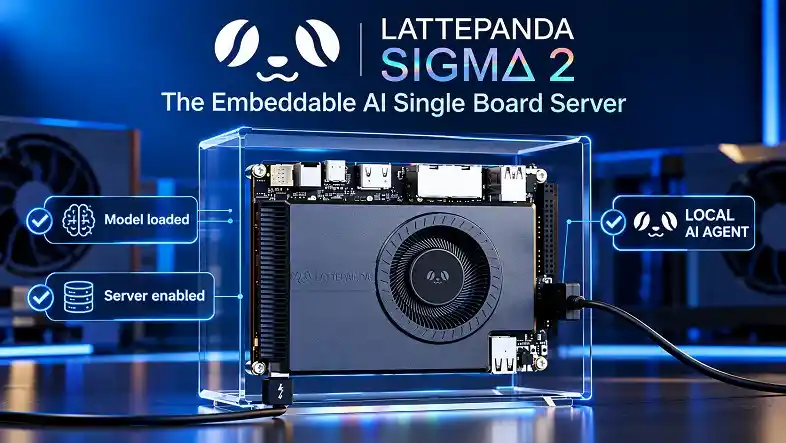
Image Credit: Thailand AI News
Powered by Intel’s Core Ultra X7 358H processor and integrated Arc B390 graphics, the LattePanda Sigma 2 delivers up to 180 trillion operations per second (TOPS) of combined INT8 AI performance. As highlighted in this AI Hardware news report, the device’s biggest attraction is its ability to combine substantial computing power, high-speed networking, extensive expansion options, and real-time hardware control on a single board designed for direct integration into commercial products.
Powerful Intel Processor Drives Local AI Performance
The Sigma 2 features a 16-core Intel Core Ultra X7 358H processor, comprising four performance cores, eight efficiency cores, and four low-power efficiency cores. With clock speeds reaching 4.8 GHz and 18MB of cache, the processor supports demanding applications requiring both conventional computing and specialized AI acceleration.
Its integrated Intel Arc B390 graphics processor contains 12 Xe-cores and delivers up to 122 TOPS of INT8 AI performance. A dedicated neural processing unit contributes up to another 50 TOPS, helping the platform achieve its advertised combined maximum of 180 TOPS.
These figures represent theoretical processing capabilities rather than guaranteed performance across every application. Nevertheless, they demonstrate LattePanda’s ambition to deliver serious AI computing capabilities within an unusually compact platform.
Large Memory Capacity Supports Advanced Language Models
One of the Sigma 2’s most impressive features is its support for up to 64GB of LPDDR5X-8533 memory, providing bandwidth of 136.5GB per second.
According to LattePanda, as much as 59GB of memory can be allocated for GPU workloads, enabling the board to accommodate certain quantized mixture-of-experts language models containing approximately 35 billion parameters.
The company claims that, using INT4 quantization and Intel’s OpenVINO optimization framework, the Sigma 2 can run the Qwen3.6-35B-A3B model locally at approximately 30 tokens per second.
Such capabilities could allow developers to create responsive AI assistants, document analysis platforms, and automated agents without continuously sending sensitive information to external servers.
The substantial memory capacity also supports the key-value caches needed by AI applications handling longer conversational contexts, although actual performance will depend on model configurations and software optimization.
Designed for Robots and Intelligent Industrial Equipment
Unlike traditional miniature computers, the Sigma 2 is intended to become an integrated component of intelligent products rather than operate as a separate computing device.
Potential applications include autonomous robots, industrial inspection systems, professional instruments, machine vision platforms, and specialized AI appliances.
For robotics developers, local AI processing can reduce dependence on network connections while allowing machines to analyze visual information, identify obstacles, plan movements, and respond to changing environments.
The board also incorporates an RP2350 microcontroller, providing general-purpose input/output connectivity and real-time hardware control.
With preloaded MicroPython firmware, developers can connect sensors, actuators, and other electronic components while coordinating physical operations with AI-powered decision-making.
This combination could simplify the development of intelligent machines that require both advanced computing and direct interaction with their surroundings.
Extensive Expansion and High-Speed Networking
LattePanda has equipped the Sigma 2 with connectivity options more commonly associated with larger computing systems.
The board includes three M.2 M-Key slots, one M.2 E-Key slot, an OCuLink interface supporting PCIe 4.0 x2, and two Thunderbolt 4 Type-C ports.
These connections allow developers to add compatible storage devices, peripherals, and additional AI acceleration hardware as computing requirements increase.
Dual 10-gigabit Ethernet ports provide high-bandwidth networking capabilities, potentially benefiting applications involving large datasets, network-attached storage, industrial monitoring, and distributed computing.
Other connections include two USB 3.2 Gen 2 ports, two USB 2.0 ports, HDMI 2.1, DisplayPort 2.1 through USB Type-C, and embedded DisplayPort 1.5.
Together, these interfaces provide flexibility for integrating the board into compact servers, automated equipment, and specialized computing environments.
Preinstalled Software Simplifies AI Development
The Sigma 2 supports Windows 11 and Ubuntu 24.04 LTS or later, offering compatibility with established AI development tools including OpenVINO, llama.cpp, and Ollama.
LattePanda says the board ships with Ubuntu, GPU and NPU drivers, OpenVINO Model Server, OpenClaw, and selected local AI models preinstalled on its onboard SSD.
This configuration is intended to reduce setup complexity and help developers begin experimenting with local AI applications more quickly.
Potential uses include private retrieval-augmented generation systems, multi-agent AI applications, home laboratories, and compact servers combining storage, virtualization, and AI inference.
For businesses handling confidential information, local processing could also provide greater control over where sensitive data is stored and analyzed.
Commercial Integration and Premium Pricing
LattePanda is targeting commercial manufacturers by offering a guaranteed product lifecycle exceeding three years, customizable BIOS configurations, personalized boot logos, and direct engineering support.
Youliang Yu, product manager of LattePanda Sigma 2, explained that local AI is moving beyond experimental development into everyday products and systems. The company’s objective is to provide developers with a practical platform combining computing performance, memory capacity, expansion, and real-time control.
The Sigma 2 carries a promotional pre-sale price of US$2,599 through mid-November, after which its listed price is expected to increase to US$2,799.
Further specifications are available on the official LattePanda website, while purchasing information can be found through DFRobot.
A New Direction for Compact AI Computing
The LattePanda Sigma 2 demonstrates how increasingly powerful AI processing capabilities are moving into smaller, more versatile computing platforms. Its combination of substantial memory, dedicated acceleration, high-speed connectivity, and hardware control could make it attractive to developers building sophisticated local AI systems.
However, its commercial success will ultimately depend on real-world performance, thermal management, software reliability, and overall deployment costs. If these challenges are addressed effectively, the Sigma 2 could become an important platform for bringing advanced artificial intelligence directly into autonomous machines and intelligent products.
For more details, visit:
https://www.lattepanda.com/lattepanda-sigma-2