
What To Know
- A major shift in how artificial intelligence can be owned and used personally is unfolding, following the debut of a pocket-sized AI computer that challenges cloud dependence and subscription-driven intelligence.
- Tiiny AI’s configuration places the Pocket Lab in a rare category of personal systems capable of supporting models exceeding 100 billion parameters, an achievement that recently earned the company recognition from Guinness World Records as the smallest mini-PC capable of running a 100B-parameter large language model locally.
Thailand AI News: A major shift in how artificial intelligence can be owned and used personally is unfolding, following the debut of a pocket-sized AI computer that challenges cloud dependence and subscription-driven intelligence. Tiiny AI, a US-based deep-tech startup, has unveiled the Tiiny AI Pocket Lab, a compact personal AI system capable of running extremely large artificial intelligence models entirely offline. The announcement, made during the Consumer Electronics Show, drew widespread attention from international media, developers, and technology analysts who see it as a potential turning point in the AI hardware landscape.
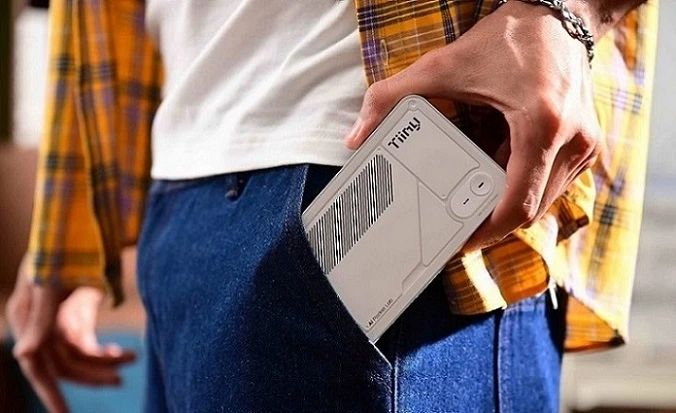
Image Credit: Tiiny AI
Rethinking Where Intelligence Lives
Unlike mainstream AI platforms that rely heavily on cloud data centers, recurring fees, and continuous internet access, Tiiny AI Pocket Lab is designed to bring advanced intelligence directly into the hands of individuals. The device allows users to operate large language models locally, without sending sensitive data to external servers. This approach is gaining momentum as users become increasingly aware of long-term costs, privacy risks, and operational vulnerabilities associated with cloud-based AI services.
This Thailand AI News report highlights how Tiiny AI demonstrated the Pocket Lab running https://www.thailandmedical.news/models with up to 120 billion parameters fully offline at CES, achieving practical decoding speeds exceeding 20 tokens per second. Rather than positioning the device as an experimental showcase, the company emphasized real-world usability, arguing that local AI has reached a point where it can support everyday professional and personal needs.
A Compact Device with Serious Capability
Despite its small physical footprint, the Tiiny AI Pocket Lab is engineered to deliver performance once thought impossible in portable systems. The device features a multi-core ARM-based processor paired with a custom neural processing unit, delivering approximately 190 trillion operations per second of AI compute power. With 80GB of LPDDR5X memory and substantial onboard storage, it is capable of handling inference workloads traditionally reserved for high-end workstations or cloud servers.
Industry observers note that memory alone often becomes a cost barrier for running large models locally. Tiiny AI’s configuration places the Pocket Lab in a rare category of personal systems capable of supporting models exceeding 100 billion parameters, an achievement that recently earned the company recognition from Guinness World Records as the smallest mini-PC capable of running a 100B-parameter large language model locally.
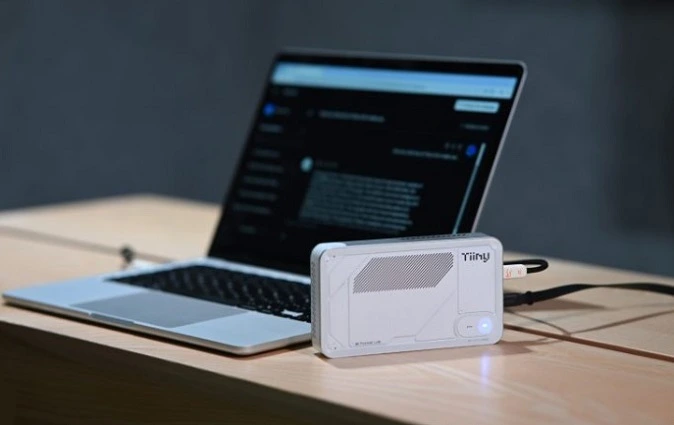
Image Credit: Tiiny AI
Privacy, Power, And Long-Term Control
Company executives argue that the real bottleneck in artificial intelligence is no longer raw computing power, but dependence on centralized infrastructure. Cloud AI, while transformative, has introduced concerns around sustainability, energy usage, outages, and escalating costs, particularly for long-context processing. By contrast, the Pocket Lab operates within a modest power envelope, making it suitable for energy-efficient personal intelligence while maintaining strong performance.
All user data, preferences, and documents are stored locally with bank-level encryption, offering persistent personal memory without exposing information to third parties. This design directly addresses privacy concerns in sectors such as healthcare, education, research, and small business operations, where data sensitivity remains a major barrier to AI adoption.
Software Built for Local Intelligence
Alongside the hardware, Tiiny AI introduced its on-device software platform, TiinyOS. The system enables one-click deployment of multiple open-source large language models and AI agent frameworks, allowing users to experiment, build, and deploy workflows without cloud reliance. Developers can create local automation tools, content generation systems, and reasoning agents while maintaining full control over data flow and performance.
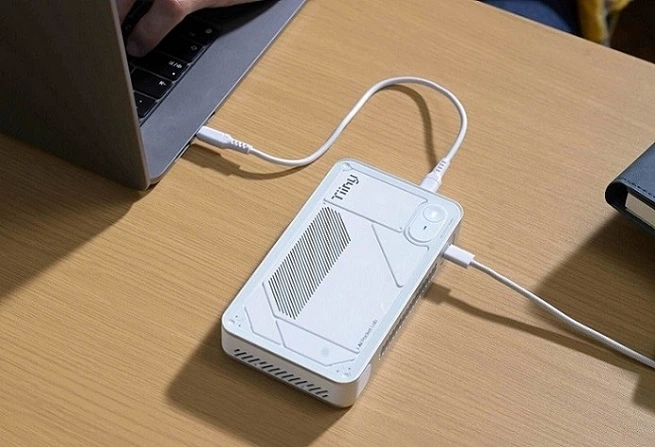
Image Credit: Tiiny AI
The company positions the Pocket Lab not as a replacement for laptops or desktops, but as a dedicated AI engine that works alongside existing computers. Through simple plug-and-play connectivity, even older systems can gain access to advanced AI capabilities without expensive hardware upgrades.
Market Timing and Regional Focus
Tiiny AI plans to launch the Pocket Lab via Kickstarter, with pricing aimed at lowering barriers to entry rather than positioning the device as a luxury product. Analysts see this move as a strategic attempt to accelerate adoption of local-first AI systems as enterprises and individuals reassess the economics of intelligence delivered as a service.
Thailand has been identified as a priority market within the Asia-Pacific region, driven by rapid digital transformation, a growing developer community, and increasing demand for affordable AI solutions that do not require GPUs or cloud subscriptions. These factors align closely with national initiatives focused on innovation, education, and small business technology adoption.
What This Shift Could Mean
The emergence of compact, high-capacity personal AI systems reflects a broader rebalancing of power in the artificial intelligence ecosystem. As models grow larger and more capable, the question of who controls intelligence, data, and long-term costs becomes increasingly important. Devices like the Tiiny AI Pocket Lab suggest a future where advanced reasoning and contextual understanding are not rented by the token, but owned outright by individuals and organizations.
This development signals more than a new gadget launch; it represents a philosophical shift toward personal, private, and portable intelligence that could reshape how AI is trusted, governed, and deployed across industries and borders.
For more details, visit:
For the latest AI Hardware, keep on logging to Thailand AI News.