What To Know
- While OpenAI insists each new version expands safety, reliability, and real-world alignment, the perception at ground level is drifting in the opposite direction.
- AI hallucinations may be fundamental to current model design, yet users increasingly view them as a product flaw—not a technical inevitability.
AI News: Hype Meets Headwinds
OpenAI’s flagship product, ChatGPT, once commanded nearly every conversation about generative AI. From creative writing to customer service, the platform seemed unstoppable. Yet in recent months, OpenAI’s dominance appears less secure. What began as scattered user complaints has grown into a broader narrative: momentum is shifting, and the AI landscape no longer revolves around a single player.
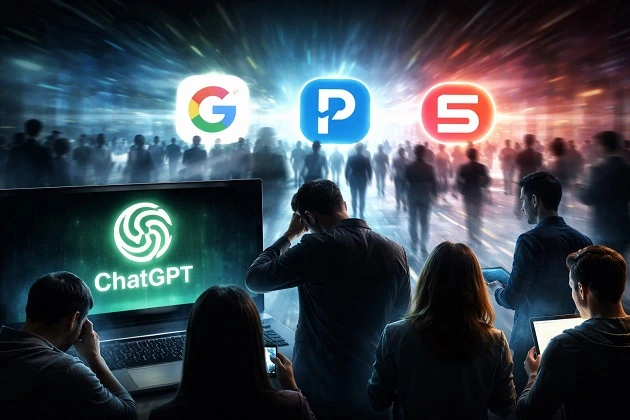
Image Credit: Thailand AI News
The 5.2 Update Sparks Frustration
The public rollout of ChatGPT 5.2 was meant to mark a resurgence of capability after several muted updates. Instead, the release has fueled concerns. Across social platforms and tech communities, longtime users describe performance issues ranging from sluggish responses to more frequent hallucinations and inexplicable refusals.
While OpenAI insists each new version expands safety, reliability, and real-world alignment, the perception at ground level is drifting in the opposite direction. Businesses report increased troubleshooting. Developers say they spend more time verifying outputs than generating them. Teachers who once praised ChatGPT for clarity now caution students about accuracy.
For subscription users, this feels like paying more for less.
Subscriptions Under Pressure
Thailand AI News monitored public sentiment across multiple consumer tech communities and found a clear pattern: users are cancelling—and talking publicly about cancelling.
Anecdotes range from minor annoyance to full abandonment. Power users describe “six weeks of regression,” “inconsistent logic,” and “constant guardrails,” with some concluding that the platform is no longer reliable enough for professional use.
While OpenAI has not released subscriber churn numbers, online sentiment often precedes market data. If user confidence drops, enterprise confidence tends to follow.
A Crowded Field Eager to Benefit
Just as OpenAI faltered, competitors surged. Google’s Gemini has pushed aggressively into mobile ecosystems, with strong rumors linking the model to deeper Apple integration. That development alone signals a strategic shift: Apple is famously selective about external partnerships. The possibility that the most valuable tech company is exploring alternatives weakens OpenAI’s aura of inevitability.
Meanwhile, Perplexity AI is winning converts in search and research workflows with crisp sourcing and built-in citations. DeepSeek is expanding rapidly, positioning itself as leaner and more efficient. Several open-source models now match premium tools on creative tasks while delivering transparency and customizability that proprietary systems cannot.
For the first time since ChatGPT’s launch, OpenAI looks like one option among many—not the default.
Accuracy Problems Raise Trust Questions
Accuracy remains the industry’s unsolved problem. But OpenAI has drawn particular scrutiny in recent health-related cases where ChatGPT allegedly provided incorrect or misleading responses. Media investigations have amplified concerns, and public perception is moving from curiosity to caution.
AI hallucinations may be fundamental to current model design, yet users increasingly view them as a product flaw—not a technical inevitability. When a tool is marketed as reasoning intelligence, its mistakes are held to human standards.
Consumer Patience Is Finite
The magic of ChatGPT’s early days came from surprise and delight. That emotional edge may be slipping. Users now express fatigue: more refusals, more constraints, and more boilerplate apologies.
When a service is no longer inspiring—but merely functional or frustrating—the audience becomes less loyal. That erosion is what rivals are banking on.
OpenAI Still Has Strengths
While the narrative has shifted sharply, OpenAI remains a formidable player:
• Deep relationships with Microsoft
• Corporate API integrations
• A massive developer ecosystem
• A brand that still commands global recognition
However, advantages can evaporate quickly in a market defined by speed.
The Road Ahead
The next phase of AI will not be decided by marketing or momentum. It will be determined by:
• Tangible improvements
• User trust
• Pricing sustainability
• Technical reliability
• Willingness to align with customer needs
If OpenAI cannot deliver visible gains—and fast—people and capital may keep moving elsewhere. Rivals smell opportunity, investors are scrutinizing results more closely, and consumers appear ready to vote with their wallets. Thailand AI News will continue tracking where those votes go next.
For the latest news about OpenAI orChatGPT, keep on logging to Thailand AI News