

What To Know
- In a decisive move that could disrupt the AI hardware landscape, China’s Alibaba has reportedly introduced a versatile AI chip that challenges Nvidia’s H20—marking a significant shift toward domestic technology and away from reliance on foreign suppliers.
- Armed with long-standing ties to Alibaba, Inventec is expected to accelerate its AI server production—particularly as shipments move from AI server racks (L10) in the first half to higher margin motherboard and server integration work (L6) in the second half of the year.
AI News: A Bold New Player in AI Chips
In a decisive move that could disrupt the AI hardware landscape, China’s Alibaba has reportedly introduced a versatile AI chip that challenges Nvidia’s H20—marking a significant shift toward domestic technology and away from reliance on foreign suppliers. This latest chip is currently in testing and is manufactured by a Chinese semiconductor company—not by TSMC—signaling China’s intensifying push to develop its own AI infrastructure.
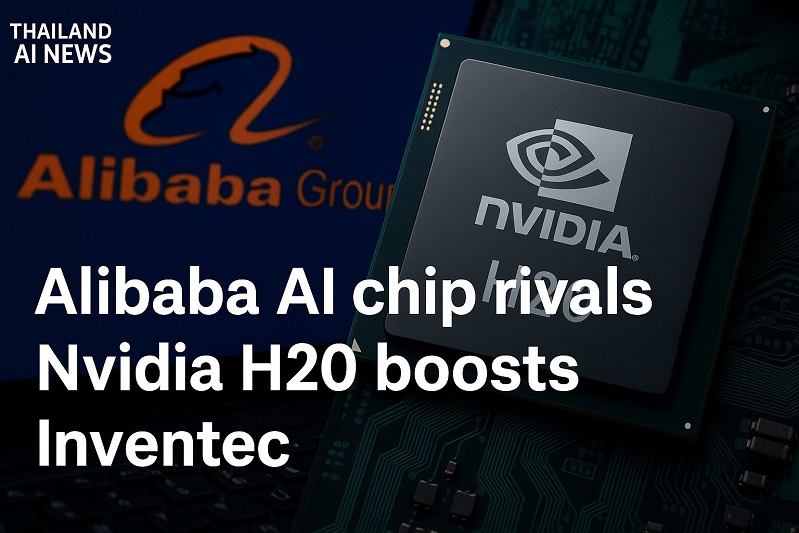
Alibaba’s new AI Chip not only rivals Nvidia’s H20 but is more efficient and cheaper
Image Credit: AI-Generated
Homegrown Chips, Global Ambitions
Behind the scenes of this hardware achievement, Alibaba’s broader AI cloud agenda is clear. Its cloud computing business continues to soar—first quarter cloud revenue recently reached RMB 33.4 billion, up 26 percent year on year, exceeding the previous quarter’s 18 percent growth. Meanwhile, its AI related product revenue has maintained triple digit annual increases for eight consecutive quarters.
Think of Inventec, one of Taiwan’s leading server ODMs, as an immediate beneficiary. Armed with long-standing ties to Alibaba, Inventec is expected to accelerate its AI server production—particularly as shipments move from AI server racks (L10) in the first half to higher margin motherboard and server integration work (L6) in the second half of the year. Full year AI server shipments are poised for double digit growth.
Broader Catalysts in China’s AI Chip Race
Alibaba is not alone in this race. Shanghai based MetaX recently debuted a chip designed as an H20 alternative, trading off higher power use for expanded memory—a design it hopes to bring into mass production soon. Beijing based Cambricon also made headlines, reporting $247 million in revenue in Q2, driven by strong demand for its Siyuan 590 AI chip.
This AI News report comes amid a tightening U.S. export environment. Though Nvidia briefly resumed H20 exports to China under Trump, Beijing soon discouraged firms from using them, citing security concerns.
A Strategic Turning Point
The arrival of Alibaba’s domestically produced chip—compatible with Nvidia software frameworks yet manufactured solely within China—represents a strategic leap forward. It could enable developers to adapt existing AI workloads with minimal friction, while reducing geopolitical vulnerabilities and supply dependencies.
At the same time, the ripple effect will boost server makers like Inventec, which stand to benefit from increased demand for AI-capable hardware. The shift in product mix also promises healthier margins for these firms, reinforcing the entire AI ecosystem.
This milestone suggests that China’s AI hardware ecosystem is entering a new era—one where in-house innovation is not only viable but increasingly pivotal. The knock-on effects are likely to resonate across suppliers, cloud providers, and the broader AI market.
For the latest on AI Chips, keep on logging to Thailand AI News