What To Know
- In a stunning development shaking the very foundations of consumer artificial intelligence, Apple has announced a sweeping multi-year collaboration with Google that will see the tech giant’s next-generation Siri and broader Apple Intelligence efforts anchored on Google’s highly capable Gemini AI models and cloud technology.
- Under the terms of the collaboration, Apple Foundation Models – the internal models that power Apple Intelligence features – will be based on Google’s Gemini architecture.
AI News: In a stunning development shaking the very foundations of consumer artificial intelligence, Apple has announced a sweeping multi-year collaboration with Google that will see the tech giant’s next-generation Siri and broader Apple Intelligence efforts anchored on Google’s highly capable Gemini AI models and cloud technology. This AI News report marks a turning point in how the world’s most valuable companies are reshaping AI power structures and consumer experiences as we head deeper into 2026.
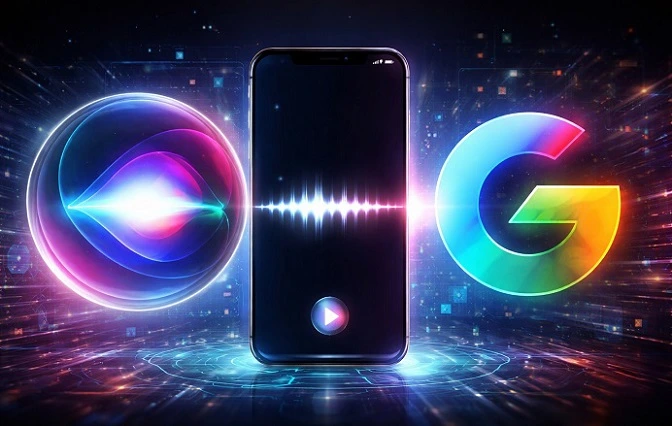
AI partnership reshapes Siri with Gemini infusion into Apple foundation models.
Image Credit: Thailand AI News
Behind the headlines of this unprecedented partnership is a story of technology strategy and competitive pressure. Apple – long seen as the gold standard of device ecosystems – has struggled to bring its own in-house AI ambitions to full fruition. The company’s Siri virtual assistant has faced repeated delays and critical feedback, even as rivals advanced with more powerful language models and cloud-based intelligence services. After extensive evaluation of AI capabilities across the industry, Apple’s leadership concluded that Google’s Gemini models offered the most robust and flexible foundation for future enhancements to Siri and beyond.
New Era for Siri and Apple Intelligence
Under the terms of the collaboration, Apple Foundation Models – the internal models that power Apple Intelligence features – will be based on Google’s Gemini architecture. This means that the voice assistant millions of users rely on daily will gain significant intelligence and context awareness improvements driven by Gemini’s sophisticated natural language understanding and reasoning capabilities.
The newly empowered Siri is expected to handle more complex tasks more fluidly and engage with users in ways that feel closer to human interaction than ever before.
Despite fears that such a close tie with Google could undermine Apple’s reputation for independence, the announcement emphasized that all personalized and sensitive interactions will still be processed directly on users’ devices or through Apple’s private cloud compute infrastructure. Apple insists this hybrid deployment preserves its toughest-in-class privacy standards while still delivering the power of one of the world’s leading AI engines.
Strategic Shift and Industry Implications
The significance of Apple’s decision extends well beyond Siri. It signals a strategic pivot away from Snapchat-style experimentation toward deep reliance on externally developed foundation models. Previously, Apple had integrated other AI tools – including optional generative AI agents like ChatGPT for specific tasks – but never at the core intelligence layer. That role will now be filled by Gemini’s models.
Industry analysts see this partnership as a validation of Google’s AI momentum. Gemini’s rapid rise in performance benchmarks and broad multimodal capabilities gave Apple confidence to move past internal development delays and competitive alternatives. Google now has its technology powering leading AI experiences on both Android and iOS platforms, a scenario few predicted even a year ago.
Meanwhile, the broader AI market is watching closely. OpenAI, once seen as the unquestioned default provider of conversational AI, now occupies a secondary role in Apple’s AI ecosystem. Its models will remain available for users who opt in for certain tasks, but will no longer form the backbone of Apple’s intelligence layer. This shift underlines just how fluid market leadership in AI has become, with major players jockeying for dominance through alliances rather than outright internal build-outs.
Business Power and Competitive Consequences
The Apple-Google AI deal has also had ripple effects in investor markets. Alphabet, Google’s parent company, briefly hit a staggering $4 trillion market valuation after the announcement, underlining investor confidence in Gemini’s future and the strategic value of its alliance with Apple.
Yet questions remain around long-term implications. As two of the world’s largest tech companies integrate their AI efforts so closely, concerns are growing about market concentration and dependency on a small number of foundation model providers. Observers argue that while the short-term gains for user experience are clear, enterprises and developers alike will need to consider risks around vendor lock-in and innovation diversity.
In the broader consumer landscape, the impact will be felt most directly by billions of iPhone and iPad users who rely on Siri and Apple Intelligence. Expectations are high that the upgraded assistant will transform how people interact with devices, manage tasks, access information, and engage with smart features daily. The success or failure of this integration could set the course for how AI evolves across mobile ecosystems in the coming decade.
With Apple placing its AI bets on Gemini and Google, the competitive landscape of generative AI is being rewritten. Tech giants and startups alike will be watching this alliance closely, weighing its implications for innovation, privacy, and the future of intelligent systems. The stage is set for Siri to emerge as a more capable and contextually aware assistant than ever before, and for Apple’s AI strategy to enter a bold new chapter.
For the latest developments in the AI industry, keep on logging to Thailand AI News.