What To Know
- Rather than positioning Claude as a separate chatbot window, the company is now embedding its AI assistant into the tools employees already rely on daily, including Slack, Figma, Canva, Box, Asana, and Clay, with Salesforce integration expected in the near future.
- A user can instruct Claude to draft and send a Slack message, search and retrieve documents from Box, generate charts, or help modify design elements in Figma and Canva, all without leaving the conversation.
AI News: Anthropic has taken a decisive step toward redefining how artificial intelligence fits into everyday professional life by launching interactive Claude apps that work directly inside popular workplace platforms. Rather than positioning Claude as a separate chatbot window, the company is now embedding its AI assistant into the tools employees already rely on daily, including Slack, Figma, Canva, Box, Asana, and Clay, with Salesforce integration expected in the near future. This move signals Anthropic’s growing ambition to dominate the enterprise AI space by turning Claude into a fully integrated digital coworker rather than a passive assistant.
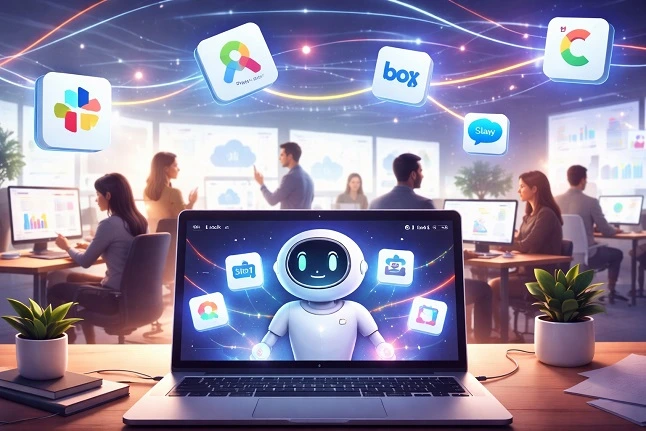
Image Credit: Thailand AI News
Claude Evolves from Chatbot to Workplace Operator
The newly announced feature allows users to call up interactive apps from within the Claude interface itself. Once enabled, Claude gains access to a logged-in instance of each connected service, meaning it can perform authenticated actions instead of merely offering suggestions. A user can instruct Claude to draft and send a Slack message, search and retrieve documents from Box, generate charts, or help modify design elements in Figma and Canva, all without leaving the conversation. This AI News report highlights that the emphasis is not novelty but efficiency, reducing context switching that often slows down knowledge workers.
Anthropic has framed the update as a natural evolution of how work gets done in modern organizations. According to the company, tasks such as analyzing data, designing visual assets, and managing projects benefit significantly from dedicated interfaces. By combining those interfaces with Claude’s reasoning abilities, users can iterate faster and with fewer manual steps, blending human direction with machine execution in real time.
Enterprise First Strategy Becomes Clear
Unlike many AI launches aimed at mass consumers, this feature is not available to free users. Access is restricted to Pro, Max, Team, and Enterprise subscribers, reinforcing Anthropic’s enterprise-first strategy. Eligible users can activate the apps through the Claude directory, where permissions and integrations are managed. This controlled rollout reflects a deliberate focus on businesses that prioritize security, governance, and reliability over experimentation.
The choice of launch partners also underscores this direction. Slack anchors internal communication, Figma and Canva dominate collaborative design, Box manages cloud storage, Asana handles project timelines, and Clay supports CRM and data workflows. Together, they form a core productivity stack for many organizations, making Claude’s new capabilities immediately relevant rather than experimental.
Built on an Open Technical Backbone
At the heart of these integrations lies the Model Context Protocol, or MCP, an open standard introduced by Anthropic in 2024. MCP provides a shared framework that allows AI models to securely interact with external tools and data sources. Notably, OpenAI’s own Apps system, launched in October 2024, is built on the same protocol. Support for app integrations under MCP was finalized in November after collaborative engineering efforts across companies.
This shared foundation means Anthropic is not building a closed ecosystem. Instead, it is betting that open interoperability will accelerate adoption and encourage third-party developers to plug their tools into Claude. In theory, any workplace platform that supports MCP could eventually become accessible to the AI, expanding its reach far beyond the initial lineup.
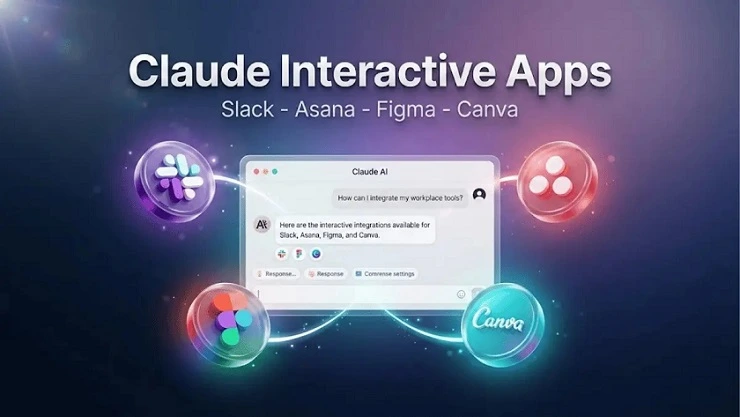
Image Credit: Thailand AI News
Claude Cowork Amplifies the Vision
The implications grow even larger when viewed alongside Claude Cowork, Anthropic’s agentic AI tool released just a week before the apps announcement. Cowork allows users to assign complex, multistage tasks involving large and open-ended datasets, tasks that previously required scripting or terminal commands. While app access is not yet available within Cowork, Anthropic has confirmed that the integration is coming soon.
Once connected, Cowork could autonomously analyze data stored in Box, update marketing visuals in Figma, and post summaries or alerts to Slack channels. This points toward a future where AI agents manage entire workflows across platforms, with humans providing high-level direction rather than micromanaging each step.
Safety and Oversight Remain Central
Anthropic has been careful to temper excitement with caution. Agentic systems can behave unpredictably, especially when granted broad permissions across sensitive platforms. The company’s safety documentation urges users to monitor agents closely and to limit access to confidential information such as financial records, credentials, or personal data. Creating dedicated folders or restricted workspaces for Claude is recommended as a practical safeguard.
This emphasis aligns with Anthropic’s broader positioning around responsible AI. Rather than racing to offer unrestricted autonomy, the company appears intent on balancing capability with control, particularly in enterprise environments where mistakes can have significant consequences.
Competitive Pressure Intensifies
The launch places Anthropic in more direct competition with OpenAI, Microsoft, Google, and Meta, all of whom are pushing AI deeper into workplace software. Microsoft’s Copilot is spreading across Office, Google continues to enhance Workspace with AI features, and Meta is targeting business messaging. The battleground is no longer raw model intelligence but how seamlessly AI can be embedded into daily workflows.
Anthropic’s reliance on an open protocol could prove to be a strategic advantage if MCP gains widespread adoption. However, it also raises questions about whether the industry will rally around a shared standard or fragment into competing ecosystems, a pattern seen repeatedly in enterprise software history.
What This Means for Workers
For everyday users, the change is immediately tangible. Marketing teams can move from idea to designed asset faster. Project managers can generate timelines, updates, and summaries without juggling multiple tabs. Designers can collaborate with AI suggestions appearing directly inside their creative tools. The result is a blurred line between assistant and coworker, with Claude actively participating in the flow of work rather than sitting on the sidelines.
Anthropic’s latest move represents a significant shift in how artificial intelligence is positioned inside organizations. By embedding Claude directly into core workplace tools and preparing it for deeper agentic autonomy through Cowork, the company is signaling that the future of AI is not about answering questions in isolation. It is about acting within systems, shaping outputs, and accelerating collaboration while remaining carefully supervised. Whether this cautious but deeply integrated approach becomes the dominant model for enterprise AI will depend on how well Anthropic balances power, trust, and usability in the months ahead.
For the latest new developments in Claude, keep on logging to Thailand AI News.